

At this point, I would estimate that we are halfway through this Beowulvian rendering of the first book of the Iliad, so let’s recap.
In the first part, the god Apollo sent a plague on the Greek host encamped outside Troy, for the reason that King Agamemnon dishonoured one of his priests by refusing to release his daughter from war-concubinage.
In the second, the seer Calchas identified the cause of the plague, and warned that it would not abate until the girl was sent back to her father – much to the annoyance of Agamemnon, who very much desired to keep her.
In the third, Agamemnon demanded that Achilles compensate him for this loss by giving up his own war-concubine – sparking a bitter argument that culminated in the decision of Achilles, the greatest of all Greek warriors, to sit out the war and allow the rest of the host to be beaten by the Trojans.
In the fourth, the elderly Nestor tried and failed to resolve the dispute, and Achilles had the last word – saying that he would allow Agamemnon to take the girl from him, but would shortly kill him should he dare lay hands on any of his other belongings. Here’s how we rendered that:
“But now hark, and hold this in your heart and mind:
“I’ll not strive for the girl – I’ll not set my hands
“On thee,1 or any other who intends to come
“And remove once more what to me you gave –
“But of what sundries are mine beside my swift black boats,
“I’ll not suffer one to be seized unwilling:
“Should you come and try me, let this crowd observe
“Your black blood billow round the blade of my spear!”
The main event of this fifth part will be the requisition of Achilles’ war-bride, so it befits us to say a few preliminary words about her. According to Wikipedia, her name was Hippodameia (meaning ‘horse-tamer’), but Homer conventionally refers to her as Briseis (‘daughter of Briseus’). By way of physical description we can gather very little, other than that she was beautiful; for what it’s worth, this is how she was imagined in a much later Roman wall painting:

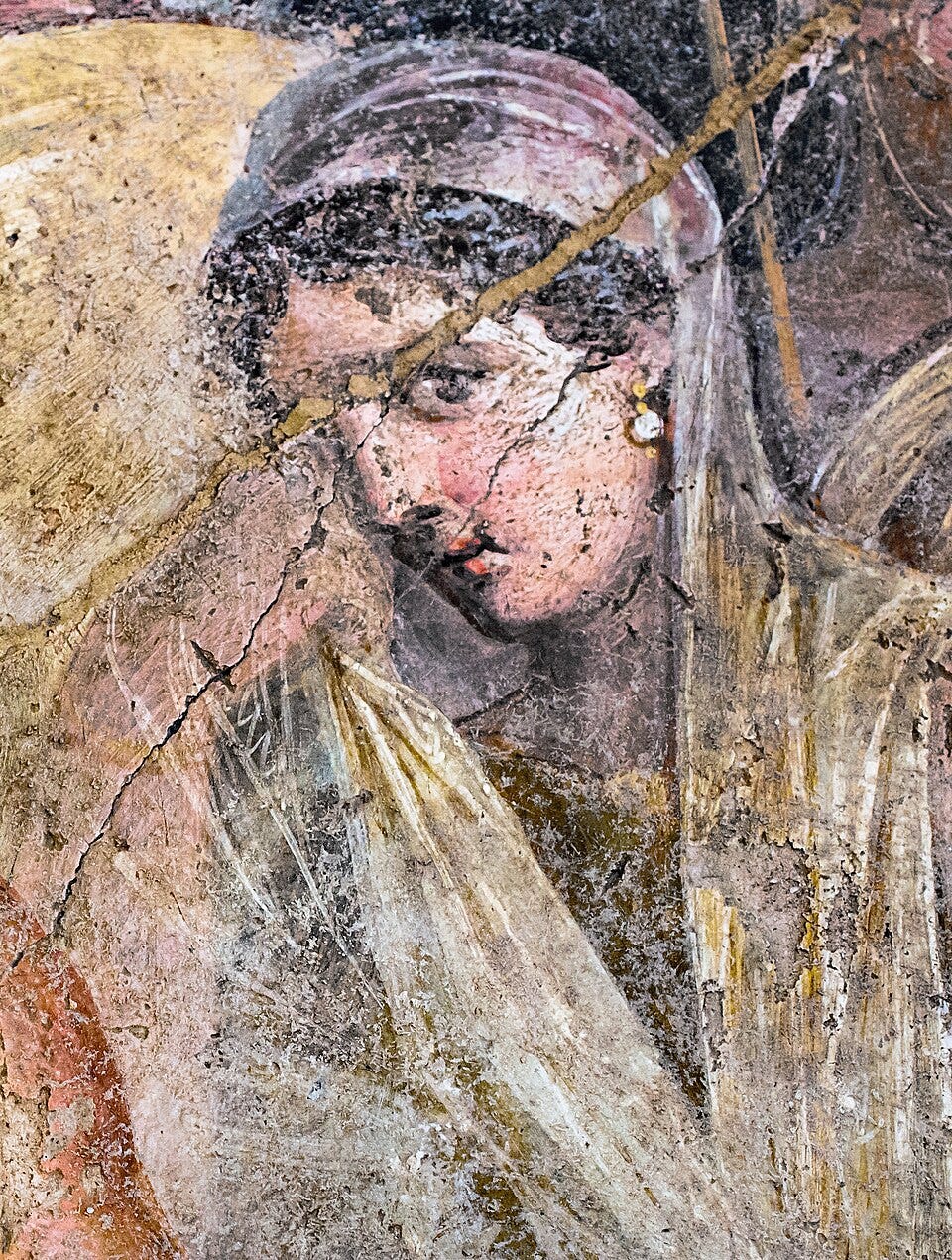
In the last two installments, Briseis has been much contested by Achilles and Agamemnon, yet no reference has been made by either of them to any of the personal qualities that make her desirable. She is first and foremost a ‘prize’ (γέρας), a reward and symbol of honour, which Achilles has lost by having been forced to give her up. Quite frankly the two of them may as well be quarrelling over a sack of gold or some other treasure; and it is Achilles who seems the most indifferent to anything but his own honour, since Agamemnon at least praises his own war-bride, Chryseis.
The first clue that there is something more to this picture appears at the end of the following scene, in which Agamemnon’s heralds come to take Briseis from Achilles. For ease of comprehension, note that ‘son of Peleus’ refers to Achilles, and ‘son of Atreus’ to Agamemnon. The ‘son of Menoetius’ is Patroclus, Achilles’ closest companion, whose death in battle towards the end of the poem will draw him back into the fighting and eventually to his own death.
So having battled back and forth    with bitter words,
They stood, and dissolved    the assembly-host
By the Achaean ships.    The son of Peleus
Went, with his warriors,    to his well-planed boats –
And with the son of Menoetius –    to his sheltered camp.

Meanwhile the son of Atreus    to the sea-waves dragged
A thrusting ship;    took twenty rowers;
Put on board, for the god,    a blessed hecatomb;
And led to her chair    fair-chéeked Chryseis,
Consigned her to the charge    of resourceful Odysseus.

And as away they sailed,    upon the watery roads,
Agamemnon commanded    the men of the host
To purify themselves    from the plague's defilements.
They washed away the filth;    to the waters cast it;
And offered to Apollo    perfect hecatombs –
Both bulls and goats –    beside the briny furrows,
Barren and harvestless.    To heaven rose
The smoke and the savour    in spiral-coils.

Thus the army bustled;    and yet Agamemnon
Relinquished not the threats    he had laid on Achilles;
So he spoke to his heralds,    who esquired him always –
Talthybius, Eurybates –    ready attendants:
"Go ye to the camp    of Achilles Pelides,
"And take by the hand    and hither lead
"Fair-cheeked Briseis;    if he quits her not,
"Then I shall go to take her    with a troop of men –
"And that shall chill him colder    than his quitting the girl."

So he spake, and sent them    with that stark decree;
And trepidly they traipsed    by the untillable brine;
'Til when they came to the ships    and camp of Myrmidons,
By shelter and black ship    they saw him there:
Achilles sitting;    and the sight of them
Did not please him at all.    They promptly stopped –
Freezing stock-still    in fright and awe,
And nor accosting nor questioning    the king before them.

Yet inside he understood,    and bespake them thus:
"Hail and welcome,    heralds of Zeus,
"Messengers of men.    Ye may move yet closer;
"No fault do I find with ye;    fully culpable
"I hold the one    who has hither sent ye
"For the sake of Briseis,    to seize her from me.
"God-sprung Patroclus!    Go in haste now
"To lead the girl out;    and let them take her,
"And lead her away;    and let them henceforth
"Bear their witness –    before blessed gods,
"Before mortal men;    and more besides,
"Before that heartless king –    if e'er again
"My help should be needed,    the host to save
"From a wretched ruin.    He rages and fumes,
"Seethes and smoulders,    in destructive mind,
"With nor hind nor foresight –    and heeds not a whit
"How the Greeks, by their fleet,    may fight unscathed."

He thusly spake;    and Patroclus obeyed
His beloved friend;    and led the girl,
Fair-cheeked Briseis,    from the camp's shelter.
He gave her to be taken;    and the two went back,
Returned to their king,    by the Achaean ships,
Leading her away –    who, reluctant, went with them,
A woman unwilling.    Then went Achilles
Away from his companions,    and wept in solitude...
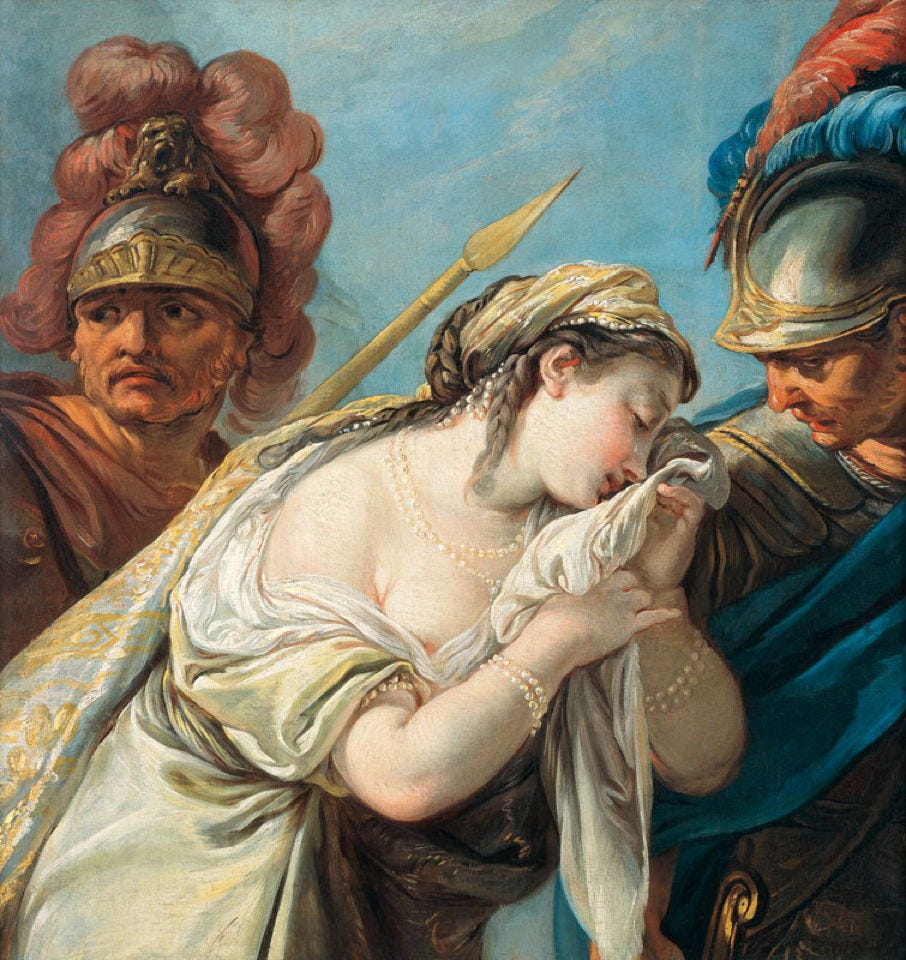
As this 18th-century painting of the scene (one of many) shows, Briseis herself is none too pleased at having been parted from Achilles – the man who sacked her city, slew her wedded husband, and also killed her three brothers before the events of the Iliad. Only after she is returned to Achilles following the death of Patroclus (much, much later in the poem) do we see her again, and only here does she speak her mind and explain herself. Lamenting over the body of the dead Patroclus, she says that he had always been kind to her, and had promised to persuade his friend Achilles to raise her from war-prisoner to legitimate wife.
That this persuasion was successful can be gathered from Achilles’s rebuff to a previous deputation from Agamemnon, in which he declares that his original intention was to marry Briseis; he even compares the injustice of his being separated from her to the rape of Helen that started the Trojan War. But this marriage, of course, is not to be. By the time Briseis is returned to Achilles, he is once again dominated wholly by his anger (which has simply been transferred from Agamemnon to Hector, the Trojan slayer of Patroclus) and is well on the way to his own death at the gates of Troy. At this point he even remarks that he would rather have seen Briseis die in the sack of her city than have lived to become the cause of the quarrel and all the Greek disasters that it brought about.
It might be said of Achilles (and, of course, is often said) that he was first and foremost in love with his own martial honour, of which his captive ‘sex-slave’2 Briseis was merely a symbol. It might also be said of Briseis (and, of course, is not so often said) that she all too quickly forgot the deaths of her husband and brothers, and devoted herself to their killer in the hope of regaining the queenly status that she had lost. These are carping, ‘Thersitean’ opinions, not to be identified with the thoughts of Homer. But there does seem to be some intentional contrast between Achilles and Odysseus, hero of the Odyssey, who gave up the ultimate honour of immortality in order to return to his wife; and thus perhaps by extension, between Briseis and Penelope, who went to every length to resist remarriage despite having every reason to believe that her husband was dead. The contrasting fate of these two love relationships is just one aspect of the contrast between the wider fate of Achilles and that of Odysseus.
But we are getting a long way ahead of ourselves here. In the next part, we shall meet Achilles’ divine mother Thetis, and see how she purposes to help him.
Notes
To his sheltered camp
The word used for the structures in which the Greek warriors live is κλισία (klisia), which is often translated ‘tent’ but is apparently more like ‘encampment’, implying a wooden building. At the original time of writing I read an archived blogpost by an amateur translator that made this case quite persuasively, but have unfortunately mislaid the link to it.
Perfect hecatombs
That is to say, the hundred animals (mixed bulls and goats) that made up the hecatomb were all without defect or blemish.
To heaven rose the smoke and the savour…
The κνίση (knise), i.e. the savour or nidor, given off by the roasting meat was supposed to be pleasing to the gods – an idea hardly confined to Greek tradition.
That shall chill him colder than his quitting the girl
Embellished; all that the original text says is that ῥίγιον ἔσται (rhigion estai) “it shall be more chilling [for Achilles]”, with the word ῥῖγος (rhigos) ‘chilliness’ connoting horror or terror as well as physical cold, the common ground between them being the physical reaction of shuddering.
He rages and fumes, seethes and smoulders…
These four English verbs are spun out from a single Greek one, θύω, which can mean either ‘storm, rage, seethe’ or ‘sacrifice, immolate, slaughter’. These are apparently distinct words with the same sound, and the right one in this context is obviously the ‘rage’ or ‘seethe’ one; but there is reason to suppose that the secondary connotation of ‘sacrifice’ is intended by Homer, since Achilles seems to be implying that Agamemnon has sacrificed the whole Achaean host to his wrath. In the immediate context, he first accuses him of having a ‘destructive mind’; then he says that he cannot consider anything ‘forward or backward’ (meaning that he heeds neither past nor future, but also implying blindedness; and note here that the second θύω may be derived from a root meaning ‘smoke’, which in any case would be the main product of a sacrifice); finally, he refers to the safety of the host in its fighting by its ships, arguably foreshadowing the much later scene in which the Trojans will push the Greeks back to their camp and almost succeed in burning their fleet at its moorings.
Here, once again (see the notes to the last post), I am tempted to suspect that Homer chose his words more carefully – and thus, perhaps, had more leisure to pick and choose them – than Milman Parry and his followers made out when they identified his work as an example of oral composition. Since I lack the requisite language skills to say for sure whether the word is deliberately ambiguous, or whether such ambiguity must absolutely rule out oral composition, this must remain a mere suspicion until someone with more expertise confirms or denies it.
The inconsistency between ‘thee’ and ‘you’ arises from my originally writing this after the fashion of older translations, with ‘thee’ and ‘thou’ used throughout as second person singular pronouns and ‘you’ or ‘ye’ only as second person plural. Since I am equating the sounds t and th for the purposes of metre, the word thee can be quite useful in certain places. Truth be told, I have half a mind to write the theeing and thouing back in again, but I shall go on as I have started.
Note that while Briseis is described as a γέρας (geras) ‘prize’ and indirectly elsewhere as ‘plunder’ (ληῐ̈́ς leis), the word δούλη (doule) ‘female slave’ is not used of her, presumably because it would imply a more menial status; the strictly correct modern term would be ‘prisoner of war’, albeit one at the mercy of an individual rather than a state.