

In Part VI, we left Achilles seething on the shore of Troy and waiting for his mother Thetis to take his petition to Zeus. Odysseus, meanwhile, has embarked on a trip to Chrysa to return Chryses’ daughter to her father – who, you’ll recall, successfully entreated Apollo to bring a plague down upon the Greeks. Once he has got his child back, Chryses will pray to Apollo again and end the plague – leaving the Greeks hale and sound to face the disasters that Achilles has just asked Thetis to arrange for them.
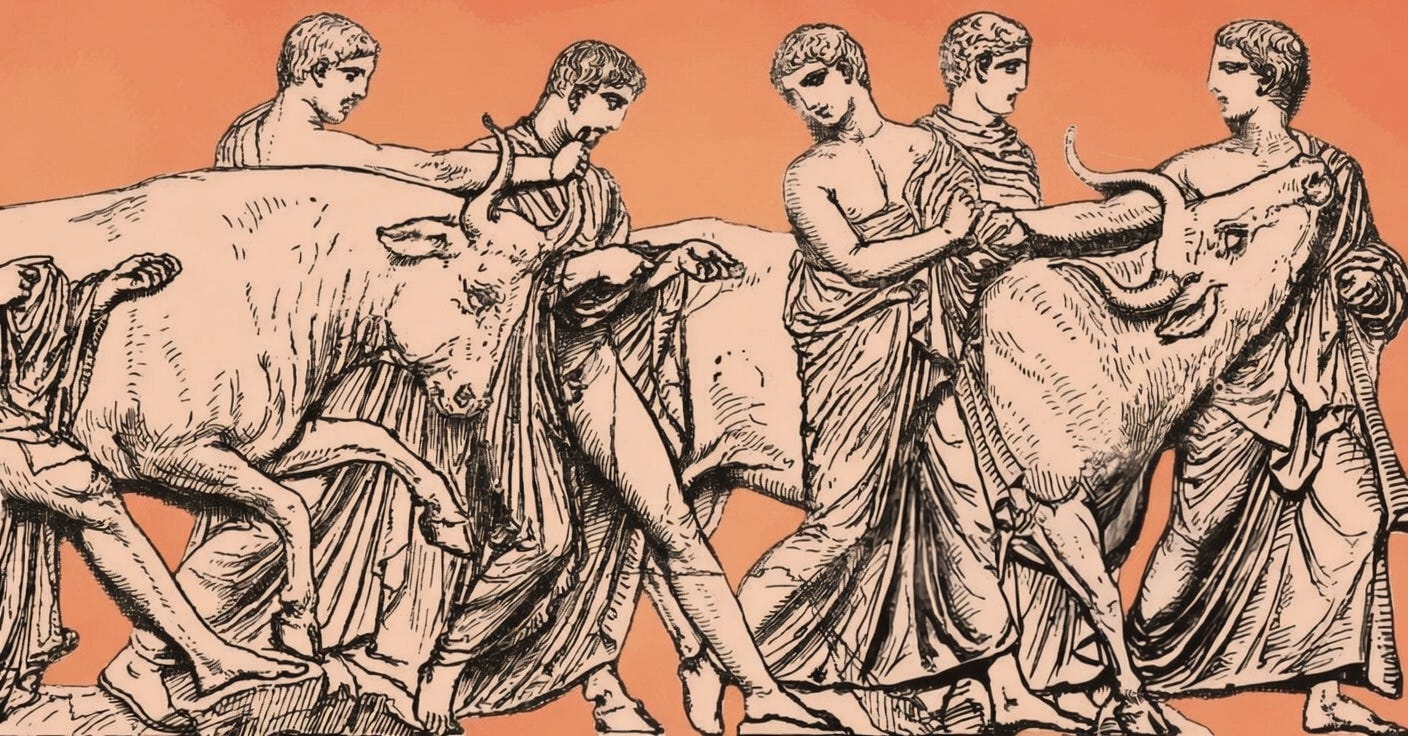
But since it is the god who is being propitiated, much more than the priest, this requires also the sacrifice of a hecatomb – in theory, though apparently not always in practice, an offering of a hundred oxen. By no means will these animals be burned entirely on the altar so that the god alone can enjoy them (that would be a holocaust, or burnt offering, usually made at night to underworld powers); rather, the inedible bones and gristle will be burnt on the altar along with some of the meat and fat, the aroma of which was supposed to be pleasing to the gods. The rest of the meat, including the choicest portions, will be consumed by the gathered humans in a great commensal feast made in honour of the god.
This tradition of sacrifice was said by the Greeks to have been started by the Titan Prometheus, when he outrageously cheated Zeus out of the choice meat on behalf of the human race. H.J Rose tells the tale in his Handbook of Greek Mythology (p.55):
It being agreed that men should sacrifice to the gods and share the victim with them, the question arose which part should be for men and which part for the gods. Prometheus was called upon to arbitrate. He killed an ox, cut it up, and separated the flesh and entrails from the bones. The latter he wrapped in fat and made, with the hide, into a bundle; the rest he enclosed in the stomach. Zeus, on being given his choice, at once snatched the inviting-looking parcel of fat, and was furious to find that he had got little but bones. Hence it is that men sacrifice little or none of the best meat to the Olympians, but eat it themselves at the sacrificial banquet.1
Zeus took revenge for this swindle, but his wrath mostly fell on Prometheus himself, and the gods thereafter accepted these rules of sacrifice.
There is little need for us to preface the text with an explanation of the rituals and customs of sacrifice and feasting, since Homer describes both in step-by-step detail. I have expanded the text a little (see the Notes for details) so as to bring to light some points that would have been common knowledge to the original audience. Those who would like to know more details can see here and here.
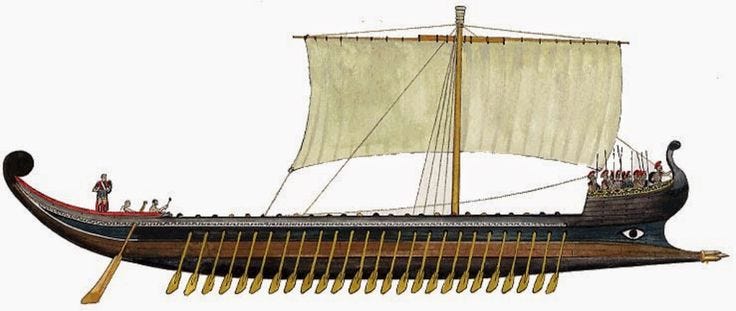
As should go without saying for long-term readers, the sacrifice and feast constitute formulaic themes inherited by Homer from the oral tradition, and are repeated with very close wording in other passages of the Iliad and Odyssey.2 Another set of themes well- represented in this section has to do with sea-travel, mooring, and setting sail; I have also expanded some of these passages for the sake of clarity.
...By that time, Odysseus
Had sailed to Chrysa    with the sacred oxen.

To the deep-hollowed harbour    they drew full nigh
Until they fared within;    then they furled their sails,
And in the swart ship stowed them.    Then the standing mast
They lowered to the mast-crutch    to lock it aft,
Loosing the forestays    that aloft had fixed it,
Quickly and nimbly.    Then they caught the oars up,
And rowed her forth    until she reached her moorings.
They cast the anchor-stones;    secured the ropes
At the stern of the ship;    then stepped they out
Upon the shore of the sea,    amidst the surf of waves,
Leading the hecatomb    for longshot Apollo.

And Chryseis stepped    out of the sea-crosser –
And was guided to the altar,    and the arms of her father,
By resourceful Odysseus,    who spoke these words:

"I am come, O Chryses,    from the king of men –
"From high Agamemnon –    to home your child,
"And to the Fulgent sacrifice    these sacred oxen,
"For the sake of the Greeks;    to assuage the Lord
"Who has heaped us Argives    with hard-groaned pains."

Thus he spake, and sent her    to her sire's hands –
And he received, rejoicingly,    his sweet-loved child.
Then they swiftly arrayed    the sacred oxen
In ordered wise    around the well-built altar.
Then they laved their hands,    laid hold of the barley,
And loud prayed the priest,    his palms uplifting:

"Hear me now, O god    of the argent bow,
"Who bestrideth Chrysa,    and Cilla divine,
"And reigneth o'er Tenedos    in regal might!
"You have honoured me once:    to my words you harkened,
"And hard did you harrow    the host of Achaeans!
"Fulfill my wish now;    ward from Danaeans
"That wrack and ruin,    and rescue their host!"

So he spake in prayer –    and Apollo listened –
And they prayed, and then sprinkled    the seeds of barley
'Twixt the horns of the beeves;    bent back their heads,
And slit their throats;    and skinned the carcasses.
They cut away the thighbones,    and cowled them in fat,
And enfolded them doubly;    and flesh laid on,
Red-raw morsels    from the rest of the body.
The elder burned them    on billets of wood,
And made flowing libations    of the flambent wine,
As with five-pronged forks    stood the flanking youths.
When the thighs were cindered,    and they'd tasted the entrails,
They sliced up the portions,    and on spits transfixed them,
And roasted them thoroughly;    and took the meat off.

When the work was finished,    and the fest prepared,
They feasted to the full –    with none found to be wanting.
Once they'd driven off their lust    for the drinking and eating,
The boys brought mixing-bowls    that brimmed with wine;
And they poured libations,    and then passed the cups round.
The Achaean youths,    throughout all that day,
Sang splendid paeans    to appease the god,
The Far-Worker;    as their voices rose,
He heard their hymning,    and his heart rejoiced.
When the sun went down,    and darkness came,
By their ships' stern-ropes    to sleep they lay;
And when rose-fingered Eos –    the early-born one –
Shining, showed herself,    to sea they took,
Towards the wide host    of the war-Achaeans –
And the Far-doer graced them    with a favouring wind.

When they raised up the mast,    and unrolled the sail,
White and wide-spread,    the wind outbillowed it –
Filled full its middle –    by the foreprow parted,
The purple sea-waves    pealed full loudly
As the ship o'er the swell went,    speeding homeward.

When they came to the Achaeans'    encamped host,
They dragged on the mainland    the dark-tarred ship,
High on the shore-sands –    and held her fast
With the lengths of wood    that they laid beneath her.
Then they scattered each way    to their ships and camps.
At this point the narration briefly returns to Achilles, still sitting and seething, before turning to Thetis and her divine petition – the matter of the next part.
Notes
Then the standing mast they lowered to the mast-crutch to lock it aft, loosing the forestays that aloft had fixed it…
‘To lock it aft’ and ‘that aloft had fixed it’ are not in the original text; I have expanded the passage in order to give a better idea of what is being done here. When it is time to set sail, the mast is raised up by halyards attached to the bow of the vessel (i.e. forestays), and when the sails are furled the mast is lowered down to a ‘mast-crutch’ (a standing wooden post with a prong for the mast to rest in) located at the stern.
‘Twixt the horns of the beeves
This detail is not in the original, but it is known that the salted barley grains were sprinkled on the head of the animal along with lustral water, causing it to nod its head and thus express its ‘consent’ to be sacrificed.
Red-raw morsels from the rest of the body
‘From the rest of the body’ is added; the small pieces of meat placed upon the fat-wrapped thighbones might have come from any part of the body, but would most likely have come from other parts of the hindquarters, and it was usual to burn the tail so that it curled in a way considered to be auspicious (see here).
The flambent wine
I have coined the word flambent, a portmanteau of flaming and lambent, in order to express the associations of the Greek word αἶθοψ (aithops) with flame and sparkling light. Like the more famous description of the sea as ‘wine-looking’ (οἶνοψ oinops, perhaps rather ‘vinous’ or ‘liquorous’ than its assumed meaning ‘wine-dark’), it seems to belong to a quite different and yet vaguely familiar conception of the sensory world, one perhaps rooted in a real difference of perception and not just one of language.3
Rose-fingered Eos
In most English translations ῥοδοδάκτυλος Ἠώς (rhododaktylos Eoos) is rendered as ‘rosy-fingered Dawn’; but in accordance with my convention, I keep the Greek name of the deity while wending her epithet into English. Eos in Greek mythology was not a simple personification of the dawn, but rather a very promiscuous goddess with a number of mortal lovers – including the wretched Tithonus, who received from Zeus (at Eos’s naive petition) the curse of immortality without eternal youth.
And held her fast with the lengths of wood…
Once the ship is hauled onto land, ‘long props’ (ἕρματα μακρὰ hermata makra) are laid beneath the hull, presumably to hold it in place. I have read articles denying that sailors of the Trojan war era would ever have beached their ships; for an article that takes Homer’s account seriously, and supplements it with extensive details, see here.
In the last chapter of this book, Rose briefly turns to the small amount of Roman mythology that was not borrowed wholesale from the Greeks, and recounts (on p.318) a tale in which Numa Pompilius haggles Jupiter down from human to animal sacrifice for the expiation of thunderbolts:
The god proceeded to name the materials of which the expiatory sacrifice was to be composed. He demanded a head; here Numa interrupted him with the words ‘of garlic’. Iuppiter continued, ‘Human—’ and again Numa intervened with ‘Hair’; the god tried again, and demanded ‘the life—’, ‘of a sprat’, interrupted Numa; Iuppiter was amused, and consented to have his warning thunderbolts expiated at this cheap rate.
He comments that this story, with its plays on Latin words (e.g. caput ‘head’), seems native to Italy and only lightly contaminated with Greek elements in other places.
For a very detailed treatment of the various acts of sacrifice as represented in different Homeric scenes, see G.S. Kirk, “Some methodological pitfalls in the study of ancient Greek Sacrifice (in particular)”, available here (scroll to the article and click to read it as a PDF).
I am thinking here of Owen Barfield’s notion (outlined in Saving The Appearances) of collectively-influenced ‘figuration’ of raw sensory data, which can change from era to era.