
Cultural Darwinism
The unlikely story of evolution from folktale to epic

It should not be forgotten that J.R.R. Tolkien’s Beowulf is a rough prose translation, made quite early in his career, and consigned to a desk drawer until it was published by his son decades after his death. The Don reportedly said that it was “not at all to his liking”, and would surely have been mortified to see it in print being weighed against the more polished translations of others. All the same, the book is well worth a read, and comes with two extras: extensive scholarly notes on the original text of the poem, and a fairytale version of its story, entitled Sellic Spell (‘Wondrous Tale’).
This latter begins as follows:
Once upon a time there was a King in the North of the world who had an only daughter, and in his house there was a young lad who was not like the others. One day some huntsmen had come upon a great bear in the mountains. They tracked him to his lair and killed him, and in his den they found a man-child. They marvelled much, for it was a fine child, about three years old, and in good health, but it could speak no words. It seemed to the huntsmen that it must have been fostered by the bears, for it growled like a cub.
They took the child, and as they could not discover whence he came or to whom he belonged, they brought him to the King. The King ordered him to be taken into his house, and reared, and taught the ways of men. He got little good of the foundling, for the child grew to a surly, lumpish boy, and was slow to learn the speech of the land. He would not work, nor learn the use of tools or weapons. He had great liking for honey, and often sought for it in the woods, or plundered the hives of the farmers; and as he had no name of his own, people called him Bee-wolf, and that was his name ever after. He was held in small account, and in the hall he was left in a corner and had no place upon the benches. He sat often on the floor and said little to any man.
But month by month and year by year Beewolf grew, and as he grew he became stronger, until first the boys and lads and at length even the men began to fear him. After seven years he had the strength of seven men in his hands. Still he grew, until his beard began to show, and then the grip of his arms was like the hug of a bear. He used no tool or weapon, for blades snapped in his hands, and he would bend any bow till it broke; but if he was angered he would crush a man in his embrace. Happily he was sluggish in mood and slow to wrath; but folk left him alone.
One day, this Beewolf hears of a unnamed king in a faraway country, whose hall is invaded every night by an ogre called Grinder. He sets off on a journey to the hall, and falls in with two companions who are on the same quest. Once he has reached the hall and offered the king his help, he has a brief contest of words with a jealous retainer named Unfriend. After a bear-hug, Unfriend becomes outwardly polite to Beewolf, but continues to scheme against him in private.
After his two companions fall asleep waiting in the hall for Grinder, and end up being killed, Beewolf takes his turn to stay up. He wrestles with the ogre and rips his arm off, but cannot prevent him from getting away. Accompanied by Unfriend, he makes an expedition to the monster’s lair – a cave located in a mere behind a waterfall – and dives off a steep cliff into the water on the assurance that Unfriend will haul him back up on a rope. He encounters Grinder’s mother, who is stronger and more cunning than her son, and beheads her with a giant sword that he finds among her belongings. After killing the wounded Grinder, he turns back, laden with treasures – only to find that Unfriend has abandoned him and loosened the knots of the rope by which he was to climb back up. He climbs up anyway, returns to the hall, gives Unfriend the thrashing he deserves, and at last returns to his own homeland to become a great king.
By no means have we divulged every detail here, and those who have read Beowulf will find much more to smile at. For those who haven’t – suffice it to say that Sellic Spell is the story of Beowulf, but not as we know it.
The ‘real’ Beowulf has a name that has often been identified as bee-wolf, a possible kenning for ‘bear’ (though there are other, more likely possibilities). He has bear-like strength, was considered lazy and useless in youth, and shows a preference for unarmed combat. But he is no foundling raised by a bear; he is the son of Ecgtheow, the grandchild of King Hrethel of Geatland, and nephew to the famously large and strong King Hygelac. The death of this Hygelac takes place during a raid into Frisia that was also recorded in the history of Gregory of Tours, making it the best-attested historical event in the whole poem.
The monsters of the poem, such as Grendel (a name that may or may not have to do with ‘grinding’), are of course not so historical. But Grendel does not menace any old hall belonging to any old king ruling over any old country; he menaces the hall of the Danish king Hrothgar of the Scylding dynasty, stated in the Norse analogues to have ruled from a seat at Lejre on Zealand (a location backed up by archaeological evidence). Although Hrothgar has a jealous retainer called Unferth, whose name vaguely resembles unfrið ‘unpeace’, he does not betray Beowulf and ends up on good terms with him after their initial verbal clash (and his name, again, was probably a real one with a different origin). These details and complexities are absent from Sellic Spell; the story is set in the world of fairytale with its nameless kings, timeless countries, simplistic heroes and villains, and predictable sequence of events.
Is Sellic Spell, then, no more than a silly spiel, a Beowulf for children? The answer is no. Like everything else in the book, it is a scholarly work.
What Tolkien was trying to do here was to reconstruct the ‘original’ Beowulf – not the archetype of the poem, not even the oral-poetic legend that preceded its writing, but the still older folktale from which both the tale and the text were supposed to have emerged. This Tolkien believed to have been a lost variant of the ‘Bear’s Son Tale’, attested across and outside Europe in hundreds of variants. The common elements of the story are as follows:
The hero is sired, suckled or otherwise raised by a wild animal, often a bear.
He has a difficult youth, in which he performs feats of great strength, but also botches what work is given him and is shunned by others for his acts of violence.
He falls in with two companions, obtains an unique weapon, and undertakes to defend a dwelling against some sort of monster (often a gnome or dwarf), which he defeats after his two companions prove unequal to the task. The enemy flees, often after having had one of its body parts severed in the fight.
The hero tracks his defeated foe to an underground lair, often encountering a second and more dangerous adversary, for which he sometimes requires a special strengthening drink. The enemy is guarding some (usually three) captive maidens, whom the hero liberates. Relying on his companions to haul him back up to the surface, he is instead betrayed by them and left in the underworld.
He escapes to the surface, often with miraculous help, and revenges himself on his treacherous companions before marrying the best of the maidens. Often this involves a period of subterfuge in which he waits for an opportunity to expose the traitors, who have put it about that they accomplished the feat of rescue.
Not all variants contain every part of this story, and in Tolkien’s reconstructed variant the whole business with the maidens and the marriage is left out, just as the poem Beowulf leaves out all details of the hero’s marital status and has him grow old and die without issue.1
What we do not find in Tolkien’s Beowulf is a detailed scholarly argument for the origin of the poem in the folktale. This was not needed, because the case had already been made in detail by the German scholar Friedrich Panzer in his 1910 work Studien zur germanischen Sagengeschichte I: Beowulf. This book is divided into two parts: an exhaustive documentation of two hundred variants of the Bear’s Son Tale, and a critical comparison with Beowulf and various Norse analogues. No-one to my knowledge has undertaken to translate it into English, so I had to resort to Grok-translating an online text that doubtless contains some errors (DM me if you want the conversation, which I am happy to give out on request).
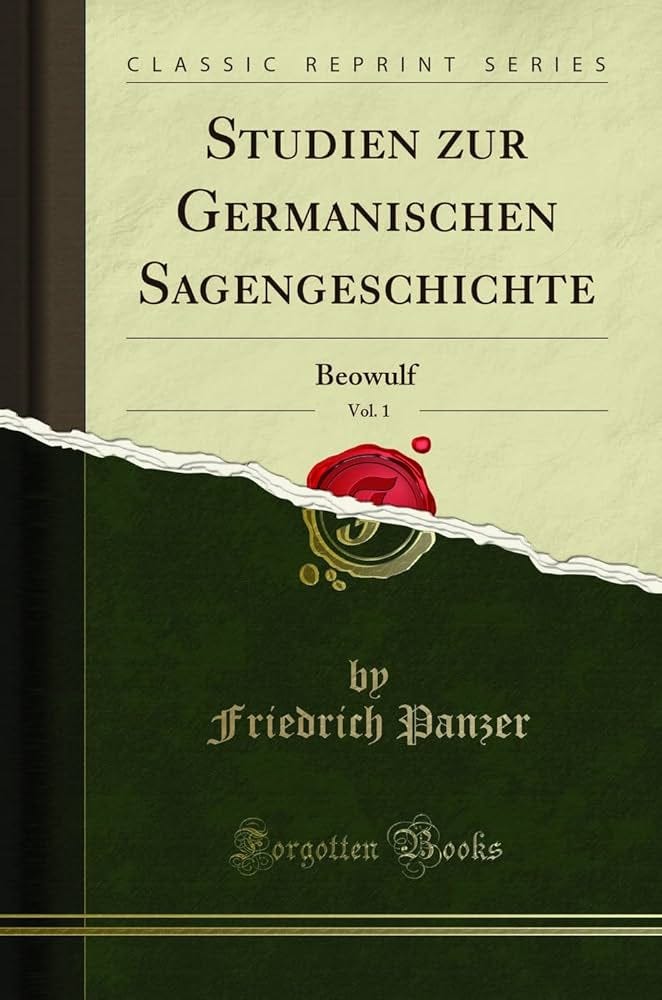
My intention here is not to criticize Panzer’s detailed arguments for the connection of the folktale with the poem; hopefully, what we have said so far has sufficed to make the case.2 The thesis has not gone without criticism, but most of those who disagree accept the notion of folktale origins, and simply wish to trace the poem to a different folktale. Thus Martin Puhvel, in Beowulf and Celtic Tradition, argues that a more compelling connection exists between the Grendel story and the Irish ‘Hand and Child’ tale-pattern (in which a monstrous arm invades a dwelling and is torn off); but Panzer himself noted this connection in his book (in Chapter 6 of Part II, pp.386-89), and at most can be faulted for touching on it too briefly.
I would rather question Panzer at a more fundamental level, on the assumption that pervades his theory: that the folktale is original and primary, and that the epic poem (or heroic saga) is only a secondary elaboration. Might it not be quite the other way around? And would this not account just as well for the similarities between the two?
There should be no doubt as to which of the two has the better claim to antiquity according to the written record, since the writing of epics with ‘folktale’ characteristics (some of which are very old, such as Gilgamesh and the Odyssey) almost everywhere precedes that of folktales. Panzer extracted most of his two hundred variants of the Bear’s Son Tale from collections dating to the 19th century; and yet it is these folktales, or rather hypothesized medieval variants of them, to which he traces the origin of the 8th-century Beowulf as well as various 14th-century Icelandic sagas such as Grettis saga Ásmundarsonar, Orms þáttr Stórólfssonar and Hrólfs saga kraka.
Of course, the wide geographical spread of folktale types proves that they existed long before the first written collections were made. But the same can be said for the themes and story-patterns of heroic poetry. For example, the basic ‘return’ storyline of Homer’s Odyssey (in which a hero returns to a wife who turns out to be either treacherous or faithful) was found by early 20th-century collectors to recur time and again in South Slavic traditional poems concerning the deeds of Bosnian heroes in the Ottoman era. In How To Kill a Dragon, Calvert Watkins traces certain verbal formulas of heroic poetry across the various Eurasian daughter-languages of Proto-Indo-European, indicating that the art of traditional poetry was already well developed long before the writing of any of these languages.
Might folktale, then, be nothing more than the distant echo of this poetry – a degenerate form of the art practiced by common people who can no longer wield the poetic language or recall the names and homelands of the heroes? Might Sellic Spell, after all, represent a simplified Beowulf rather than a prototypical one?
Before we develop these arguments further, let us see what Panzer has to tell us about his own reasoning. Throughout most of the book, he takes the priority of the folktale over the poem as a given; but at the end of the first part (Chapter 9, Alter und Heimat des Märchens, pp.226-45), he not only shows some awareness of an alternative point of view but also furnishes a certain amount of evidence for it. I shall take the liberty of adding some links, emphasizing some passages, and making some omissions so as to keep the excerpt from trying the patience of the reader.
If we see Germanic sagas from the early Middle Ages converging with our fairy tale in a way that excludes chance, but this fairy tale, even if only in the 19th century, is nevertheless recorded in Bulgaria or on a Greek island, in Siberia or in the highlands of the Pamir, one will hardly want to derive these fairy-tale variants from the Germanic saga recorded centuries earlier. Rather one will without further ado incline to the opinion that a common source must underlie them here, namely our fairy-tale material, which, older than that saga, has spread from a point unknown for the time being to different regions, tenaciously maintaining its connection also in oral tradition, but attaining literary form and written record here early, there only many centuries later, according to the cultural conditions.
Now some older records also figure in our list. It does not mean much that our fairy tale, as the last section showed, was printed in Sweden in the 18th century as a chapbook; but it is important that it attained literary form much earlier already in the Orient. … Somadeva’s reworkings prove that our fairy tale was known in India not only in the 11th century but, since he himself rests only on the more comprehensive work of Gunadhya, in the 1st or 2nd century A.D…
In these records, since persons and places are named, the fairy-tale form is actually already abandoned and transformed into the form of saga; to place them together with the pure fairy tales is, as said, pure convention, which on the one hand is explained from the accidental history of fairy-tale research, on the other from the fact that these records have indeed changed almost only the external form of the fairy tale but have mostly preserved its spirit as well as the material very well. The literary traditions of other peoples could just as well be adduced here. It has already been indicated above that in the chronicle of Gargantua, in the sagas of Thor and Heracles, elements of the Strong Hans fairy tale [closely related to the ‘Bear’s Son’] are found clearly enough…here only the demonstration may seem desirable that the Bear’s Son type, at least with its middle and final part, was known in Greek Asia Minor in the 1st century B.C.
Our fairy tale is found, though not quite complete, namely in the 35th narrative of Conon… [there follows an account of a story in which a shepherd is let down to a cave, finds a heap of gold, then is betrayed by his companion before being rescued by Apollo and punishing the traitor, conforming to the later parts of the Bear’s Son Tale]
But Indo-Iranian tradition allows us to trace our fairy tale still essentially further back than this Asia Minor record. I begin with a passage from Firdausi’s Shahnameh [Book of Kings], which transmits the complete Bear’s Son tale in detailed epic narrative in the story of King Feridun… [there follows the story of a hero named Feridun who is suckled by a cow, has a club of steel made for him, is betrayed by his brothers, enters an enemy castle, and liberates two women before waiting for an evil king known as ‘the dragon’ to return and defeating him]
It hardly needs detailed exposition that in this story of Feridun, as the Shahnameh tells it, we have before us the Bear’s Son tale in perfect elaboration... [there follows a detailed exposition of the various large and subtle connections of the story with the folktale]
Now however it is well known that the narratives of the Shahnameh about the first mythical kings of Iran are by no means inventions of Firdausi. They rest rather on old tradition, long previously also fixed in writing, which is attested clearly enough not only with individual elements but in its whole structure already in the Avesta… [there follow two excerpts from the Avesta, the ancient Zoroastrian religious corpus, which show a much older Iranian provenance for the motif of liberating two women from a demon] …Here we learn therefore… that the Avesta already knew of the liberation of two women from the power of the demon; the names [of the women in Avestan] correspond to Firdausi’s [in Persian]…
[There follows a more detailed dissection of the Iranian tradition, which need not detain us, before Panzer turns to consider the Vedic tradition of ancient India]
If Indra needs the weapon he has brought against the demon, it is still only a mighty draught of Soma that gives him the strength for his heroic deed: we are reminded of the strengthening drink of the fairy-tale hero… Three lakes full of Soma is Indra said to have drunk before the battle, just as in general, and indeed from the day of his birth onward, he appears as an enormous drinker and eater who devours one or even hundreds of oxen at a time. In this he reminds us as much of the Bear’s Son and Strong Hans as when, right after birth, he speaks, is of gigantic size, and possesses a strength to which no one can compare. Indeed, it even seems that the Veda knew the motif of the hero’s despised youth…, since [Rig Veda] IV, 18.5 says: “Like a blemish she has hidden him, the mother, though he was full of heroic strength; then he rose up, putting on his garment himself”…
Indra is younger than the gods; once… he is even called outright “the younger brother” of the gods. But he has to complain that these older brothers of his, or, as it is often said, the Maruts, Indra’s constant companions (marutvat “accompanied by the Maruts” is a standing epithet of his), fearfully abandoned him in the battle against the demon, just as the brothers or companions abandon our fairy-tale hero. Of Trita, however, stories emerge that report active betrayal by the evil brothers, the details of which, as we already saw with the betrayal of Feridun’s brothers in the Shahnameh, strikingly match the fairy tale here as well.
In RV. I, 105.17 there is an allusion that Trita was rescued from a vat (pit?) by divine help: “Trita, hidden in the vat, calls the gods to help; Brhaspati heard him and created breadth for him out of narrowness”…
More precise information about the story in question is provided by a narrative that Sayana quotes from the Satyayanins in RV. I.105… The three brothers Ekata, Dvita, and Trita (i.e., the “First,” “Second,” “Third”) once found a well while wandering thirst-tormented through a waterless forest. T[rita] climbed down, drank, and handed some up to his brothers. But they threw him back down into the well, stole all his possessions, covered the well with a wagon wheel, and went away. “Then Trita, who had fallen into the well, could not climb out again and wished in his heart, ‘If only the gods would pull me out,’ whereupon he became the seer of this hymn praising them.” The betrayal by the brothers here matches the Bear’s Son fairy tale in detail, where even the covering of the well after the betrayal is not missing…
After all this, it can hardly be doubted—and as far as I see, is not doubted by the specialists—that these legends of Indra-Trita go back to the time of Indo-Iranian tribal unity and were brought by the Indians from the old homeland into their new settlements. The epic core in the Vedas has been greatly reshaped by mythological-philosophical elaboration, such as Indian religious poetry also applied to this material, but by no means destroyed. Indeed, in many respects the chronologically older Vedic tradition has undoubtedly remained truer to the original than that of the Avesta…
I refrain from investigating whether extra-Aryan components…are recognizable in the traditions examined. For our purposes it suffices that we have been able to trace the Bear’s Son fairy tale, I may well say, not only in its elements but in its entire structure back to the times of Indo-Iranian community life. For it is indeed my conviction that the fairy tale is not a submerged myth; rather, the reverse is true: in the myths touched upon, poetic-religious interpretations and further elaborations of the older fairy tale are to be recognized.
For anyone who consumes scholarly works with the digestive acid of scepticism, instead of merely swallowing their evidence and conclusions as solid dogma, the concluding statement of Panzer translated above can only read as an outrageous non-sequitur. By the same comparative method by which he connected the Bear’s Son Tale to Beowulf, he has just traced that tale through Persian hero-legend to the most ancient religious writings of Iran and India. Without labouring a point that would have been obvious to his audience, he has noted that a tradition found in India, Iran and Europe can only be assumed to go back to the Aryans (a word that still denoted, at the time of writing, the entire Bronze Age people known today as the Indo-Europeans), who did not migrate across Eurasia as commoners swapping old wives’ tales but as conquerors bearing heroic poetry and religious tradition. Yet having said all this, he summarily dismisses the idea that the tale might have originated as myth and only later ended up as folklore, and concludes the exact opposite without argument. And there ends the chapter, and the discussion, as Panzer moves on to the second part of his book to discuss the parallels of Beowulf with the Bear’s Son Tale.
To take some famous words from Tolkien quite out of context, there is something irritatingly odd about all this. And one wonders, indeed, what has gone wrong with our modern judgement!
One clue can be found in Panzer’s introduction to the second part of the book– in which, without resuming the discussion of the origins of the Bear’s Son Tale, he spends some time attacking the theories of Karl Müllenhoff on the interpretation of Beowulf. Unlike Panzer, Müllenhoff is not taken seriously in Beowulf scholarship anymore, and is generally remembered for three things: dealing harshly with other scholars in writing, trying to pull the text of the poem apart into various shorter ‘lays’ (Lieder) and interpolations, and identifying the heroes and monsters of the story with allegorical nature-myths. It is on the last of these points that Panzer takes him and his academic following to task:
To the majority of scholars down to this day it appears as a settled matter that behind this narrative an old myth lies hidden, to which Müllenhoff in the year 1849…has given the interpretation that has since remained authoritative. Beowulf is a representative of Freyr, a divine being that stands by men in the battle against the elements. For Grendel is the god or demon of the wild dark sea at the time of the spring equinox, which overflows and devastates the land and swallows men; the god protects men from him by subduing Grendel. But Grendel’s mother is a personification of the sea-depth; when she appears once more slaying, and Beowulf, diving after her, kills her on the sea-bottom, this means: the god takes from the sea, when it floods once more, the power that moved it, in order to calm it definitively. To this part of the myth the dragon-fight offers the autumnal counterpart. “In autumn the storms rise again and the sea floods the land again: the dragon rises and lies down on the possession of men. Once more the divine hero proves helpful to men and once more knows how to push back the demonic, giant powers, to reconquer for men the treasures that the soil harbors; but his realm is now provisionally at an end, for winter stands before the door: the aged Beowulf finds death himself in the battle and is buried with all his treasures.”
To this interpretation of Müllenhoff ten Brink… adheres completely and Symons… follows it with slight modifications: Grendel is a personification of the storm-flood, which is subdued by the hero of peaceful cultivation. In Beowulf’s dragon-fight the nature-myth underlying the culture-myth still breaks through: the culture-hero is further developed from an older light-being; only that Beowulf is a hypostasis of Freyr is rejected. Similarly for Kögel…Grendel is a personification of the terrors of the undiked marsh. “The myth of the slaying of Grendel symbolizes the diking of the marshland finally successful after long labors and its utilization through meadow-growth and grain-cultivation.”
E. Mogk… declares it is true that Beowulf belongs “to poetry, to heroic saga, not to the demon- or god-myth”; but his battle with Grendel appears to him too as a kind of allegory: “a mighty natural event, the penetration of the sea, which in prehistoric times tore off whole pieces of the land, poured itself over the countries and thus created islands and destroyed human settlements, may have lived on in the people and given the impulse to this magnificent folk-poetry.”
[There follow more examples of much the same stuff from other scholars of Panzer’s time]
As far, therefore, as the individual scholars diverge in their interpretation, they are, as one sees, united that an old myth underlies the Beowulf saga. … And yet one should think that already the very different results to which all these attempts at mythological interpretation have come should have awakened lively doubts about the justification of such a conception at all, which a critical consideration of the individual attempts must considerably strengthen. That Müllenhoff’s nature-mythological interpretation actually possesses no support in the natural processes themselves in cardinal points has already been set forth by Heinzel...
Above all, however, this interpretation does justice in no way to the real tradition. It was indeed a child of its time; I must confess that I possess no feeling for it from the outset. It is incomprehensible to me how anyone can find it plausible that a figure like Grendel’s mother really represents “the personification of the sea-depth,” that this figure of so bloodless, thought-like an abstraction owes its highly concrete, living existence; it is incomprehensible to me how one can believe in a myth that would have conceived the sea as a son of the sea-depth, how one can rest content with an interpretation that is yet completely incapable of really explaining any positive detail of the saga. The favorite conception is in truth also by no means won from the narrative, but springs rather from a speculation that must then be most violently read into the narrative. And how questionable yet remains even for him who would admit its starting-point, in detail this interpretation that constantly jumps back and forth between a culture- and nature-myth, that at some points (esp. in the dragon-fight) becomes self-contradictory to the point of pure impossibility! I will not enter into a criticism of the details; the best criticism will always remain that positive one that sets a usable new in the place of the contested old. But a usable new explanation of the Beowulf saga has been found: it can probably be doubtful to no one who has read the first part of this book that in this saga nothing other than the Bear’s Son fairy tale lies before us. … Saga and fairy tale do not merely have some motifs in common; rather the saga of Beowulf’s battle with Grendel is according to my conception nothing other than the fairy tale of the Bear’s Son transformed into heroic saga by the art of the scop.
This, then, would seem to explain (at least better than anything else in this book) Panzer’s strange aversion to the idea of a ‘submerged myth’. Apparently, he associated all such ideas with the arbitrary nature-allegories concocted by Müllenhoff, against which he was obliged to push back hard in order to change the scholarly consensus of his time. That other scholars held much the same set of associations3 would explain why Panzer’s folktale-origins theory was so widely and confidently adopted after the collapse of Müllenhoff’s authority.
But Panzer was forgetting something: that Müllenhoff’s theory in no way resembled the alternative hypothesis of mythical origins at which he hints in his discussion of the Shahnameh, Avesta and Rig-Veda. Müllenhoff and friends did not trace the story of Beowulf to millennia-old mythology handed down from the poetry and religion of the Aryans; they traced them rather to local, popular, Germanic myths about the sea, the storm, the marsh, the harvest, and popular fertility-deities like Beowa and Freyr. In Müllenhoff’s idea of the nature-myth, no less than in Panzer’s idea of the folktale, oral-traditional culture is not just handed down by the common people but essentially generated by them as well.
This notion is something of an unexamined assumption for many students of Germanic tradition. It is baked into the modern English concept of folklore (a word that looks like an Anglo-Saxon inheritance, but was actually made up by an antiquarian in the mid-19th century4), and its influence on the Germans who did so much to collect and study that lore has been even stronger. It has its roots in the Herderian romantic-nationalist idea that epic poetry comes from the people, that is to say the nation5, which either generates it by some mysterious communal process or uses an individual genius as its mouthpiece (in much the same way as a mob might elect a leader to represent it). The Grimm brothers, who laid the foundations of Germanic philology and folkloristics in the 19th century, took this idea very seriously; and although it has been taken less and less seriously thereafter, in the time of Panzer we can yet find Francis Gummere in The Beginnings of Poetry (1901) arguing that the poetic art first arose spontaneously from the rhythms of communal labour. Although some have taken aim at the idea6, for the most part it just seems to hang around in the conceptual background while scholars focus on other things, much as does the ‘primordial soup’ of Darwinism in which life is supposed to have been generated.
The comparison with Darwinism is apt, since the idea that epic and saga were elaborated from folktale shares a fundamental assumption with this biological theory: that whatever is high, complex and rarefied must have followed and evolved out of what is low, simplistic and common, as opposed to having preceded it and degenerated into it.7 Yet this is a form of Darwinism that lacks its most obvious rationale, since in the field of culture the existence of the ‘intelligent designer’ is not a matter of controversy for anyone. And when it comes to the products of human creativity (what Tolkien called ‘subcreation’), the process of development is not always from simple to complex: consider, for example, the descent of alphabets and other syllabaries from Egyptian hieroglyphs and Chinese characters.
But what would be the alternative hypothesis?
The one briefly floated earlier on – that heroic oral poetry comes first and later degenerates into saga and folktale – is not seriously defended here, although it can certainly be argued from the written record in the case of Beowulf and the Bear’s Son. Since we are dealing with orally-derived traditions, the written record cannot be trusted unreservedly; and in any case, as Panzer has shown us, the earliest relevant texts point rather towards the religious than the heroic. Moreover, we must concede to Panzer that some elements of the story-pattern he identifies (such as the betrayal of the hero) appear suppressed in Beowulf and better expressed in the folktales8 – though a different impression might be garnered from a full survey of other oral and written variants of the Beowulf-poem, now of course long vanished into air and fire.
What seems more likely to me – and I daresay I am not the only one – is that traditional poetry originated in what we would today call cult or religion, among people whom we might term priests, shamans, vates, or some other such (probably inadequate) equivalent. Above all it is the nature of the poetic art – with its memorial and rhetorical uses, its supernatural story-patterns, and its association with hymn, prophecy and magic – that betrays its origins in such a knowledge-bearing class. And the method of reading esoteric teachings out of the symbols and narratives of poetry (as in Porphyry’s essay on the Cave of the Nymphs in the Odyssey) is an ancient one, suggesting that the signs are there, regardless of whether the poets remembered their meanings or the interpreters read them aright.
One would suspect that the fantastical adventures found in epic poems were not originally attributed to famous heroes, but rather belonged to the incarnate gods or vatic sages of the original cultic poetry, describing their spiritual experiences and probably also serving as ritual guides to their repetition. The story-pattern found in Beowulf and the Bear’s Son Tale – with its animal-marriage, its night encounter with a demon, its ‘sacrifice’ of two companions, its underground expedition and liberation of royal maidens, etc. – looks to be rooted in some sort of initiatic ritual, although we must leave aside the question of what exactly this might be.
The absence of this form of poetry from the written record can be explained by more than its presumed antiquity. Traditional poetry is an art of collective memory, which would have had huge importance in an oral culture, and we would expect an initial antipathy towards writing to have persisted for some time among those who practiced it. Writing not only threatens the authority of preliterate knowledge-bearers, but also arguably threatens knowledge itself, by allowing the ignorant to imitate it parrot-style without the need for training, talent, or deep understanding. Thus it was that the Vedic Brahmins and Zoroastrian priests long preferred to memorize than to write down the Rig Veda and Avesta, and that the lore of the Druids was lost to history (unless anything of it survives in Welsh poetry) because of their resistance to writing.
It stands to reason, then, that the first written poetry would be the work of a later and somewhat degraded class of knowers, who had more or less come under the sway of rulers and warriors (who of course would have had much more to gain by the promotion of writing).9 This change in status would presumably have come about some time before the dawn of literacy, possibly as a result of the armed migrations, and would not have involved the total degradation of poets into entertainers and genealogists devoid of their old spiritual authority. Early on, they would have been valued for their ability to invoke divinities on behalf of their patrons (as in the Rig Veda); and the old idea that poets immortalize heroes in song would make more sense if this entailed attributing the traditional deeds of sages to them.
In sum, what we have here is a rough ‘degenerative hypothesis’, consisting of three stages (with intermediate sub-stages):
‘Cultic’ poetry (degenerates to memorized hymn)
Heroic poetry (degenerates to prose saga)
Folk story
The last of these, we must say, is nothing more than the residue of the two higher types of poetry as preserved among the common people – or rather, as it was preserved among them prior to the modern tide of schooling, hyperliteracy, television etc., which has levelled even this last redoubt of archaic oral culture and left only a mass of dead texts in its wake.
I can foresee some objections to this hypothesis, at least on the details; but I like to think that it makes more sense than Cultural Darwinism. The question is whether our regarding the Bear’s Son Tale as submerged myth rather than elaborated folklore makes any difference to the interpretation of Beowulf, since it would probably have been all the same to the person who wrote it.
I would say that it makes some difference. I have read papers in which academics cheerfully punt on such questions as how Beowulf armlocked Grendel, or why he found it harder to defeat his mother despite her being weaker than her son, simply because these details are assumed to be embellishments of some folktale analogue with a simpler story. Regarding the original form of the story to have been, in all likelihood, more complex and subtle than the extant versions motivates us to pay more attention to some of these details. There has also been a great deal of Freudian, Jungian and other such interpretation of the themes of Beowulf, none of which can ever be called right or wrong, as long as those themes are assumed to have bubbled up from some collective well of ideas onto which any modern construct can be projected. By contrast, once we assume that there is (or at least was) some conscious and specific meaning behind them, we are better motivated to try to understand it on its own terms – assuming, of course, that this has not been rendered impossible by the accumulation of later meanings upon an original one that may well have been somewhat ambiguous.
More important, however, is the difference made to our reasons for studying traditional poetry in the first place.
As we have said, mass literacy and mass media – now to be followed by machine-generated slop – have washed oral folklore out of the people, and there is no indication that anything much is likely to bubble up from them again in the foreseeable future. As long as the ‘folk’ is considered prior to the ‘lore’, there is not much to do by way of revivalism other than to larp like it’s 1899 (or to nag the folk into being more traditional, or to try to persuade the media class to be less overtly anti-traditional). But if the ‘lore’ was always primary, and illustrative of spiritual reality, then it can never be destroyed; and if the art is its receptacle, then we need it more than ever; not, ironically, to resist the threat of oblivion that used to hang over preliterate societies, but to hold what is essential in the heart and mind against the modern tide of letters, images and slop.
That said, Beowulf does contain a brief reference to Hrothgar’s daughter Freawaru, who is said to be betrothed to Ingeld of the Heathobards (who will eventually turn against his wife and wage war on his father-in-law). Presumably the marriage of Freawaru to Ingeld was too well-known for the poet to marry her to Beowulf instead, but this need not have concerned the writer of Sellic Spell. Tolkien might have amended the story by having Grinder kidnap the princess and Beewolf liberate and marry her.
For those not yet convinced, a ‘digest version’ of the theory with a single Bear’s Son variant can be found here (“John of the Bear and ‘Beowulf’”, 1967, Robert A. Barakat).
See e.g. this review of Panzer, in which the ‘mythological theory’ is treated as synonymous with the ‘Müllenhoffian tradition’.
Specifically, William Thoms in 1846, in a letter to the Athenaeum literary magazine. Old English had the word folclar, coincidentally compounded from the same roots, but this connoted a teaching made to the people and not one originating from them.
Hence the concept of a ‘national epic’, a term that is indistinguishable in some languages from ‘popular epic’. This point is tediously misunderstood by those who say that Beowulf cannot be regarded as an English national epic because it makes no reference to England, when they ought rather to cite the fact that it makes almost no references to the Angles.
Louise Pound, in Poetic Origins and the Ballad (1921), attacked Gummere’s idea of a communal origin of poetry, albeit only to assert the obvious role of the individual artist (who can still be regarded as a representative of the folk). From what I can gather of the intellectual history surrounding this idea, other theories that take serious issue with it (e.g. Lord Raglan’s mythologism) tend to be encumbered with other claims that prevent them from being widely accepted.
The connection with Darwinism is more apparent in the somewhat analogous modern theories of the origin of language, typically by some gradual or sudden evolutionary process. I find it far more reasonable to suppose that language, like its derivatives (written scripts, mnemonic number systems, etc.) belongs to the category of invented technical arts; that some prehistoric sage must have thought it out and taught it to his followers, who then taught it to a wider group, which at length ended up outcompeting the ‘unworded’; that it is generally devolving from complexity to simplicity (compare e.g. the grammar of modern English with that of Proto-Indo-European, or modern Chinese with its much more nebulous ancestor); and that in the unlikely event of its being replaced by some modern machine-assisted substitute, and forgotten, no communal or evolutionary process would suffice to bring it back. This hypothesis in no way conflicts with the revelation that some animals possess rudimentary language, since this would stand to the language of humans as the tool use of certain animals stands to that of humans.
I am thinking here again of the Beowulf-poet’s brief reference to Freawaru and her marriage to Ingeld after the triumph of Beowulf, in which the demands of saga-history seem to have blocked the development of the traditional story-pattern.
Note here that Homer’s sympathies seem very much to lie with Mycenaean-era kings against those who encroach upon their rights – whether they be overkings like Agamemnon, common soldiers like Thersites, or noble upstarts like Penelope’s suitors.
Fantastic article. I've never been convinced that anything as insipid as Sellic Spell could have been the immediate inspiration for Beowulf, but hadn't considered that Beowulf itself, while much more exalted than its Germanic myth-cognates, might be regarded as a less soðe gebunden form (on an image-symbolic if not necessarily a verbal level) of something far more exotic and elemental.
My quibble is with the three-stage degeneration model. First, subjectively, I don't agree that heroic poetry is strictly a downgrade from ritualistic/primitive mythic poetry. It's probably true that it corresponds to a social demotion of the poet from divine conduit to propagandist, entertainer, and the like; and insofar as one's enjoyment of Beowulf does not depend on participating in or even deeply appreciating the poet's religious milieu, it resembles folklore more than it does an accessory to ritual. But I'm not such an elitist that I consider popular (or courtly) appeal to be an ipso facto indictment of the aesthetic quality of a work. Beowulf is bound to be by some objective measures subtler and more complex than its earliest sources; more importantly, its overriding purpose can be loosely described as artistic, which gives it an obvious advantage over genres where any "merely" artistic appreciation is incidental. I too am happy to punt on questions like why Beowulf found Grendel's mother harder to kill than Grendel himself, not because I don't think the poem deserves to be taken seriously due to its ostensibly vulgar origins, but because it forms a coherent enough whole that I can tolerate some shadowy psychologization or even outright arbitrariness. And as you conceded in passing, the hypothetical ancestral form probably also had its share of arbitrariness. If deep-primitive parallels like the Australian ritual-myths documented by Joseph Campbell are anything to judge by, either artistic mediation a la Beowulf, anthropological voyeurism a la Campbell, or direct participation would be necessary to make it palatable. I don't expect I would derive any deep spiritual edification merely from knowing the prehistory of Beowulf's armlock on Grendel, even if it happened to have a very satisfying explanation.
Second, although there is a sense in which heroic poems are intermediate between ritual/mythic poetry and folktales, it goes too far to position them as a necessary causal link. In the Stone or Bronze Age communities you seem to have in mind, there would be little to stop the priestly/shamanic version of the tale from percolating into the broader community, being recycled for whatever didactic/pedagogical/recreational purpose, and then taking on a life of its own. Also, the transmission could just easily have gone in the opposite direction. It's not as if myths spring full-formed (verse and all) into the mind of the shaman and immediately graft themselves onto a ritual which arises co-dependently. Moreover, base folktales must be more portable than their esoteric ritual counterparts, and so might preferred in cases where one needs to invoke horizontal cross-cultural transmission to explain the patterns of diffusion. Heroic poetry generally presupposes a more complex society than do either of the other modes, so it seems a bit of a stretch to make it the intermediate step in a degenerative process.
I have checked your first long quote in the original, everything seems fine except for the "vat" Trita is in. The original here is "Kufe", which I know a the bottom part of sleighs, ice-skates, water-planes, and such. I looked it up and wiktionary has a regional meaning as "vat". I suspect someone in the chain before Panzer made a mistake here.
Reading the post I did anticipate the ending in general terms, but it came up a lot more specific, and not in ways especially supported by the rest of the post. I dont think the alternative needs to be this specific. It certainly seems plausible for stories to end up as folklore, regardless of how they got their start or how they fell in that original role.
How do you think this compares to Alexander the Great, and how stories of his life spread and changed? This happened in already literate cultures, and often these stories are preserved in writing, but they follow many of the mechanisms usually associated with oral transmission.