

(Full disclosure: I am not a trained philologist, a qualified expert in Old English, or anything more than an autodidact. So take the speculation outlined here with a dose of sea-salt. Even if it be partly or wholly wrong, it may contribute to understanding.)
In the prologue to the epic poem Beowulf, the Danish dynastic founder Scyld Scefing (‘Shield son of Sheaf’) passes away and is laid on a ship with a hoard of hard-won treasures. His men then set him adrift on the ocean (garsecg), never to see him more. This is how the scene is described in the original text:
Þa gyt hie him asetton segen gyldenne,
Heah ofer heafod; leton holm beran
Geafon on garsecg. Him wæs geomor sefa,
Murnende mod. Men ne cunnon
Secgan to soðe, selerædenne,
Hæleð under heofenum, hwa þæm hlæste onfeng.
Which might be translated, pretty closely, as follows:
Moreover they set up for him    an ensign of gold,
High above his head;    let the heave-waves bear him,
Gave him to the ocean.    Grieved were their hearts,
Their minds in sorrow.    Men were not able
To say for certain,    not sages in hall
Nor heroes under heaven,    who hauled that freight in.
But had we wished to translate more literally than this, with strict fidelity to the meanings of words, we would be forced to break the poetic effect of this scene. For the compound word gar-secg (say ‘gaar-sedge’) does not literally mean ocean – although its usage in this sense is attested by many Old English sources and not at all in doubt. What it literally means, by all appearances, is spear-man.
If this is a metaphor, it’s more mystifying than evocative. Such a bizarre circumlocution might not seem too out of the ordinary in Norse skaldic poetry, which was practically an esoteric code (to which Snorri Sturluson’s Prose Edda was written to serve as a key) filled with such opaque kennings as ‘Sif’s hair’ for gold and ‘Thor’s mother’ for earth. Contrary to common belief, the Old English poetic language was nothing like this. What kennings are found in Beowulf are of the simple, evocative, and readily intelligible type: hronrad ‘whale-road’ for sea, woruldcandel ‘world-candle’ for sun, banhus ‘bone-house’ for body, at most hildeleoma ‘battle-light’ for sword. And many others, such as wegflota ‘wave-floater’ for ship, are entirely transparent.
In such company, a word that supposedly personifies the ocean as a man with a spear sticks out like a sore thumb. And the fact that Bosworth and Toller could find no pagan sea-god north of Neptune to answer to such a description should make us all the more suspicious. Let’s be honest: garsecg as ‘spear-man’ makes no sense, full stop.
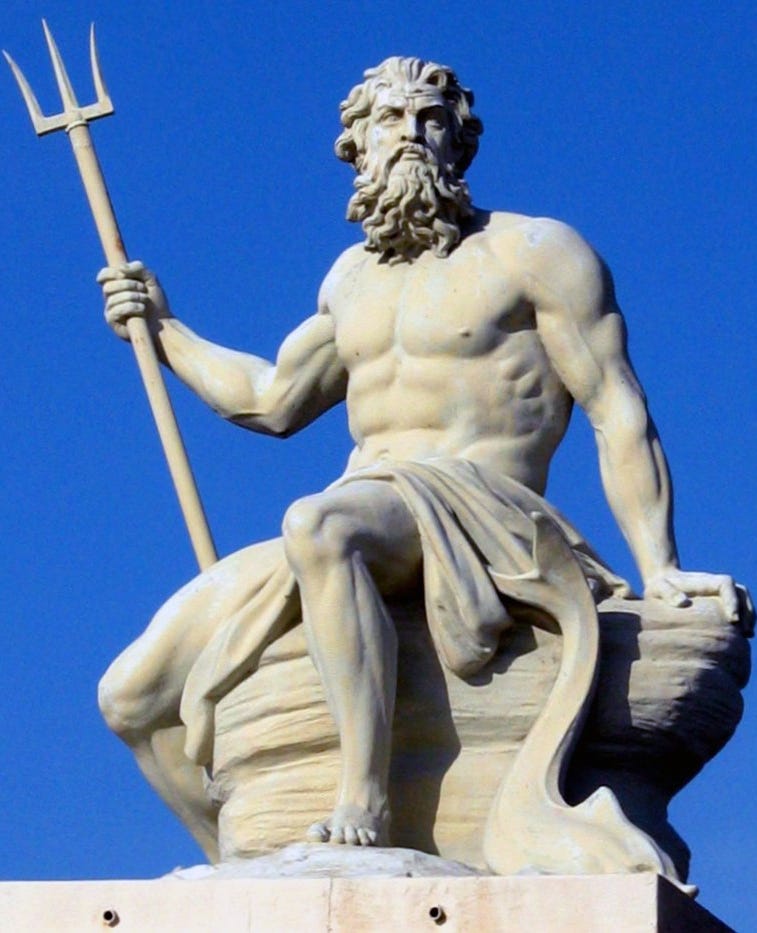
So why do scholars persist in analysing it as such? The answer is that spear + man is the most unproblematic interpretation of gar + secg. At least this is the conclusion of the most useful academic article I have been able to find on this subject: “…And That Difficult Word, Garsecg (Gummere)” by R.L.M. Derolez, written way back in 1946. (It’s available in full at DeepDyve, which requires credit card registration, though if you’re hard up like me you can just take out a free trial and cancel it later.)
As Derolez notes, “the first element of garsecg offers no difficulties”: the word gar means spear or javelin. It was used in compounds for the spiky leaves of certain plants, and is related to another word gara that apparently denotes triangularness, applicable to areas of land and bits of cloth (though not, one imagines, ocean waves). For secg, on the other hand, there are four possibilities:
Secg ‘man, warrior’, which is the best-attested, occurring in most poems. Its Old Norse cognate, seggr ‘man’, is also a poetic term. In Vladimir Orel’s Handbook of Germanic Etymology, both forms are traced to Proto-Germanic *saʒwjaz, related to Latin socius ‘fellow, companion’.
Secg ‘sedge’, found mainly in Latin glossaries. Though sedge leaves are long and sharp, and found in watery areas like marshes (though not out in the open sea!), only by a long stretch of the imagination might ‘spear-sedge’ be construed as a metaphor for the ocean billows. Moreover, this botanical term does not seem the type to crop up in epic poetry.
Secg ‘sword’, a scantily-attested poetic term. On the basis of a single attestation in Beowulf, it is assumed to be a feminine noun, which might rule it out on the grounds that garsecg declines as a masculine noun.1 But some nouns in Old English (such as sæ ‘sea’) could be masculine or feminine, and perhaps this was one of them: as Derolez notes, it might be related to secg ‘sedge’ with its long, blade-like leaves, and one imagines it could also have been conflated with secg ‘man’ (cf. the modern synechdoche ‘hired gun’). Yet ‘spear-sword’ as a metaphor for ‘ocean’ is hardly an improvement on ‘spear-man’.
Secg ‘sea’, attested only three times in Latin glossaries, with the variant spellings segg, seeg and saecg. This word would seem at first sight more promising, but Derolez remarks that it inhabits a “sphere of uncertainty”, due to its scanty attestation and lack of etymological cognates. Yet ‘spear-sea’ makes a lot more sense than ‘spear-man’, ‘spear-sedge’ and ‘spear-sword’, and could be a reference to the dangers of the open ocean, although these were hardly absent from minor seas during the heroic age described in epic poetry.
Derolez, who seems more or less inclined to the straightforward ‘spear-man’ interpretation, goes on to criticize some proposed solutions to the puzzle by scholars of his time. Friedrich Dahlmann’s analysis of the second component as ecg ‘edge, blade’ (by which one might posit a compound like gærs-ecg, ‘grass-edge’) is ruled out on the grounds of the feminine noun declension of this word. William Redbond’s suggestion of a Welsh loanword (mor-caseg, meaning ‘sea-mare’ or ‘wave’), which might account for the lack of cognates in other Germanic languages, seems unlikely given that the English absorbed very little language from the conquered Welsh. Henry Sweet’s attempt to identify garsecg with an even more mysterious hapax word, gasric, is rejected on the grounds that the latter term apparently refers to a whale. A couple other attempts to construct alternative definitions are judged inconclusive.
In this grab-bag of unlikely theories, we find one that seems to my eye to be more valuable than it looks at first glance. Derolez dismisses it as follows:
[Gregor] Sarrazin…cuts the compound into gar + secg, taking the first element as a corruption of [Old Norse] garð- [‘garth’], the second being secg “sea”. He seems to forget that there is an [Old English] geard [‘yard’] corresponding to ON garðr.
And so he moves on, towards his conclusion, in which he admits that “the problem cannot be said to have come much nearer to its solution”. But let us not be so hasty.
First of all, there is no reason to suggest that Sarrazin stupidly ‘forgot’ about Old English geard. It is a fact that Old English eventually absorbed the Norse word garðr into its vocabulary, while retaining the native geard (pronounced with a ‘soft’ g, that is to say a y-sound), and that both survive to this day as the doublets garth and yard. All that Sarrazin was proposing, then, is that garðr had found its way into Old English (albeit in corrupted form) at some time before the composition of Beowulf; and granted, this seems unlikely. In my view the evidence of the poem suggests it was composed during the Mercian supremacy in the 8th and early 9th centuries; some scholars engaged in close study of the language argue for an earlier date; but the view that it was composed during the Viking Age, when a host of Norse words invaded the English language, is definitely a minority position.
But the question of Norse derivation is secondary. The important point is that Sarrazin identified a word derived from the Germanic root *gardaz, meaning ‘yard’, ‘garth’ or ‘enclosure’, as the true origin of the first component of garsecg. And this element of his theory is not so easily dismissed.
What after all was the ocean, the garsecg, in the traditional Germanic mind? Derolez is very clear on this: the word “denotes the ocean which, in the opinion of both classical and Germanic antiquity (Miðgarðsormr, the ON world-serpent, rests on its bottom!), encloses the inhabited world.” He goes on to say that “garsecg figures the limit between the world of the living and the world of death” and that the ocean on which Scyld’s funeral ship is carried away “no longer belongs to ‘middangeard’”. It would seem that Derolez cannot discourse upon the concept of garsecg without constant reference to Old Norse miðgarðr ‘mid-garth’ or Old English middangeard ‘middle-yard’ – both of which are descended from the Proto-Germanic compound *midjagardaz, and express the traditional concept of the world of human life begirded by the ocean. This ocean is the natural counterpart to the ‘middle-garth’: the periphery to its centre.
No wonder Sarrazin thought ‘garth-sea’ was a reasonable hypothesis as to the true meaning of garsecg.2 And given the transparency of Old English kennings3, it is surely a more reasonable one than ‘spear-man’. But if gar- is in reality derived from some descendant of *gardaz, it cannot be Norse garðr or English geard. Might we trace it as a loanword from some other source? Indeed we might – but only through the black hole of obscurity that is the Old Frankish language.
This language was far from obscure at the likely time and place of Beowulf’s writing (8th or early 9th century Mercia). It was spoken at the Carolingian court of Charlemagne, which is well-known to have conducted all sorts of diplomacy and trade and trade war with the Mercian kingdom of Offa.4 Englishmen faring back and forth across the Channel might well have absorbed seafaring terms from the Franks, perhaps including quite fundamental ones, just as modern Englishmen absorbed such fundamental nautical terms as skipper and dock from the Dutch. And though the Frankish language is largely a mystery today, due to a dearth of surviving texts, one of the handful of words to have been reconstructed in it is *gardo ‘garden’ (through French jardin) – which must have been derived from Proto-West Germanic *gard, itself descended from Proto-Germanic *gardaz.
So let us suppose that the first element in garsecg was originally derived from Old Frankish and pronounced as *gard, and that it denoted the ‘middle-garth’. The obvious corrolary is that the second element meaning ‘sea’ was a Frankish loanword as well5 – which might explain its scanty attestation in Old English, as well the inability of scribes to spell it the same way twice, although they managed this with their own words often enough. One problem is that this element, unlike *gard, lacks obvious cognates in other Germanic languages. Or does it?
Here I will suggest only one possibility, although there may well be others. In Vladimir Orel’s Handbook of Germanic Etymology, we find the following reconstructed Proto-Germanic compound:
*saiwi-weʒaz sb.m.: ON sjó-vegr ‘way on the sea’, OE sæ-weʒ ‘sea-way’. Compound of *saiwiz ~ *saiwaz and *weʒaz.
Wiktionary helpfully shows a list of daughter-language descendants for each element of this compound, *saiwiz ‘sea’ and *wegaz ‘way’. Old Frankish is predictably absent, but judging from the Germanic languages closest to it (as far as I know Old Dutch is the best horse to bet on), one would imagine the whole compound to have been *seoweg or *seweg (long vowel followed by a short one) in that language. Now let us further suppose that this compound was contracted into a single word, *seg (long vowel), in much the same way that Old English hlafweard ‘loaf-guard’ was contracted into hlaford then loverd and then finally lord. By this reasoning we obtain the second element of our hypothetical loanword, *gardseg.
But how do we get from there to garsecg – which drops one consonant, lengthens a vowel, shortens another, and changes a sound? The only possible answer is folk etymology – the phenomenon whereby unfamiliar loanwords are transformed by analogy with native words. Folk etymology is what turned Spanish cucaracha into modern English cockroach (the roach part of which properly denotes a species of fish), and Latin asparagus into dialectical sparrowgrass. As is evident from these examples, the nativized words need not always make much sense.
From the perspective of an Old English speaker, the first element of *gardseg would have seemed semantically obscure (because it doesn’t sound like geard), and the combination of e followed by hard g in the second would have sounded strange (because such words in Old English are pronounced with a ‘soft’ g, as in weg, which sounds like its descendant ‘way’). The smoothing of the word into the more pronouncable garsecg would have required no other reason than this, though perhaps a bare suggestion of danger or spear-fishing also went into the mix. To draw the closest possible analogy, it is like taking ‘garth-main’ and turning it into ‘guard-man’.
At this point we can close the circle: garsecg really does mean ‘spear-man’, or perhaps ‘spear-sword’.6 But this name would not have been taken seriously at the time, and to translate it literally in modern English would be like rendering cockroach as roosterfish. I would suggest the translation ‘world-sea’; for those more inclined to archaism, ‘garth-sea’; and for anyone who insists on retaining the idea of personification by a deity, there can be no substitute for the ‘world-serpent’.7
As Derolez notes, the attribution of feminine noun gender to secg ‘sword’ is based on a single usage in Beowulf: ac wit on niht sculon // secge ofersittan, ‘at night we two shall // oversit the sword’, in which oversit has the idiomatic meaning of ‘forgo’ and the final -e on secg is assumed to denote feminine accusative case. In light of the masculine declension of secg ‘man’ and secg ‘sedge’, this does not exactly fill us with confidence; and given the many errors made by the Beowulf scribe, who did not always understand what he was copying, it is not beyond the realm of possibility that he stuck a final -e on secg to denote dative case because he thought these lines referred to literal ‘sitting’ upon a sword. Thus ‘spear-sword’, which the Wiktionary entry for garsecg dismisses as the “least likely” etymology, appears to be at least as defensible as ‘spear-man’ and ‘spear-sedge’.
The fact that the ‘middle-garth’ concept could be expressed in abbreviated form, that is to say with the ‘garth’ or ‘yard’ element used on its own to denote the world, is proven by the Old English adjective geardlic ‘worldly’.
We might rather say ‘non-Norse kennings’, since other recorded West Germanic poetic idioms appear to be much more similar to Old English than to Old Norse skaldic verse. The Old Saxon Heliand contains simple kennings, like middelgard and likhamo ‘body-raiment’.
See for example Max Adams, The Mercian Chronicles, chapters 7-9.
Note that due to the modern obscurity of Old Frankish, its relative closeness to Old English, and the relative scarcity of very early Old English texts, there may be no way of telling how many such loanwords found their way across the Channel. It seems almost inconceivable that none of them did.
One minor sticking point in my theory is that words constructed by folk etymology, at least in modern English, usually have a more obvious semantic connection to their referents (e.g. female from Old French femelle, and penthouse from apentis; though there are exceptions, like cockroach). If the open ocean in the Dark Ages was naturally associated with extreme danger, and further viewed as a realm of the dead, then it is better to posit ‘spear-sword’ than ‘spear-man’ as the superficial meaning of garsecg.
UPDATE (2025/08/07): At the time of writing this post, I went along with Derolez’s suggestion that the word gasric referred not to the ocean but to a whale, but on reflection this may not be the case. The couplet containing the sole instance of gasric comes from the Franks Casket (specifically here), is written in backward-facing runes, and reads as follows:
Fisc flodu ahof on fergenberig (The flood heaved the fish upon the fell-crag)
Warþ gasric grorn þær he on greut giswom (The gasric was in grief where on ground he swam)
The ‘fish’ in question is the whale whose bones were used to make the casket, as is proven by the addition of the word hronæsban (whalebone). ‘On ground he swam’ presumably refers to the beaching of the whale, and possibly also to its transformation into a casket. Most scholars read ‘gasric’ as a reference to the whale, unhappy at its having been beached, which may admittedly be the most natural interpretation; but since it is the sea that does the ‘heaving’ of the whale in the first line, perhaps it is also the referent of the word grorn in the second, which in this case could denote tempestousness or grief for the loss of the whale or simply loud rumbling and roaring (c.f. grornian ‘to mourn’ or ‘to murmur’). Supposing that the cutter transposed the runes ᛋ (s) and ᚱ (r), or used them to approximate the speech-sounds only vaguely, the word might instead be read as garsic.
(Although it may seem unlikely that the maker of such a sophisticated work of art could have made such an error, mispellings and omissions of runes do occur elsewhere (see e.g. here), and some of the runes on the Franks Casket are deformed or incomprehensible; as for approximate spellings, elsewhere on the casket gisgraf is used for gescræf, though this could have arisen from the lack of a rune that corresponds to the sound sc [ʃ].)

Supposing that the word is in fact garsic, this would surely be an early or Northumbrian form of garsecg, and gives us an important clue as to the true form of this word according to our theory of Frankish origin. Old English has a word sic (literally ‘sike’, but pronounced ‘seech’), meaning a stream, brook or watercourse, which seems a more likely prospect than our hypothesized worn-down ‘sea-way’. The Proto-West Germanic form of this word is given by Wiktionary as *sīk, and although descendants are listed only for Old English, Old Saxon and German, by analogy with *līk (Proto-West-Germanic root of Old English lic, ‘body’) we can suppose the Old Dutch form and probably the Old Frankish one to have been *sīk as well. Thus our reconstructed Frankish original of garsecg would be *gardsīk, and all our arguments regarding sound change through folk etymology would still apply to it, since neither the cognate of geard nor that of sic would be immediately recognizable to Old English speakers.
I'm not a professional, but garsecg has seemed odd to me for a while. It appears in Andreas 4 times, in 2 of which it is spoken by characters in the poem (spoken by Andrew at 392, and by Christ - in disguise as ship captain - at 530).
In North & Bintley's edition for the usage at 238, they also have this to say, which might be interesting to add to your ideas above:
"This noun also glosses oceanus 'ocean' (a Greek-derived word which is based on the mythological figure Oceanus) in MS Cotton Cleopatra A.III (WW 154-39; 304.17; and 462.15). The elements recommend a straightforward 'spear-man' sense, which might be correlated with a fifth-century account of sacrifices in early Saxon piracy."
At this point the note also references North's 1997 book, Heathen Gods in Old English Literature (pp. 217-21). I haven't read it, but might be an interesting rabbit hole.
Of course, this takes the interpretation in a different direction from yours, relying on reading the 'spear' element as an actual reference to spears.
The folk etymology angle seems quite plausible, though again, I'm not familiar enough with the philology to be confident one way or another.