

(Last updated 2026/10/22 with BIELD, FRIST, GALE, GENTEL, HERN, MACHET, SWIVE, UMBREL, WERTH, WIERD)
In 1966, Paul Jennings wrote three articles for Punch magazine, in which he invited readers to imagine what the English language would be like had the Norman Conquest never happened. He did so not only by writing a counterfactual history, but by expelling all foreign-derived terms from it and replacing them with words of only the purest Anglo-Saxon ancestry.
The result might best be described as strange yet homely:
Ful many folk unwitten what had been the tale of this our land if eke our maiden strand had been breached by some mighty, wel-found and strongly furbished ingang of lustry outlanders, such as might not be offstricken and worsted by our stout yeomen forebears together-standing in a hardy wappenshaw, for all their derring-do. And such, I ween, was never so like to broach and overwhelm us as the ungoodendlich ingang of William the Conquered.
Wel may the bells outclangen; wel may the folk and their childer be blithe and merry on a folkwide holyday, on this nine-hundredth yearday when we make wassail for our goodenlich offpushing of William the Conquered. For many a moon the Anglish have taken as granted and godspel truth, as a foregift and bottom-thing of our folkbeing, that never an outlander, from east ne west ne any other gau of the lodestone, has made conquest of this snugfast eyot ‘set in the silver sea’ as sang our greatest bard. And thus are we othermost and quite fromstanding out of all other folk of Europe, sith on the Mainland their blood, like their tongues, be naught but a hodge-podge of Frankish, Romish, Neustrian and many others, the outfall of many hundredyears’ turmoil, the twisted tale of ingang and outgang and endless othering of land-edges.
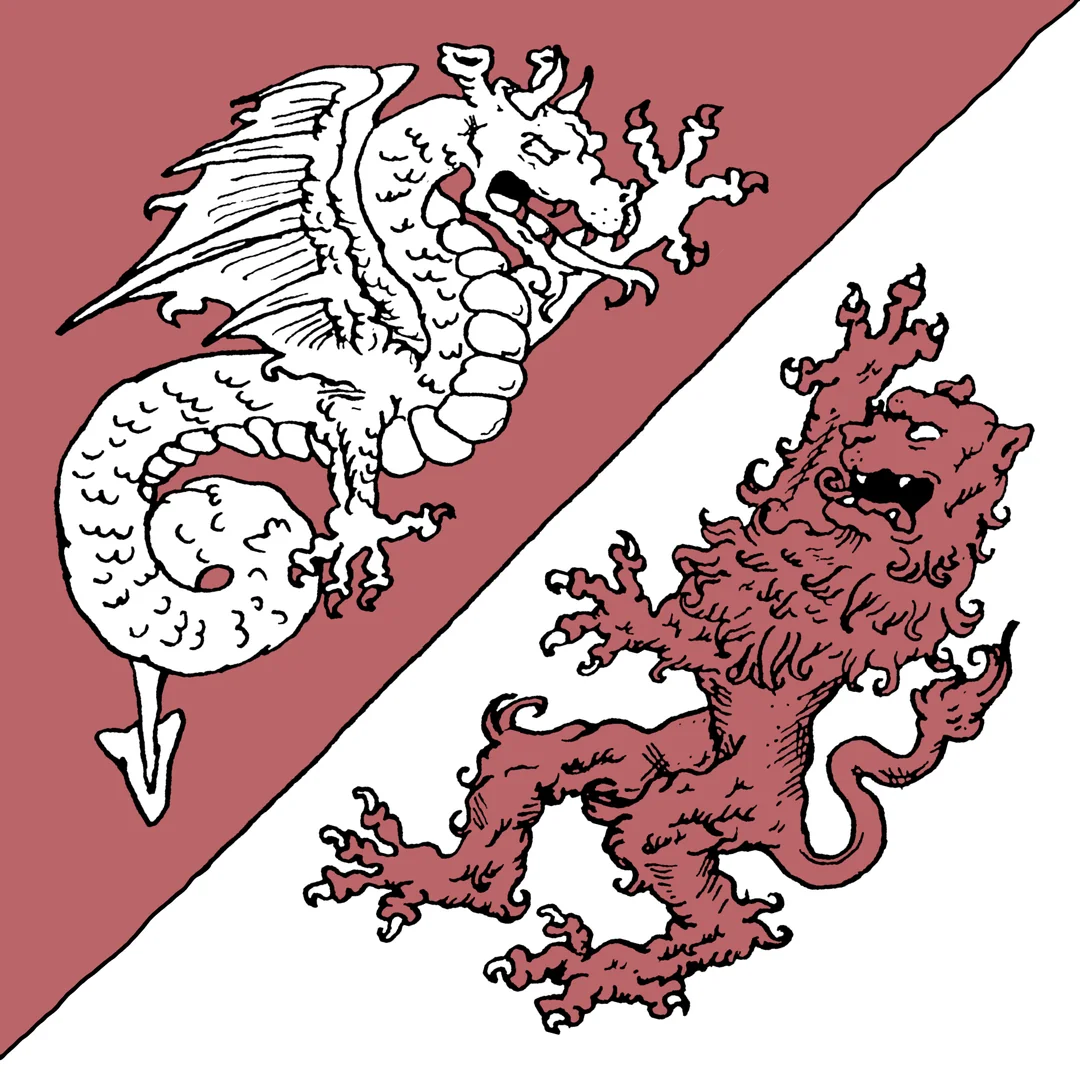
For Jennings, the idea of an unmixed form of English seems to have been no more than a literary conceit that constrained him to avoid opaque Latinate vocabulary, creating an effect similar to that of languages like German or Chinese in which the meanings of words are ‘transparent’. Yet the name that he gave to this language, Anglish, has since been taken up in all seriousness by others. Anglish now has a homepage, a newspaper, an online community, and even a flag symbolizing the perpetual division and tongue-battle of Saxon versus Norman.
Most interestingly, Anglish also has a dictionary wordbook, which proposes replacements for all the foreign words to be purged from our post-Norman tongue. Since many of these replacements have had to be revived from obsolescence, they include such blasts from the past as arvethly (‘with difficulty’, from Old English earfoþ), beem (‘a trumpet’, OE byme), loave (‘praise’, OE lof), and wite (‘punishment’, OE wite). All of these are impeccably pure Anglo-Saxon words; but ironically, they are also incomprehensible inkhorn words, the very sort of thing that Jennings was challenging himself to avoid.
My feelings on all of this are quite mixed.
On the one hand, I think the Anglishers have their hearts in the right place. I agree with them that the use of opaque Latinate terms does damage to clarity of thought. And in the course of reading and translating Old and Middle English texts, I have come across many obscure or obsolete native words that all but cry out to be revived, even from the inkhorn. On the other hand, I tend to associate word-policing much more with modern rot than with ancient roots, and I doubt that such a mixture as modern English could ever be unmixed again – or, for that matter, that it would have ended up unmixed even had the Bastard lost at Hastings.1 In other words, I would say yes to revivalism, but no to prescriptivism.
It would be nice, then, if there existed some framework other than language-purification in which lost English words could be revived and Latinate ones gently dispreferred. I would venture to suggest that there is indeed such a framework, and that it is the restoration of traditional poetry.
Perhaps some or most of those interested in Old English revivalism are uninterested in any sort of poetry. Such readers are advised to bear with me anyway. Words and phrases used in story and song have a way of trickling into ordinary speech (consider, for example, the effects of rap music on the English language). By no means am I saying that revivalism must forever confine itself to poetry, only that it would do well to start with this medium.
The logic of poetic restorationism has been worked out at leisure in other posts. All that need concern us here is that it entails our adopting the oldest English poetic meter, which is commonly called ‘alliterative’ but which I prefer to call stave-rhyming or chyming. Both of these words simply mean that this meter is based on the matching of initial sounds in stressed syllables, rather than by the end-rhyming introduced into English from foreign sources during the medieval period.
Here, for example, are the opening two lines of Beowulf in the original Old English, with stressed syllables marked in bold:
Hwæt we Gar-Dena in geardagum
þeodcyninga þrym gefrunon2
And here they are again, in a more or less faithful translation:
O what glories we have heard of the great kings told
Of the spear-armed Danes in the days of yore
And here are two lines from the Middle English Arthurian poem Sir Gawain and the Green Knight:
Now neȝez þe Nw Ȝere, and þe nyȝt passez3,
Þe day dryuez to þe derk, as Dryȝtyn biddez;
And in translation:
Now nighs the New Year, and the night passes
Day dims to darkness, as deemed by God
Obviously there is nothing in this meter that prevents us from using Latinate words (such as pass and glory). So what has it to do with Anglish? My answer is that the native English meter possesses certain characteristics that tend to point to an Anglish-like word choice, without ever forcing this by prescriptivism.
One of these is the distinctive style. It is possible to fill out lines in this meter with a heavily Latinized or even slangy modern vocabulary, and some poets like to do just that. Yet unless you are actively trying to create a dissonant effect (like, for example, W.H. Auden in The Age of Anxiety), this is bound to seem a poor use of a verse-style that naturally evokes the mead-halls and war-bands of the Dark Ages.4 Moreover, anyone who learns the style from the original texts (or from archaizing translations, like Francis Gummere’s Beowulf or J.R.R. Tolkien’s Sir Gawain and the Green Knight) is bound to have plenty of archaic words to hand.
Yet in my view this factor is not the most important one.
As a close look at the above examples will show, the native English meter is governed by a number of consistent rules. Each line must consist of two half-lines, composed of short self-sufficient phrases containing two strong stresses each, and these must be linked together by chyme (‘alliteration’). Under these constraints, many longer Latinate words with unintuitive stress patterns (take for example the words alliteration and unintuitive) prove cumbersome as well as stylistically jarring. There is a general bias away from Latinate longwindedness towards a more compressed style of expression, although many Latinate words (the likes of pass and glory) fit into this without trouble.
The need to chyme forces us to come up with synonyms and circumlocutions for common concepts, and the need to pack more information into each line drives us to expand our range of prefixes and prepositions. Thus traditional poetry stimulates the revival of some older English words, as well as screening out some Latinate ones.
Some is the operative word here. Since we are only trying to revive lost English words, not to replace all Latinate ones, we can afford to exercise more prudence and selectivity (or, if you like, glewness and choosiness) than has been shown by many enthusiasts of Anglish. Moreover, it should go without saying that all revived words are to be used only sparingly, and not merely for the sake of using them. An archaizing style of poetry has the right to make some demands upon the uninitiated5, but should not go out of its way to court incomprehension or mockery.
Prudence means choosing only those words that are bound to their meanings by fortunate associations (either with sounds or with words in common use), and accepting that most obsolete words that lack such associations are lost for good. However nice the words wlitig (beautiful) and wlonc (proud or splendid) might be in Old English, they cannot simply be ported into modern English as litty and lonk, because the phrase a litty lady and a lonk knight conjures up the image of a bluestocking and a lunkhead. This goes double for words with obscene or comical associations, like fack ‘timespan’ (OE fæc) or widge ‘horse’ (OE wicg) – both of which, I am sorry to say, can be found in the Anglish Wordbook. “Litty lady, wilt thou not tarry for a short fack, and peradventure come on my widge?”6
The good news is that some unviable words can be rescued by a prudent choice of form. For example, Old English hweorfan ‘to turn’ is modernized in the Anglish Wordbook as wharve, which is the form that survived in Scots English. But this resembles the noun wharf (which is more distantly related to hweorfan) and so brings up an irrelevant association with the docking of ships. To revive this word as wherve, on the other hand, not only avoids this but also takes advantage of a felicitous association with swerve. This sort of conflation and convergence does of course happen in the ‘natural’ development of words.7
Laid out below, in alphabetical order, are some proposals for word revival. Some were found in old texts, some were sought in the dictionary, and others were coined in much the same way as Jennings’ inventions; some have to do with poetry and some are more suited to prosaic speech and writing; most originate from Old English, but some are Latinate coinages that build on words already borrowed into English. Please bear in mind that this post is a work in progress, to which new words may be added at any time, and that suggestions are always welcome.
A
AFORETHELETTER (prepositional phrase) - Anglicization of French avant la lettre. Could also be rendered as afore-the-letter.
ALOOSE (verb) - to release, set free, redeem, liberate, deliver. From OE alysan, which was often used for the Christian concept of redemption (alysing, ‘aloosing’).
ATHEL (adjective) - noble, highborn (referring to the trappings of high birth); excellent, splendid (referring to things, e.g. an athel medicine); genuine, sincere, devout (referring to purity of intent). From OE æþele.
ATHELING (noun) - a nobleman of high birth, or a prince, i.e. a royal heir. In Anglo-Saxon usage, the first definition was earlier, the second later.
ATTER (noun) - venom or poison. From OE ator. The association with adder is accidental (the Old English term for this snake was nædre) but of course useful. Could be used in compounds like attersnake, attercob (venomous spider), atterfull, etc.
B
BANE (noun) - killer, murderer, deadly enemy. From OE bana. Can be used in traditional poetry as a simple means of creating epithets for personages with the names of personages that they are known to have killed (e.g. Beowulf bane of Grendel).
BEARSARK (noun) - an Anglicization of Norse berserkr, meaning ‘bear-sark’ (see SARK), possibly a pun on ‘bare-sark’. Since the Norse borrowing berserker is stressed on s, not b, this form is arguably easier to use in verse.
To my knowledge there are no accounts of Anglo-Saxon berserkers. Yet the character of Beowulf, who fights unarmed and enraged and may be based on the same personage as a Norse hero who turns himself into a bear, leads us to wonder whether such a warrior cult existed before their migration or conversion to Christianity.
BEHIGHT (noun) - a vow, promise or daring pledge; see BIGHT.
BERG (noun) - a hill or mountain. From OE beorg. Reinforced by iceberg. Can be further reinforced in the form highberg.
BIELD (noun) - boldness, courage, confidence; alternatively, shelter, refuge, protection. From Old English bieldu ‘boldness’, transparently related to bold. Thou art my shield and bield against the attacks of this world.
BIGHT (noun) - a daring pledge or threat to do some deed, usually one that presents a challenge to one’s skill or courage.
This is the Old English word beot, often mistranslated as ‘boast’, but actually closer to ‘dare’ in that it looks forward to deeds undone. Since beot was contracted from an earlier form bihat, it is only natural that bight should be contracted from behight. The fact that this word also means a loop of rope used in knots reinforces the meaning of a ‘binding’ pledge.
BLONCO (noun) - a white horse, or any beautiful horse. From Old English blanca, Middle English blonk, with final -o added for the sake of association with the modern Spanish loanword bronco ‘wild horse’.
BURGE (noun) - a walled town. Doublet of borough, a word that once had the same meaning, but has since taken on more abstract and map-bound connotations.
BURGESS (noun) - a townsman, a citizen. Not a pure English word, but far preferable to the unanglicized bourgeois, which in my view it ought to replace in normal speech. Petit-bourgeois, a word used by Marxists to refer to small traders anyone they don’t like and everything they don’t understand, could be semi-Anglicized as petty-burgess.
C
CHYME or CHIME (noun, verb) - a common word repurposed as a synonym for ‘stave-rhyme’ or ‘head-rhyme’ (as opposed to end-rhyme), the form of ornamentation used in the native English poetic meter. Replaces alliteration.
COB or COP (noun) - a spider.
From OE *coppe, attested in atorcoppe (‘poisonous spider’; see ATTER), and surviving in cobweb. The form cob is more readily intelligible, but cop is arguably preferable, precisely because of its overlap with the modern slang term for a police officer (which comes from copper, ‘one who seizes’). The spider that catches small flies in its web while letting larger creatures pass is an old metaphor for a corrupt judge, and one that seems long overdue for revival.
D
DERN (noun, adjective, verb) - a secret, something hidden; hidden, secret, obscure; to hide oneself or something else. Dark and dern. From OE dyrne, dyrnan.
DREAR (noun) - blood, gore, from OE dreor. He was covered in drear. I am not sure whether the present meaning of dreary, which used to mean bloody and terrible as well as gloomy, reinforces this word’s meaning or detracts from it.
DREE (verb) - to endure, to suffer. From OE dreogan. Scots English retains this word, as well as the phrase to dree one’s weird – to submit to one’s fate (see WIERD).
DRIGHT (noun) - a warband, an army. Although OE dryht was pronounced to rhyme with modern German nicht, this dright should rhyme with modern English right.
DRIGHTEN (noun) - a lord, i.e. the leader of a dright. By extension, the Lord God, who is the usual referent of this word.
DRIGHTLY (adjective) - noble, lordly, aristocratic, from OE drihtlic (i.e. ‘dright-like’). Given its obvious derivation from dright, perhaps its most natural meaning in modern English would tend towards ‘warriorlike’, ‘physically imposing’, and so on. In this case a drightly maiden would be an Amazon rather than a stereotypical princess.
E
EDDER (noun) - a vein or artery, or a channel or stream of liquid. From OE ædre. Reinforced by association with ebb and eddy.
ELLAN (noun) - vigour, zeal, spiritedness.
From Old English ellen, but ostensibly an Anglicization of the modern French loanword élan with stress shifted to the first syllable. The meanings were not identical (OE ellen also embraced valour, strength), but are relatively close.
ETHEL (noun) - one’s home, homeland, or ancestral patrimony. Revived in this form with an eye to the female name (which actually comes from æþele ‘noble’; see ATHEL). An iconic word, like the Greek omega, due to the frequent use of its rune in old texts as well as in modern nationalist and neopagan symbology.
ETTEN (noun) - a troll, a jotunn, a man-eating giant.
From OE eoten. Used by Tolkien in the placename Ettenmoors. The most salient characteristic of an etten is not the size of the body, but the cannibal proclivities, and in modern parlance the word might be extended to a human cannibal.
F
FAIN (adjective) - glad, pleased, willing. Used in the sense of ‘willing or eager to [do something]’ (fain to, fain of) or ‘would rather, would gladly [do something]’ (would fain). Usage examples can be found at Wiktionary.
FANG (verb) - to catch, grasp, take (usually with the hands; the noun fang, meaning sharp tooth, is an abbreviation of fangtooth). From OE fon.
FEMMEN (noun) - a maiden or young girl, by extension a woman. The Anglish Wordbook modernizes OE fæmne as feamen, but this lacks the association with femme and feminine.
FLETCH (noun) - the feathered vane at the back of an arrow, thus by metonymy simply an arrow (see also FLONE). Influenced by French flèche.
FLONE (noun) - a missile, usually an arrow, but also a javelin or throwing-dart. From OE flan, now surviving only in dialects; a candidate for revival due to its usefulness in poetry (although see also FLETCH), as well as associations with flown and even drone.
FOR- (prefix) - adds to verbs and sometimes adjectives a generally negative meaning of destruction, exhaustion, wrongness, excess, abstinence, etc.
See here for a fuller list of meanings and some word examples. Candidates for revival include forwander ‘to wander to exhaustion’, forlay ‘to ambush’, forgrow ‘to grow decadently’, forheed ‘to ignore’, and forlead ‘to seduce’. The prefix can also be used on other words, including suitable Latinate ones, as in e.g. forrevel ‘to party to exhaustion’.
FRAIN (verb - FRAINED, FRAINING) - to ask or inquire, but also to find out by asking, thus by extension to hear about something.
From OE (ge)frignan, which often appears in poetry with reference to oral sources, and has to be translated as ‘hear about’ – implying passive learning rather than active inquiry. We might follow the Old English usage by using it with direct objects (as in, for example, I frained his story), or else opt to further clarify the meaning by using it with of or about (as in, she had frained of his deeds.)
FRIST (noun, verb - FRISTED, FRISTING) - a respite, a delay, a time allotted for repayment for a debt; by extension, to grant someone a respite, a delay or a time for repayment, or to postpone or defer something. What’s fristed is not forgotten. From OE fyrst, ‘length of time’; the later form frist is a better prospect for revival because of its vague association with freeze.
G
GAIN- or GEN- (prefix) - adds the meaning of opposition, counteraction, reciprocity, or repetition (see here for more details).
Although words like gainsay ‘contradict’ and gainstand ‘oppose, resist’ are stressed on gain, the prefix might become more useful in poetry by a shift of stress to the verb, e.g. as in she gainstood him staunchly. In this case gain would be pronounced with a schwa vowel and might be spelt accordingly as gen.
GALE (verb - GALED, GALING) - to sing, cry out, or chant something (especially a magic spell). From OE galan, which survives only in nightingale ‘night-singer’, but may also be associated with gale in the sense of ‘wind-gust’.
GANG (noun) - a going, a course, a journey. Can be affixed to other words to produce such terms as outgang ‘exit, egress’, ingang ‘entrance’, undergang ‘going-under, downfall’, umbgang ‘about-going, circumambulation’, nightgang ‘night journey’, etc.
GARTH-MOAT (noun) - the ocean, conceived in archaic wise as a great ‘moat’ begirding the ‘garth’ of the inhabitable world (see also MIDDLE-GARTH). From OE garsecg (literally ‘spear-man’ or ‘spear-sword’), via my suggested reconstruction as a loanword *gardsīk imported from Frisian or Frankish and distorted by folk etymology.
Obviously neither garth (from Old Norse garðr) nor moat (from Old French mote) are English in origin. But the purist form yard-sike would be as unintelligible as it is ugly, and in any case the original word sticks out like a sore thumb in Old English.
GEN or GENST (preposition) - contraction of against, very useful for limiting the count of unstressed syllables in verse. They grappled together, Grendel gen(st) Beowulf.
GENTEL (adjective) - noble, knightly, highborn.
This comes from Latin gentilis ‘kindred’ through Old French gentil ‘noble’, hence is not an Old English word. Nonetheless it is an old word (or an old sense of a word) in need of revival, or at least of distinguishment from the now-dominant sense of ‘kind, docile, placid’, which has considerably degraded the ideal of a gentleman and reduced some turns of phrase in older books (e.g. gentle arms) to ridiculousness. I propose splitting the word in two by means of a slight variant in spelling and pronunciation: gentle for the newer sense, gentel for the older one.
GHAST (noun) - an otherworldly monster such as a troll (see ETTEN), nix, elf, dragon (see VERM) or demon. From OE gæst ‘spirit’, used in Beowulf of all such creatures.
The reason why the normal descendant word ghost has to be supplemented by this doppelganger is that it has come to describe a disembodied and ethereal thing. The monsters of Beowulf, by contrast, are at once as eerily unworldly as ghosts (see the entry for SHRITHE for some details on this) and as terrifyingly solid as zombies or folklore trolls. Modern English has, or rather had, no appropriate word for such things.
GIN (verb - GAN, GINNING) - to begin. She gan to sing.
GLEE (noun) - since this word means joy or merriment, but can also mean music (as in gleeman ‘minstrel’ and gleewood ‘harp or lyre’), it may be a viable one-word translation for Old English dream. The term hæleþa dream, or warriors’ glee, seems to have conjured up a strong nostalgia for ancient heroic conviviality.
GORER (noun) - a spear or javelin. Not at all far from OE gar. Could be extended into compounds like goreshaft, gorespear, goring-wood etc.
GROOM (noun) - I suggest using this as a general term for a man, not just one being married. The Old English term was guma, which survived in brydguma ‘bride-man’ and was later corrupted into bridegroom.
H
HAP (noun) - what happens, i.e. eventuality, which depending on context might take on the significance of chance, luck, fate, or history.
This is an analogue to Old English wyrd (see WIERD), which was to the verb weorþan ( ‘to come to pass’) more or less what hap is to happen. One reason to prefer hap to the revived wyrd is that this word has acquired excessively fatalistic connotations that do not wholly reflect its original usage. The association with happy is perhaps unfortunate, since one’s hap is not always good, but a negative meaning may always be clarified with modifications such as ill-hap.
HALETH (noun) - hero, warrior, nobleman. From Old English hæleþ. In Middle English and Scots, this word was conflated with æthel (see ATHEL) to form the noun hathel, also meaning a nobleman or man of worth.
HERN (noun) - a corner, nook, or angle. This is a dialect word descended from OE hyrne, which had the same meaning. Its relation to horn makes it a viable candidate for modern revival.
HIGHT (verb - HIGHTS, HIGHTING) - to command; to call or name; to be called or named. The latter meaning is probably most common; e.g. he was Gawain hight.
I
INVID (noun) - wickedness, wrong, ill will, fraud, malicious or deceitful intent.
From OE inwid. The sound change from w to v serves to associate this word with such well-established Latinate terms as invidious and envy. One might say, for example, He has no invid in him, or create throwback compounds like invid-net (‘a mesh of malice’).
K
KERVE (verb - KERVED, KERVING) - to cut, chop, cleave asunder. From OE ceorfan, and technically equivalent to carve, but lacks the culinary connotations of this word and thus is better suited to be used with prefixes in descriptions of bodily mutilation. To bekerve means to cut off; to forkerve means to cut out or to cut down; to umbkerve (see UMB-) is to circumcise.
L
LATCH (verb - LATCHED, LATCHING) - to grab, catch, snatch, or take hold of something. He latched the sword. From OE (ge)læccan.
LAVE (noun) - a ‘leaving’, that is to say, an heirloom or relic handed down as a legacy from one generation to another. That sword is his father’s lave. From OE laf.
LIEF (adjective) - ready, willing, fain. He would lief be gone. Perhaps easier to understand if reinforced with to, e.g. he was lief to go. The comparative form liever is equivalent to rather.
-LONG or -LING (suffix) - indicates manner, direction or position, as in headlong ‘oriented head first’ and sidelong ‘oriented sideways’. The original words were headling and sideling, and the suffix -ling had many other applications, such as to flatling ‘in a flat position’, sunderling ‘separately’ and even arseling ‘oriented backwards’.
Since headlong and sidelong are already well-known, and there is already a separate diminutive suffix -ling, these words should probably also be revived with -long. Thus we might say lying flatlong, proceeding sunderlong, walking arselong, etc.
LODE (noun) - a way, a course, or a journey, from OE lad. Arguably the word has become too associated with the secondary sense of ‘burden’ to be restored to its original meaning, but the latter is preserved in lodestar. The word livelihood is also equivalent to lifelode, ‘life-way’.
LUFT (noun) - the air, the atmosphere, the near sky (as opposed to the distant sky in which celestial bodies appear, which would be ether or heavens). From OE lyft, recast with influence from German Luft (so as to avoid loft and lift while also evoking the all-too-famous name of the wartime Luftwaffe).
M
MACHET (noun) - a sword, potentially also any bladed weapon. From OE mece ‘sword’, reformed by association with Spanish borrowing machete, hence probably best pronounced ‘mashet’. The diminutive sense of -et is perhaps unfortunate, but need not be overpowering – compare racquet and banquet.
MIDDLE-GARTH (noun) - the ‘middle-earth’, i.e. the world, from OE middangeard. The use of garth instead of earth is meant to avoid specifically Tolkienian associations.
N
NIM (verb - NIMMED, NIMMING) - to seize, take, steal. From OE niman. Implies a swift and agile movement due to its relation with nimble.
O
ONGET (verb - ONGOT, ONGETTING) - to ‘get’ something, in the sense of perceiving or understanding it. From OE ongietan.
ON MASS (adverb) - Anglicized spelling of French en masse.
ORD (noun) - a point, either of something’s origin or of a weapon like a sword or spear. From ord to end – ‘from start to finish’. From its ord to its hilt, in went the sword.
Q
QUEATH (verb - QUOTH, QUEATHING) - to say or declare. From OE cweþan.
R
RATHE (adjective) - quick; early. From OE hræd. Rather is the comparative form, so when you say that you would rather do something than something else you mean that you would sooner do it. The adverb form can be rathe or rathely. An example: the rathe-born goddess, rosy-fingered Dawn.
REDE (noun) - counsel; prudence; a plan or decision. From OE ræd. Readers of Tolkien may recall the proverb rede is oft found at the rising of the sun.
RIC or RICDOM (noun) - a word for a ‘realm’, i.e. any form of political order, surviving only in bishopric. Although it seems to be related to an ancient word for king, it could be used to describe premodern orders without recourse to the narrow term kingdom or the modern term state, which has come to denote an impersonal political machine abstracted from the rest of society.
RIME (verb - RIMED, RIMING) - to count, to enumerate, to reckon. He was riming up his golden coins. From OE riman.
RING (noun) - this word is of course well-known, but its ancestor hring and partial synonym beag had a much wider range of meanings, including bracelet, torque, wreath, orb and generic treasure. Bringing back this sense of the word allows us to use archaist poetic formulas such as ring-giving king.
ROOP (verb - ROOPED, ROOPING) - to cry out, to roar, to make hoarse. From OE hropan. Partakes of a fortunate association with whoop.
S
SAM or SUM (verb - SAMMED, SAMMING) - to assemble, to bring together, to collect. From OE (ge)samnian; the pleonasm samod ætgædere ‘sammed together’ is a common formula in Old English poetry.
SEM- or SAM- (prefix) - half-, semi-; the Old English form is sam-, but it might be more intelligible if revived as sem-. See Wiktionary for some compounds to modernize, including samwis ‘half-wise’ – the name of Tolkien’s character Samwise.
SEMBLE (noun) - a formal banquet in a traditional feasting-hall. Sit at our semble. From OE symbel.
SARK (noun) - a shirt, smock, tunic, or coat of mail. From OE sierce.
SELD- (prefix) - adds the meaning of infrequency and rarity, as in seldan ‘seldom’, seldsiene ‘seldseen’ and seldcuþ ‘selcouth’.
SENNIGHT (noun) - seven nights, i.e. a week. Ye strove a sennight on the sea-water.
SHEEN or SHEENFUL (adjective) - beautiful, attractive; radiant, shiny.
As the Bosworth-Toller dictionary shows, scyne in Old English could be used of objects, animals, women, and angels. This is a much better horse to bet on than wlitig (‘litty’) for those who want a native synonym for beautiful.
SHEND (verb - SHENT, SHENDING) - to disgrace or put to shame; to blame; to overpower; to ruin. From OE scendan. The noun shendship means disgrace.
SHRITHE (verb - SHROTHE, SHRITHING) - to advance or proceed in a stalking, looming or gliding manner.
Old English scriþan is used in Beowulf to describe the movement of the monster Grendel, who is at once brutish and ethereal, and the word is retained by some translators for want of anything like it in modern English. A more intelligible form might be strithe, formed from stride + shrithe, and intended to imply a softer and more sinister form of striding.
SIB (noun) - blood relationship, kinship, peace, alikeness. From OE sibb. Preserved in sibling.
SITH (noun) - a journey or adventure, by extension the journey of one’s life. From OE siþ. Also can mean an instance in time, hence the old phrase by siths ‘at times’.
SKINK (verb - SKINKED, SKINKING) - to pour a liquid from one receptacle to another, especially in the context of giving someone a drink. The OE word was scencan, which became shink, but the Norse-derived skink is more onomatopoeic and found in Robert Burns’s famous Address to a Haggis (“auld Scotland wants nae skinking ware”, that is to say, no watery food like ragout or fricasee).
SNELL (adjective) - quick, smart, lively, ready.
Could perhaps be harmed by association with snail, but the German cognate schnell seems to be well-known. Alternatively, the assocation with snail might give the word an ironic flavour, like pulchritudinous for ‘beautiful’.
SNITE or SNIT (verb - SNOTE or SNITED, SNITING; or, SNAT, SNITTING) - to blow one’s nose. From OE snytan. To have lost this phrase, and gained the bland phrase that replaced it, is like having lost shit and piss and gained to do one’s business in their stead. The first form snite is the actual survival of the original term in dialectical English, but the second snit is a close approximation influenced by shit and thus more likely to take hold in modern speech.
SNITHE (verb - SNITHED, SNITHING) - to cut, from OE sniþan. Given the association with snide (which is a relation), it might be well employed to describe ‘cutting’ words, such as those spoken to Zeus by Hera in the first Iliad.
-SOME (suffix) - forms adjectives from other words, most of which are stressed on the first letter-sound and thus quite useful for chyming verse. Candidates for revival include hearsome ‘obedient’, gainsome ‘profitable’, hindersome ‘obstructive’, lovesome ‘amorous or lovable’, etc.
SOOTH (noun) - truth, verity. From OE soþ. Preserved in forsooth and soothsayer (literally ‘truth-teller’). Extendable to soothful, soothfast.
STITH (adjective) - stiff, strong, rigid, unpliable. Can be used of a hard metal object, like a sword, or a stark and unyielding personality. The noun stithy means an anvil.
STOW (noun) - a place, a room, a habitation. Retained in some English placenames. Might be paired with the less intelligible steven (‘time, occasion’, from OE stefn), as in the stow and the steven ‘the place and the time’.
SWINK (verb - SWANK or SWINKED, SWINKING) - to toil, to work hard. From OE swincan. Evokes peasant scythe-labour due to its sound-association with swing.
SWITH (adjective) - strong, swift; very, much; right as opposed to left (see WINISTER). The adverbial form swiþe was often used where we today would use very, and might be revived for this purpose as swithy.
SWITHER (noun) - this is a Scots word, possibly not of English origin, denoting a swinging movement or a state of dithering confusion. It strikes me as a pithy word, like sloth or gluttony, that might be used to describe the modern vice of constant distraction and fragmented attention. A life consumed by sloth and swither.
SWIVE (verb - SWIVED or SWOVE, SWIVING) - to sard, to fuck, to have sex with someone. The Old English word was swifan, which was similar in meaning to hweorfan (see WHERVE) and according to most dictionaries had not yet acquired sexual connotations, although I would argue that Exeter Riddle 12 proves otherwise. Related in etymology to swivel and in meaning to screw.
T
THARVE (verb - THARVED, THARVING) - to need or desire greatly.
From OE þurfan. Relatively intelligible in context thanks to its natural association with starve. Could be used with a direct object (he tharved water) or with a preposition to reinforce the meaning (tharving for love).
THATS (determiner) - of which, belonging to which. A proposed substitute for the awkward use of whose in such phrases as the book whose last page is missing. To say the book thats last page is missing might sound like child-speak, but in my view it makes much more intuitive sense than persisting with whose or substituting from which the.
THEE/THOU (second person pronoun)
Some are all for reviving this; truth be told, I am still on the fence. On the one hand, its use in traditionalist translations of Anglo-Saxon works is liable to mislead the reader, since Old English did not possess the T-V distinction of politeness (and in this respect was closer to New English). On the other, this distinction was a feature of later English, and can add an extra layer of meaning to dialogues.
THEW (noun) - a habit; a custom; a virtue; a quality; a muscle or sinew. The first few meanings were encompassed by þeaw in Old English, and it would seem that the last developed from them by analogy. This analogy, I think, bears some reflection.
THOLE (noun) - to suffer, endure, or bear, from Old English þolian. Famously used by Seamus Heaney in his Hibernicized Beowulf translation. The noun form thild, from OE (ge)þyld, means patience or endurance.
T.W. (abbreviation) - ‘to wit’. Proposed native English alternative to i.e. (Latin id est).
TO- (prefix) - adds the meaning of sundering or complete destruction to verbs. Thus tocleave is to cleave apart, torend is to rend to pieces, toshiver is to break to pieces, etc.
U
UG (verb - UGGED, UGGING) - to terrify, horrify, or disgust (someone else); to be terrified, horrified, or disgusted (by something or someone else). The first meaning comes from Old English egesian; the second, and the form ug, comes from a later Norse-derived word preserved in the adjective ugly.
UM(B)- (prefix) - adds the meaning of around or about. Thus umgang means circumambulation, and umwherve (see WHERVE) means to revolve around. Often reinforces the meaning of be- (or is extended into it), as in umbelap ‘envelop’ and umbego ‘surround’.
UMBREL (noun) - a Latinate word meaning ‘shade’, used in Middle English for the vizor of a helmet (also called umbrere), but now ideally suited to replace the Italian loanword umbrella with its unintuitive stress pattern.
UN- (prefix) - this was used in Old English to express not only negation but also pejoration. Thus unþeaw (‘unthew’, a bad habit), undæd (‘undeed’, a crime), unweder (‘unweather’, bad weather), etc.
This could be revived in modern English and distinguished from the negatory meaning by stress on the prefix. Compare, for example, she remained unsmiling with she smiled an unsmile.
V
VERM (noun) - a dragon or serpent. From OE wyrm, modified to avoid near-homophony with worm.
W
WAN- (prefix) - expresses negation, lack, or pejoration. Pronounced won, as in wanton, ‘lacking discipline’. Other lesser-known compounds include wanhope ‘despair’, wanspeed ‘ill-fortune’, wanweird ‘unhappy fate’, wandought ‘undoughty, cowardly’.
WARG or WARGUS (noun) - outlaw, criminal, reprobate; monster; wolf.
These were the meanings of OE word wearg (with some doubt as to the last, but this is found in other Germanic languages, and the analogy between wolf and outlaw is found in later English law). The word is viable today only thanks to J.R.R. Tolkien, who revived it to describe a kind of wolf-demon, although later fantasy literature has muddied the waters as to its meaning.
WEDES or WEEDS - garments, clothing. In woman’s weeds. From OE wæd.
WELKEN or WELKIN (noun) - clouds, sky, heavens, upper atmosphere. This word connotes an overcast or partly beclouded day or a gloomy starless night.
WEM (noun, verb - WEMMED, WEMMING) - a stain, mark, blot (physical or moral); to stain, mark or blot. From OE womm and wemman.
WEND (verb) - although the meaning of to go is well-known, OE wendan also had the sense of to translate. For example: King Alfred wended this book from Latin into English.
WER or WERE (noun) - a man. Wers and wives, men and women. Survives in werewolf, literally ‘man-wolf’.
WERTH (verb - WERTH or WERTHED, WERTHING) - to be, become, betide, turn out a certain way. From the OE word weorþan ‘to happen’, which survived into some dialects in the form worth, as in such phrases as woe worth the day (‘ill betide the day’) and well worth thee (‘may good fortune befall you’). Related to WIERD (OE wyrd).
WHERVE (verb - WHERVED, WHERVING) - to turn, depart, change, wander, return. From OE hweorfan, influenced by association with swerve.
WIERD (noun) - eventuality, hap (see HAP), the way things turn out; by extension, fate or destiny.
Needless to say, this comes from Old English wyrd (‘eventuality, history, that which comes to pass’), which overlapped to some extent with the concept of fate, but was quite distinct from that of a preordained and inexorable destiny. The peculiar spelling wierd is meant to distinguish the word both from modern weird ‘strange’ and the reborrowed wyrd, which is now equated to destiny and taken as reflecting an ‘Anglo-Saxon fatalism’ that looms larger in the modern mind than in the Anglo-Saxon one. That said, the convergence of wyrd with fate seems already to have been a fait accompli in the Anglo-Scottish dialects that preserved the word directly (as in the phrase dree one’s w[ie]rd, ‘submit to one’s fate’ - see also DREE) and need not be resisted, given that we can always substitute hap for the word as used in its original sense.
WILVEN (noun) - she-wolf. From wylfen, the feminine form of OE wulf ‘wolf’. Compare the forms fox and vixen.
By analogy with vixen, this word could potentially be applied to either a vicious and predatory woman or a powerful and formidable one.
WINISTER (adjective) - left, as opposed to right (see SWITH).
From OE winestra, which according to Wiktionary was formed from a root meaning ‘friend’ (OE wine) so as to speak euphemistically of the direction of evil. By a weird set of coincidences, almost the very same word works just as well as a euphemism for sinister (a Latin word that literally means ‘left’), and does so by replacing sin with win (two English words unrelated to the Latin one).
WIT (verb - I WOT/WIST, thou WOST/WISTEST, he WOT/WIST, they WIT/WIST, WITTING) - to know, to be aware, from OE witan. Survives in to wit and unwitting. Not to be used as a verb without knowledge of its conjugations.
WODE (adjective) - mad, crazy, angry, furious, frenzied, possessed. To wax wode means to become enraged. From OE wod, related to the name of the god Woden.
WONE (noun, verb - WONED or WONT, WONING) - a dwelling-place or a customary habit; to dwell in or to be accustomed to something. From OE wunian and wuna. Since the sole survival of this word in modern speech is wont, its revived form is bound to be touched with the connotation of comfortable or even slothful dwelling.
WORTHRIGHT (noun) - a neologism coined by analogy with birthright, to denote a material reward or social position won by merit.
WRACK (noun) - although this word already denotes wreck, ruin, destruction, misery, etc., I suggest reviving its original reference to the condition of being exiled – a form of social ruin, and probable physical destruction, for almost anyone living in the Germanic heroic age. (In our own unheroic age, it could perhaps be extended to homelessness, or to the conditions brought about by certain forms of ‘social justice’ involving legalized theft of property or destruction of livelihood.)
One problem is that OE wræc (short vowel), meaning exile or ruination, has at some point been conflated with wræc (long vowel) meaning vengeance – resulting in the acquisition of this meaning by wrack even as its original sense of exile has been lost. This sense, however, can be displaced onto the word wreak, already associated as it is with the wreaking of vengeance.8
WRACKER (noun) - an exiled man, a wanderer, a vagrant.
The OE word wrecca sounded more like wretch, and of course most exiles were quite wretched. Yet like the Japanese word rounin (‘masterless samurai’, literally something like ‘drifter’ or ‘loiterer’), the word was highly ambiguous and could be applied in poetry to great heroes like Sigmund. One might say that the fate of a wracker is either to become very wretched or to win rare glory.
WRACKSITH (noun) - the journey of an exiled man or traveller in foreign lands. Sometimes analogized in Christian writings to life in this world. To say “this world is not our ethel but our wracksith” means “this world is not our homeland but our road of exile”. See also ETHEL, SITH.
Y
YARE (adjective) - ready, prepared. From OE gearu.
YERN or YORN (adjective) - eager, desirous (of something). The form yern survived into dialects from OE georn, and sounds enough like yearn to be readily intelligible (especially if reinforced as yernful), though the original word may have sounded more like yorn. OE domgeorn and lofgeorn could be translated as glory-yern or laud-yorn.
YON(D)- (prefix) - adds to verbs the meaning of throughout, through, beyond. In Old English the element geond was unstressed, which would produce the form yon- in modern English. To yondfare is to traverse, to yondflow is to flow through or overflow, and to yondthink is to think through something thoroughly.
Consider the analogy of Japan, which was neither conquered by a Chinese dynasty nor colonized by Chinese people at any time in its recorded history, yet has absorbed a huge amount of Chinese words into its language.
The character þ (thorn) is equivalent to modern th.
The character Ȝ (yogh) is pronounced as y or gh depending on its placement in words.
Defined not as the whole Middle Ages, but as the early part of that era in which recorded history is relatively sparse, especially circa 400-800 AD.
This right, which properly belongs to all art forms, is unfortunately not recognized today. One review of recent Beowulf translations (“Translating Beowulf for our Times”, by Caroline Batten and Charles Tolkien-Gillet, 2021) criticizes a translator for describing a dragon as a fire-drake, remarking that this might put the average reader in mind of a “flaming duck”. Rappers are not censured for using dope as a word of praise, and putting the average listener in mind of opiates; anime does not even have to be dubbed into English anymore; it is apparently poetry alone, or at least traditionalist-leaning poetry, that must abase itself before people who not only do not know its idiom but also cannot be bothered to learn it.
Obviously this sentence is unacceptable because of the strong Gallic stench of peradventure.
Thus we got shamefaced from shamefast by association with face, female from femelle by association with male, etc.
I have seen this in old poetry before (though I cannot recall exactly where): wrack without hope of wreak, i.e. destruction or ruinous injury without hope of vengeance.
>avoid opaque Latinate vocabulary, creating an effect similar to that of languages like German
This has upfallen me as well. But the demonstration that infell me was a "morphemic" oversetting from german, as forwound in this comment. Partwise one has the impression, that the english have lost even the enwaiting that words should make sense - there are no more many downleadingpatterns, and with rather little semantic inhold. This would trueseemingly have the biggest working for extrapoetical purposes, to inlead ones again. Beseperately for verb-to-verb.
>a fire-drake, remarking that this might put the average reader in mind of a “flaming duck”.
Is that realistic? Now "drake" in the ducksense is a word I trueseemingly beagainsten forholdinglike less then a motherspeechler, but for me it would clearly be otherround.
Snite is a treasure of a word