
An Alliterative Iliad (VIII)
Thetis goes to Olympus to petition Zeus on behalf of Achilles

In Part VII, we followed Odysseus to Chrysa in the Troad, where a hundred oxen were sacrificed to Apollo in order to lift his plague from the Greek army. Unfortunately, a second divine curse is about to fall on the Greeks – for in Part VI, Achilles asked his mother Thetis to petition Zeus to grant his wish, which is that the Greek host should keep losing to the Trojans as long as he remains absent from the war. Thetis agreed to do so as soon as Zeus returned from a visit to the Ethiopians – a people understood by the Greeks of Homer’s time to live at the ends of the earth.
Now that the allotted time has passed, and Zeus is back on Olympus, it’s time for the sea-goddess to keep her promise to her son.
Yet in wrath sat the other    by his rapid ships:
Divine Peleus' son,    fleet-foot Achilles.
Nor came he to council,    where chiefs win glory,
Nor went he to war;    but wasted his heart out
In sitting idle –    yearning wistfully
For combat and battle-cry.    There came at last
The twelfth day's dawn;    the eternal gods
Returned to Olympus,    led by the Thunderer,
All together.    Not forgetful was Thetis
Of her son's request;    from the sea-waves rising
In the mists of the morning,    she mounted the sky
And the tip of Olympus;    and there she found
Far-seeing Zeus,    son of Cronus –
Who was sat apart    from the sundry gods
Of many-ridged Olympus,    on the loftiest peak.

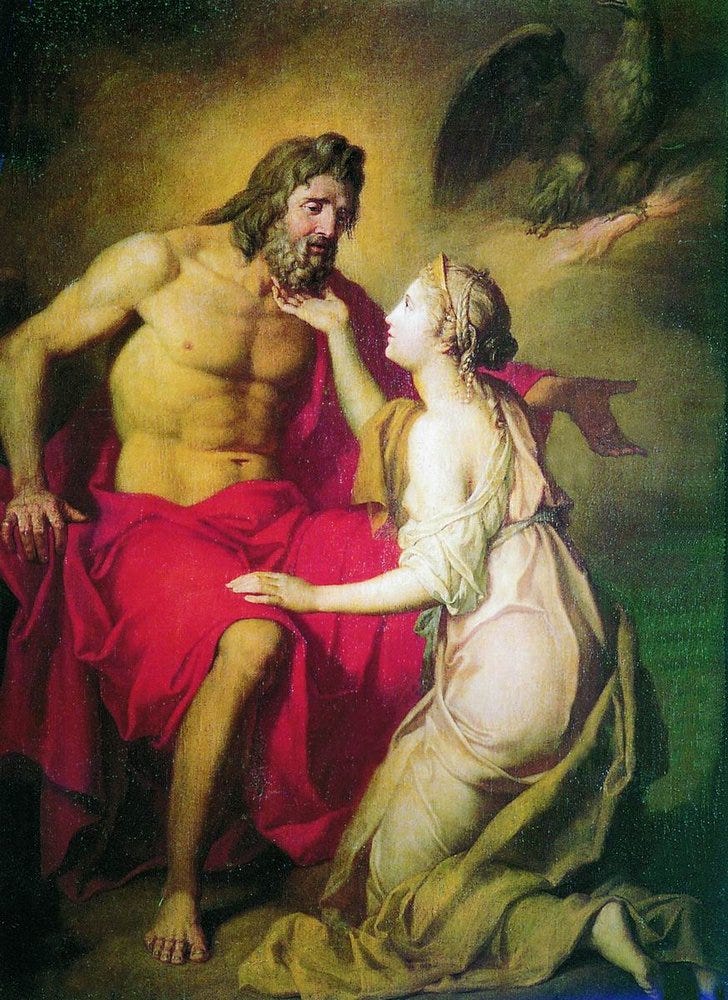
Down she sat beside him,    and seized his knees
With the left of her arms;    lifted her right hand
To cup his chin;    in supplication, spake
To Zeus son of Kronos,    the king of gods:
"O Father Zeus,    if I have favour done thee
"By my words or actions,    in the host of immortals,
"Grant my wish now;    give my son now –
"Who is swiftest-fated –    succour of honour;
"For the host-king dishonours him,    Agamemnon,
"Who has seized his prize    for himself to hold.
"But at least, you honour him,    all-wise Olympian –
"Up to the hour    when the humbled Greeks
"Shall heap him with honours,    help the Trojans –
"Fill them full of force    upon the field of battle!"
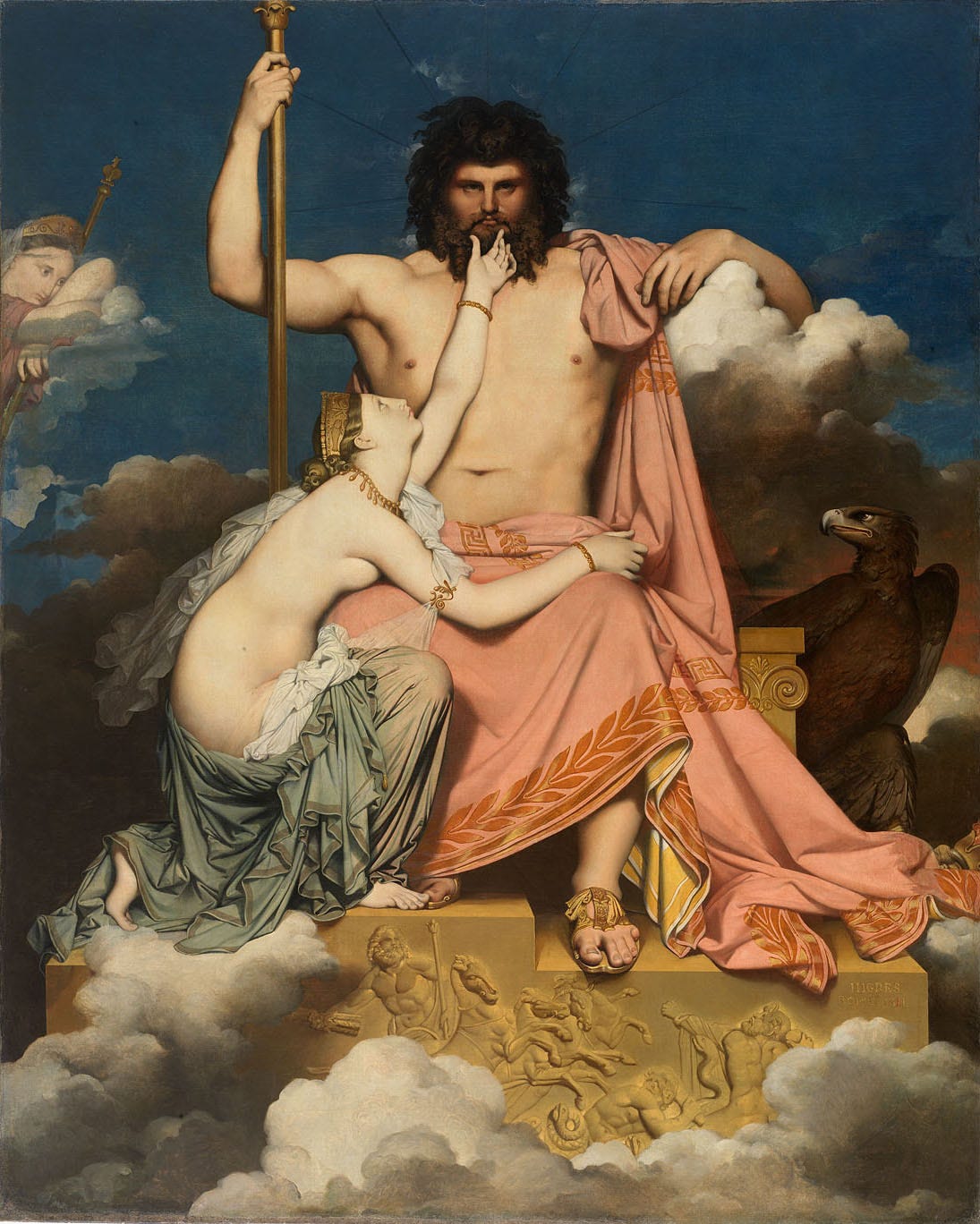

Just so she spake;    but Zeus the cloud-drover
Sat long in silence,    and responded not.
So having taken his knees,    Thetis clasped them;
Clung to him closely;    and requested again:
"Give me sure promise –    an assenting nod –
"Or refuse me fully,    since you fear nothing;
"I shall know full well then    to what degree
"I am the least in honour    midst the host of gods."

And so the cloud-gatherer,    aggrieved in mood,
Now answered thus:    "What you ask of me
"Is a baneful doing;    I shall brunt the odium
"Of Hera, who is ever    stirring up disputes
"With provokeful reproaches –    calls me partial, always,
"With aid to the Ilians,    'midst the host of gods.
"Hasten homeward now,    lest Hera see you;
"Leave your case in my care,    'til I should carry this out;
"And I shall nod my head,    that you may have my surety:
"'For this, from me,    is the mightiest pledge,
"And whatever I nod to    is never found
"To be false, revoked,    or unfulfilled in time."

Thus spake Cronides,    and nodded assent
With his blue-black brows;    the ambrosial locks
Upon his deathless head    swept down in ripples,
And Olympus shook    beneath its sovran lord.
Thetis has thus succeeded in persuading Zeus to grant Achilles’ wish, and set in motion the tragic events of the rest of the Iliad. What remains for us in this first book is to see what Hera has to say about it at the council of the gods.

Notes
In the mists of the morning…
The word ἠέριος (ee’erios) means ‘in the early morning’, but according to LSJ has the second meaning ‘misty’, and it seems likely that the ambiguity is intentional here given that Thetis has already been once described as rising from the sea like mist. A survey of different translations tells me that the allusion to mist is ignored by George Chapman, William Cowper, William Bryant, Richard Lattimore and Robert Fagles, and worked in by Alexander Pope, Robert Fitzgerald and…Emily Wilson.
Who was sat apart from the sundry gods of many-ridged Olympus, on the loftiest peak
The wording in the original is more like ‘was sat apart from the others on the highest peak of many-ridged Olympus’. This epithet may perhaps analogize many peaks or ridges to many gods, or may simply be an accurate description of the mountain.

And seized his knees…
To clasp someone’s knees was the traditional gesture of supplication.
With his blue-black brows
The colour is κῠᾰ́νεος (kuaneos), which is etymologically ‘cyan’, but in Ancient Greek referred to a deep dark blue closer to azurite or lapis lazuli. A more usual translation would be ‘dark’, ‘blackish’ or ‘sable’; but deep-black hair can have a subtly bluish tone, and in any case I think it best not to edit out the peculiar colour perceptions of Homer.