
An Alliterative Iliad (VI)
Achilles seeks help from his sea-goddess mother

In the last installment, Achilles was forced to give up his war-bride Briseis, who was unwillingly led away by Agamemnon’s heralds. He has lost honour, and wants to make Agamemnon pay for it by sitting out the war and allowing the Greeks to be slaughtered by Hector and his Trojans. Since he is the best warrior on the Greek side, he might reasonably expect that his absence from the fighting will have this result.
But in this world, nothing significant happens without the will of the gods, so Achilles cannot truly accomplish his purpose without calling on their aid. Fortunately for him – and unfortunately for the other Greeks – he is the half-divine son of Thetis, a sea-goddess who lives with her many sisters at the bottom of the ocean. As we shall see, Thetis also has the ear of Zeus, due to her having called a hundred-handed giant to his aid when his wife and other gods attempted to bind him.
The story of Thetis’s marriage to Peleus, Achilles’ father, is not told in the Iliad or Odyssey. Like the Judgement of Paris, the Rape of Helen, and several other important events in the background of the story, it belongs to the lost Cypria – the first poem in the longer Epic Cycle that narrated the entire history of the Trojan War, and of which only the two works of Homer survive. These lost poems are much shorter than the Iliad and Odyssey (the Cypria is the longest), their quality was criticized in antiquity, and summaries of their contents suggest that they were written after the Homeric works in order to fill in the gaps. The stories themselves, however, belong to an oral tradition that predated all of this literature.
D.M. Smith’s Cypria – a modern reconstruction of the ‘prequel’ based on eclectic fragments of its traditional story preserved in later works – tells the tale of Thetis’s marriage as it appears in Ovid’s Metamorphoses and Apollodorus’s Bibliotheca. Although Zeus loves Thetis, he will not sleep with her due to a prophecy that the son she bears will surpass his father (the same fear that led him to liquidate his first wife Metis), and instead decides to marry her off to the mortal king Peleus. Thetis does not want to marry below her station, and has to be caught by Peleus first, whereupon she changes into all manner of forms – a bird, a tree, a tigress – before reluctantly submitting after he continues to hold her fast. After they are wed and Achilles is born, Thetis secretly immolates him in the fire every night so as to burn away his mortality; but Peleus discovers her at this work and cries out, whereupon she abandons both him and Achilles and returns to her home in the sea.
Both of these themes are deeply traditional: Thetis’s capture and shapeshifting closely resembles the account of Proteus given in the Odyssey, and her attempting to burn away the mortality of a child before being interrupted by its uncomprehending human parent is paralleled in the Homeric Hymn to Demeter.1
Note that the following verses begin from the second half of a line; as you may recall from the last installment, the first half-line was A woman unwilling (that is, Briseis, who was reluctantly led away from Achilles by Agamemnon’s heralds).
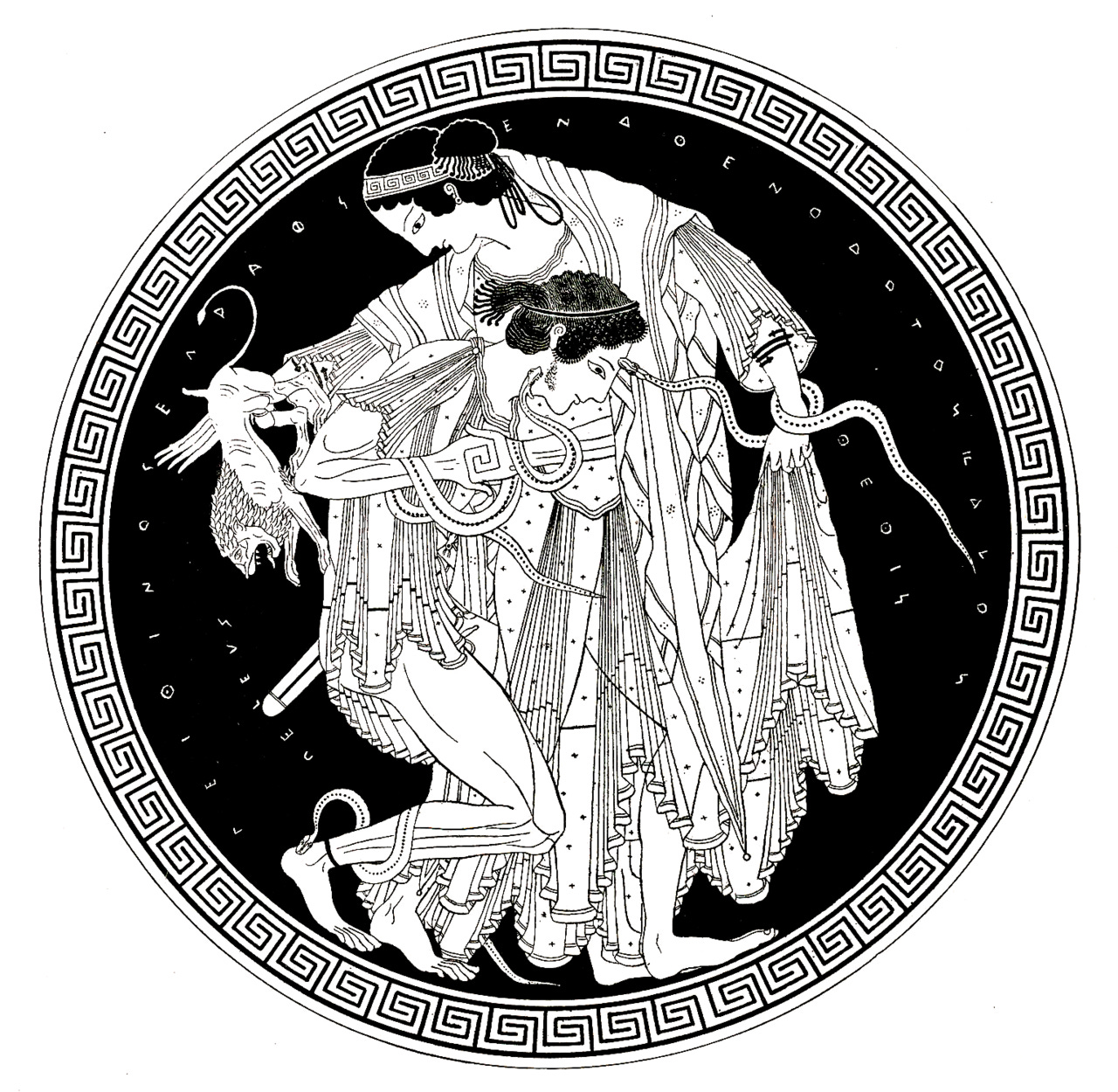

Then went Achilles
Away from his companions,    and wept in sorrow
On the shore of the hoar sea,    staring outward
On the ocean's endlessness.    And as he did so,
He cast his hands forth,    and called in prayer
Upon his dear mother,    with many a word:
"Mother who bore me!    In my minimal time
"I might have looked for some honour    from Olympian Zeus,
"Who thunders on high;    but not a titch he grants me,
"And thus I am dishonoured now    by Agamemnon,
"Who possesses my prize,    having seized her away."

Thus he spake, and wept,    and it went to the lady
Who bides undersea,    in abyssal depths
With her aged father.    From the hoary sea
She ascended swiftly    like a shroud of mist –
And she sat before him    as he shed his tears;
And with her hand she stroked him,    and she spake and named him:

"Why weeps my child?    What has sorrowed you?
"Speak, do not hide it;    share it between us."

Deep-sighing, he spake to her,    swift-foot Achilles:
"Why should I tell you    what you wit and see?
"At the city of Eëtion,    sacred Thebe,
"We struck and we sacked,    and with spoil returned;
"It was distributed fairly;    and the sons of Achaeans
"Chose for Atrides    fair-cheeked Chryseis.
"Then came Chryses, the priest    of Apollo the far-shot,
"To the speedy boats    of the bronze-clad Greeks
"With rich gifts to ransom    his rapted daughter,
"And the laurel garland,    that graced his hand
"Upon the golden sceptre    of farshooting Apollo.
"And he supplicated all    for his enslaved girl,
"In the host of Achaeans;    but chiefly two:
"The sons of Atreus,    highest-commanding.
"The rest of the Achaeans    cried assent then
"To reverence the priest,    and the ransom take;
"But Atrides was displeased,    and repulsed him harshly,
"And sent him on his way    with a stark decree.

"Afterwards, in anger,    the old man prayed –
"And Apollo harkened,    for he held him dear,
"And took at the Argives    a terrible shot.
"The dead fell in droves;    the darts of the god
"Went whizzing all ways    throughout the width of our camp.
"Then a seer explained to us    the Shooter's will:
"It was I who urged,    ahead of the rest,
"The god's appeasement;    but, gripped by anger,
"The son of Atreus,    swiftly rising,
"Spake a threat at me –    and soon fulfilled it.
"For the bright-eyed Achaeans    to Chryse send
"The girl on a swift ship,    with gifts for the Lord;
"But just now the heralds    from my huts have led
"Briseus's daughter,    whom the sons of Achaeans,
"The Grecian host,    to my hand had given.

"But now succour your son,    if you have sway to do so!
"Ascend to Olympus,    with Zeus to plead,
"If by speech or deed    you ever served or gladdened him.
"I frequently heard you,    in my father's hall,
"Exultantly telling    of the time when you,
"Alone among Olympians,    lifted ruin
"From the cloud-murking Thunderer,    Cronus's scion.
"When many immortals    had a mind to bind him –
"Hera, Poseidon,    Spear-Shake Athena –
"You unloosed his bonds,    and to the Olympian heights
"The Hundred-Hander    to his help you called –
"Whom gods call Briareus,     but all mortals
"Know as Aegaeon –    for that giant's strength
"Exceeds his own sire,    [Poseidon Aegaeon.]
"When he sat by Cronides,    in exultant glory,
"He cowed the blessed ones;    they rebelled no more.

"Go clasp him by the knees,    and recount all that,
"So that haply he may help out    the host of Troy –
"And to ship-stern and sea-shore    shove the Greeks back,
"With terrible slaughters;    they may thank their king,
"Wide-ruling Agamemnon –    who shall reck the folly
"Of doing no honour    to the doughtest in arms!"
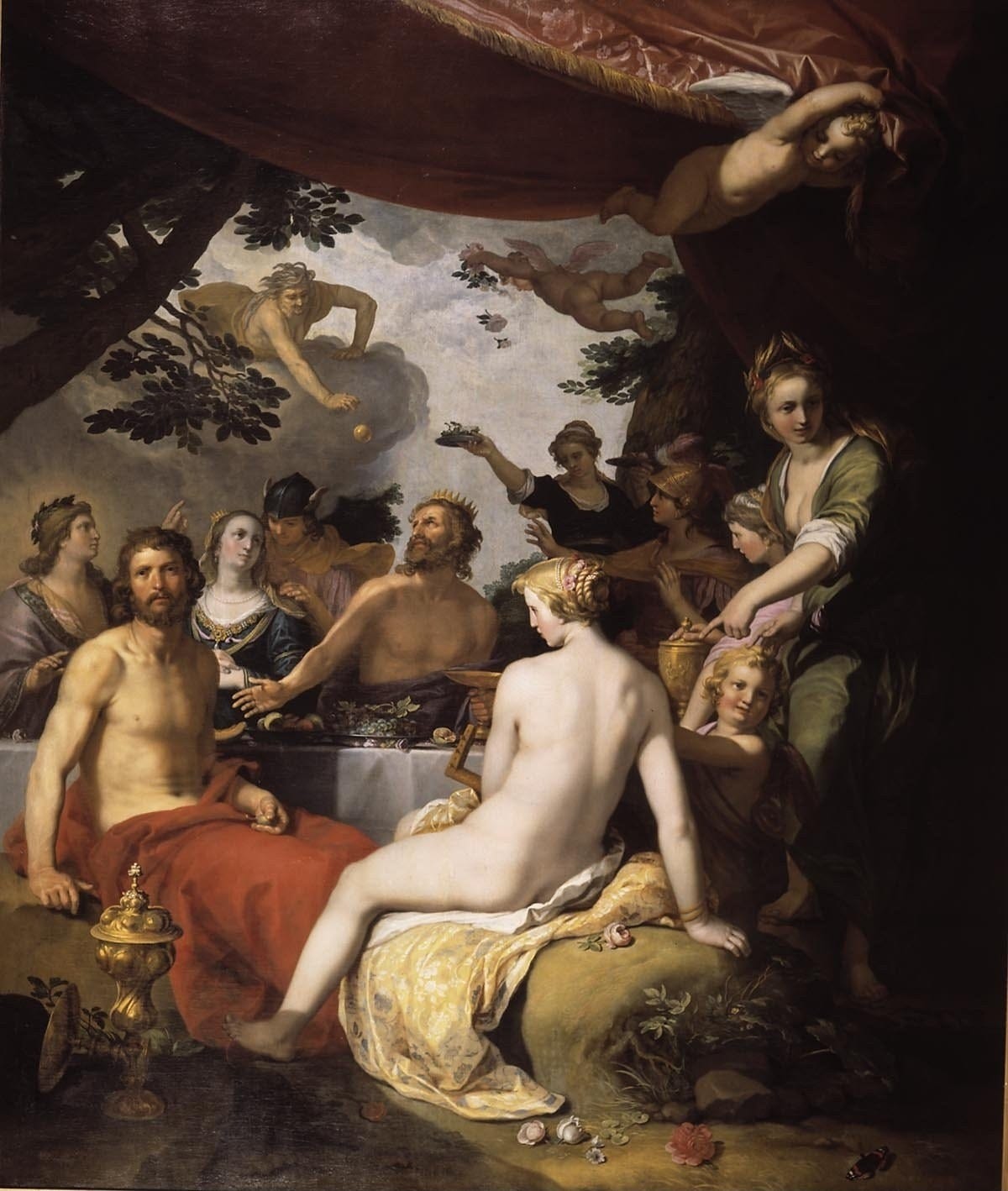

Thetis answered –    there were tears in her eyes –
"O woe, my son –    why did I bear you?
"So bitter-born are you,    bound to sorrow!
"How I wish you could sit    without weep or pain
"By your ships – since your life-lot    is short indeed!
"You are fleet-fated,    and now far exceed
"All others in sadness –    and so, therefore,
"I bore you in the hall    to an evil fate!
"But to thunder-loving Zeus    I will take your suit –
"To snowy Olympus    I myself will go,
"And try to persuade him.     Till that time should come,
"By the ships swift-travelling,    sit continually,
"And rage at the Achaeans,    and quit their war.
"For Zeus has departed    to the circling Ocean,
"With the faultless Ethiopians    a feast to hold,
"Yesterday going –    and the gods all followed.
"Days twelve will pass    ere they return to heaven.
"To his bronze-founded house    I shall hasten then,
"And clasp him by the knees    with cozening prayers,
"In humble entreaty,    and hope he will listen."

So she spoke, and departed    from that place, and left him,
With a heart full of gall    for the well-girdled woman
They had taken unwilling...
While Achilles seethes and waits for Thetis to make her petition, Odysseus is busy returning the daughter of Chryses to her father – as we shall see in the next part.
Notes
In my minimal time…
Alternatively, ‘although mortally doomed’, that is to say of brief lifespan; the original word is μινυνθάδιος (minunthadios).
And she spake and named him
This traditional formula (ἔπος τ᾽ ἔφατ᾽ ἔκ τ᾽ ὀνόμαζε) is not to be taken literally, since Thetis does not actually call Achilles by name. What it seems to mean is rather than she addresses him in an intimate way. But sometimes it is better to preserve the surface meaning of a formula than to distort it by elucidation.
With rich gifts to ransom…with a stark decree
These lines are near-identical to the ones in which Homer directly narrates this scene, and so I have taken care not to change what I wrote in the first part.
Spake a threat at me, and soon fulfilled it
Interestingly, the word for threat in Ancient Greek (ἀπειλή) has more or less the same range of meanings as Old English beot – that is to say, it can mean a threat, a boast or a boastful promise. Accordingly, I have cast this phrase as a formula that can be used in several contexts: spake a [threat/boast/pledge] / [and soon/in sooth/but scarce] fulfilled it.
Whom gods call Briareus, but all mortals know as Aegaeon – for that giant’s strength exceeds his own sire, Poseidon Aegaeon
Here I have not only expanded on the text, but also interpolated the assertion that Poseidon was the father of Briareus and was also called Aegaeon. My reason for this flagrant doctoring is that Achilles’s words – which in the original are simply “whom gods call Briareus, but men Aegaeon, for his strength exceeds that of his father” –would make very little sense without it.
Although Hesiod attributes the parentage of the ‘Hundred-Handers’ (Hekatoncheires) including Briareus to the primordial couple Uranus and Gaea, his divine genealogy differs from that of Homer on several points.2 Although Homer does not name the father of Briareus, according to Wikipedia there is an alternative tradition connecting him with Poseidon, who was also sometimes called Aegaeon; and it is obvious that Briareus could not have cowed Poseidon into obedience to Zeus were he not a good deal stronger than the sea-god. Thus, Achilles’s meaning – and this is the most speculative part – would seem to be that Briareus merits the name Aegaeon in the eyes of men, given that he is more powerful than the other divine claimant to it.
Go clasp him by the knees…
This was the traditional gesture of supplication. Where Thetis refers to it again at the end of her speech, I have expanded on the text a bit so as to make its significance clear.
You are fleet-fated…
In the original language the word ὠκύμορος (ookumoros) ‘swift-dying’ or ‘fleet-fated’ does not much resemble the famous epithet of Achilles, ποδώκης (podookees) ‘swift-footed’ or ‘fleet-footed’3, but the pun is hard to resist in English.
For Zeus has departed to the circling Ocean, with the faultless Ethiopians a feast to hold…
The word ‘circling’ is not in the original, which simply says that Zeus has gone to Ocean; but in order to make sense of this statement, we must recall to mind the archaic conception of the earth as a flat area encircled by the ocean.4 With regards to the Aetheopians (literally ‘burntfaces’), Homer understood them to be a race divided in two and located at the ends of the earth: some in the east at the sun’s rising and some in the west at its setting. When gods in the Iliad or Odyssey go to visit them, they depart from their usual roles and can neither help nor hinder the rest of humanity.
Incidentally, one of the lost Epic Cycle poems is called the Aethiopis, and deals with the events following the conclusion of the Iliad (when, SPOILER WARNING, Achilles kills Hector and drags him behind his chariot). In this tale, two allies of the Trojan king Priam come to help him against the Greeks, and are eventually both killed by Achilles: the Amazon queen Penthesileia and the Ethiopian king Memnon. Soon after slaying Memnon, Achilles pursues the Trojans to the gates of Troy, where he is fatally shot by Hector’s unvaliant brother Paris.
The account of Thetis’s dipping Achilles in the River Styx, making his body invulnerable apart from his heel, is from a later tradition; nothing in Homer can be taken as indicating that Achilles is impervious to the bite of weapons.
For example, Hesiod attributes the birth of Aphrodite to the severed and sea-immersed genitals of Uranus, whereas Homer presents her as the daughter of Zeus and Dione.
As a matter of fact it more closely resembles ὠκύπορος (ookuporos) ‘swift-travelling’, ‘fleet-passing’, an epithet of the Greek ships, which are always described as swift despite the fact that they sit idle at anchor throughout the poem.
This is also reflected in the Germanic conception of the earth as a ‘middle-garth’, called middangeard in Old English (and encircled by the garsecg, or ocean, a word that may also reflect the traditional cosmology).