
Barren Salt
Why the online right deserves Wilson and Nolan's woke Odyssey

Lately half the online right has been raging about Christopher Nolan’s upcoming Odyssey, which has a blackwashed and transgendered cast as well as a modern tone and a ‘defy the gods’ ethos quite foreign to the original poem. The main reason for the backlash is that Nolan is screwing with the foundations of Western literature, but I would say that there are some other contributing elements to it.
One is that this film is so obviously, unabashedly woke. The right happens to have spent the last year or so telling itself that woke is dead, and almost superstitiously referring to it in the past tense, because Trump’s second election win is supposed to have caused a rightward ‘vibe shift’ that has allowed society and culture to move on. This of course was a delusion, because woke is just one of many names for the folkways and caste taboos of the modern ruling class, which has suffered no loss of power or institutional authority in the last ten years of Trump’s ranting and bumbling in and out of office. But the bold truth-tellers of the right don’t like it when you hurt their feelings by pointing out the facts, so everyone agreed to believe in the magic cultural effects of ceremonial elections and now the delusion bubble is being popped.
What makes this worse is that the needle is being wielded by Nolan, whose previous work has long been suspected of lickspittle reactionary themes. Of course we have no way of knowing whether such themes will be absent from this film, other than to watch it (and I for one am not going to bother, unless someone makes a good case for its being more interesting than it looks); but if the ‘last Tory’ has indeed gone woke, then perhaps the magic election spell was not so much useless as counterproductive. That is to say, perhaps woke has not just survived the second coming of Trump but been vindicated by comparison, like a nasty-looking girl who gets the chance to bask in the shadow of an outrageously grotesque one.
Lastly, there may or may not be a subtler feeling of self-admonition quietly nagging at the right. I was curious to see whether I could catch any inkling of this in the commentary of the ‘hardcore’ dissident right, as opposed to the usual anti-woke film critics ranting away on Youtube. So I decided to check out a podcast by Auron MacIntyre (who surely ranks as high as Neema Parvini in the pantheon of dissident right elite theorists) entitled “Why Christopher Nolan’s ‘Odyssey’ Had to Go Woke”.
Alas, I can’t recommend this to anyone who values their time, except as a work of almost surreal unintended comedy.
Within the first five minutes, MacIntyre’s guest offers the one and only comment on the Odyssey: that Odysseus is a ‘strong Type A male’, ‘even a toxic male’, on a quest to get back to his wife and child and restore his homeland to law 'n' order. The host more or less repeats this take in his own words, and from this point on the conversation digresses into an almost hour-long ramble around every subject but the Odyssey: the Hegelian Dialectic, the Sovereign Individual, the American Constitution, the Free Market, the Epstein Files, the Muslims, the Banking Cabal, the Fractional Reserve System, and of course the heckin' Transnational Globalist Elites (who are probably eating their catamites with a nice Chianti even as I write this post). At the end the host says these words (and I quote): “I know we didn’t stay on the actual topic of Christopher Nolan very long, but I think we had a much more interesting discussion.”
So he spake – and dropped this podcast into the dissident right ecosystem, presumably thinking such things as this is fine and I’m okay with the title and contents of this podcast. And to judge from the comments on the Youtube version, almost none of his audience complained about the lack of attention to the topic (although some had concerns about the ideological purity of the guest).
Now, dear reader, I am well aware that not every commentator on the right is like this. But we cannot hope to diagnose an affliction by looking away from those worst affected by its symptoms; and the fact that some on the right cannot be bothered even to talk about the Odyssey for five minutes, without digressing into their tedious political obsessions for fifty, should tell us that there is some plague in the host of Western Civ’s self-appointed defenders. Ironically, unintentionally, and precisely because of its contempt for its topic, MacIntyre’s podcast succeeds in answering the question posed by its title.
Why, then, did Nolan’s Odyssey have to go woke? There are of course all sorts of reasons – institutional and financial and political – why it might have been swayed in the direction of woke. But to the question of why it had to go woke – inevitably, as a foregone conclusion, even with a conservative director not afraid to be witchsmelled by slimy journos – there can be only one answer, and this is that it was a ‘win by default’. The cultural conquest of Homer by the woke side, now set to be fortified by a $300-million-dollar movie, was not at all contested by the side now crying a barren sea of salt over the desecration of Our Sacred Heritage.
That conquest began almost a decade ago, on the humbler ground of the printed page, having been prepared for years beforehand by a single woman labouring in relative obscurity over thousands of lines of ancient Greek. I refer of course to Emily Wilson and her bestselling 2017 translation of the Odyssey – followed in 2023 by a translation of the Iliad – which has been namechecked by Nolan and seems to have inspired the modernizing bent of his movie. Wilson, as we’ll see, is primarily a feminist, and more interested in tarring Homer’s men than in blackwashing his women – which leads us to imagine that the worst travesties in Nolan’s film are to be found in the script, not the casting. (From the perspective of the original poem, though, it would be harder to find a worse travesty than ‘defy the gods’, which does not come from Wilson.)
By no means has Wilson pursued this literary campaign alone, nor has participation been limited to scholars of ancient Greek. Other feminist takes on the Homeric matter, retellings rather than translations, have been coming out at a steady drip both before and after the publication of Wilson’s translations: these include Margaret Atwood’s Penelopiad (2005), Madeleine Miller’s Song of Achilles (2011) and Circe (2018), and Pat Barker’s Silence of the Girls (2018) and Women of Troy (2021). Evidently what we have here is a full-blown literary movement, of which Wilson’s translations are only the most serious and authoritative component.
That may be a low bar to clear. I am no scholar of ancient Greek; but Jireh Gardo and Richard Whitaker are, and by their accounts, Wilson’s work is marred by elementary blunders and infelicities as well as deliberate and malicious ideological distortions. Her apparent agenda in the Odyssey is to exaggerate the wrongdoings of the hero (in her own words a “liar, pirate, colonizer, deceiver and thief”), to play devil’s advocate for the suitors and traitorous servants who are destroying his property, to portray monsters like Polyphemus the Cyclops as noble savages (a notable tendency in Beowulf revisionism as well, and one that says much more about the moderns than the ancients), and to translate every menial role from houseboy to herald as ‘slave’ so as to evoke the clank of chains and crack of whips in 18th-century cotton plantations whenever any such character comes onstage. As for her Iliad (reviewed negatively here and here), much of it is rendered in such a way as to reduce the wrath of Achilles and the death-struggle of heroes to a fight between overgrown children – making, ironically, a strong case for the proposition that women ought to leave epic poetry to men and confine their own storytelling efforts to the nursery.
You are of course free to hold a higher (or a lower) opinion of these works than I do. Either way, the ‘mode of operation’ is instructive: a scholar conquers the high ground by re-translating (and, inevitably, reinterpreting) a revered ancient work in a dead language, while lesser writers fan out in support with imaginative retellings and reinterpretations that are in turn justified and supported by the central effort. The analogy of conquest makes it all sound very nefarious, but this is simply how a modern-antiquarian cultural movement gets going: it must reclaim the sacred ground of the old, which has authority, and at the same time populate it with the productions of the new, which have vitality.
There are also inner benefits to this process that have nothing to do with influencing the wider culture. One might say that the problem with Wilson’s approach to Homer, as well as that of Atwood, Miller and Barker, is that she hates everything that he stood for and considered to be right. But, as is so often said, hatred is not the opposite of love. Someone who drips with spite and resentment towards an ancient literary work is still better able to appreciate it than someone who regards it with indifference – even if this be reverent indifference.
And this brings us to the other side in this rather one-sided ‘culture war’.
The online right existed inchoately during the 2000s, coalesced into the ‘alt-right’ around 2010, and has called itself the ‘dissident right’ for the past decade or so. What has it been doing over that past decade while the feminists have conquered Homer? Has anyone been toiling (sorry, slaving) like Emily Wilson over thousands of lines of Greek, working to create neo-traditionalist translations of the Iliad and Odyssey? Or breathing new life into Homeric stories by reimagining and retelling them?
I think we all know the answers to these questions.
To speak in collective terms, with all due exceptions for individuals, the fact is that Der Ewige Chud has spent the past decade taking the most powerful engine of intellectual edification and cultural propagation ever devised – that is to say, the internet – and using it to influence, analyse or simply obsess over the closed shop of official politics and activism. In short, as far as we are concerned, he has done nothing. And now he belatedly emerges from his political gooncave and wants to rant and rave because it is Emily Wilson’s something, and not his nothing, that Christopher Nolan has decided to incorporate into his movie.
I exaggerate, of course. I myself would not be bothering with the online right, even to critique it from within, were it not for the efforts of dissident publishers like Passage Press and Imperium Press to draw some of its energy out of the politics-and-culture-war wanksock. Imperium evidently cares enough about traditional poems and stories to have re-released a bunch of them under the series title of ‘Western Canon’, which it introduces as follows:
The Western Canon’s value is self-evident. Its status, however, has been under threat since the middle of the 20th century. Feminists, Marxists, intersectionalists, and others deny the Canon’s existence by refusing to observe its traditional boundaries, throwing the borders open to invite all manner of second- and third-rate material. They intentionally misread the Canon, deconstructing it and looking for incoherence where men have only ever found genius.
Imperium Press’ Western Canon series reclaims the Canon from the forces hostile to it. The series offers not only definitive versions of these works, but also supplementary material placing them at the centre of our aesthetic, intellectual, and spiritual life—where they belong.
These books, however, are just reprints of older translations that have passed into the public domain, such as W.C. Bryant’s Iliad and Odyssey and Francis Gummere’s Beowulf. Unlike some, I wouldn’t disparage these choices; but if one side has been moved by a spirit of ‘misreading’ and ‘deconstruction’ to produce original translations and retellings of this canon (however flawed), while the other has been held back by its reverence from attempting the same task, then it is not hard to foresee which side will be doing the ‘reclaiming’. Unless you are going to build your life and society around a fixed text (something that Anglos have only really achieved with the Bible), the effect of freezing it in stasis can only be to make it an object of indifference.
We see the same reliance on old translations in this comparison chart of four translations of the first few lines of the Odyssey (apparently first posted on 4chan’s /lit/ board), which might just stand as the most effort made by a based reactionary chud to forestall Wilson’s conquest of Homer:
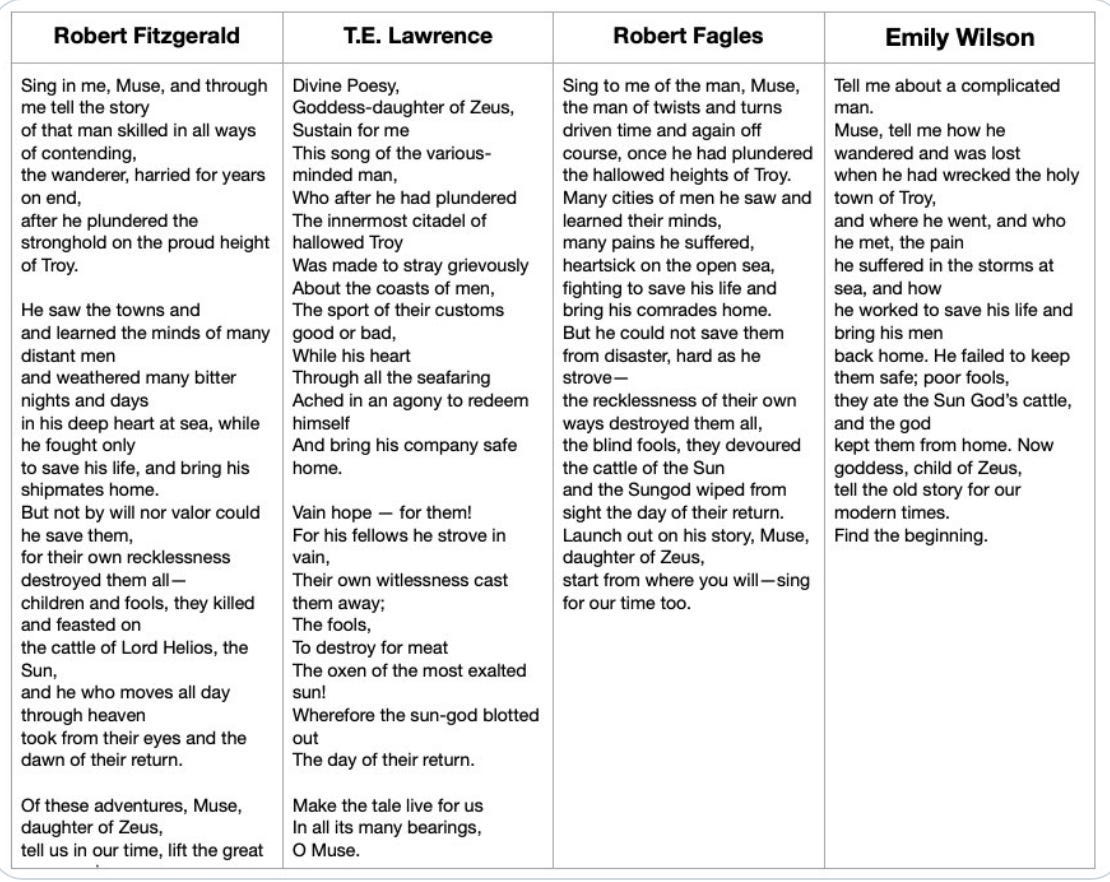
Alas, this too failed to shift the vibe, and there are at least some good reasons for this.
What we notice first is the bland modernism of Wilson’s language, and the extent to which she has stripped down the content of the original lines. The other four are in a higher register, with more epic grandeur and literal fidelity, and less excised content. They also condemn the sacrilege of Odysseus’s men more strongly than Odysseus’s own failure to save them, whereas Wilson reverses this; if you’ve looked at the original lines (click on the words to bring up dictionary definitions, or save yourself some bother by getting Grok to do it), you’ll notice that Wilson has cut out Homer’s charge of atasthalia ‘criminal folly’ against the devourers of the sun-god’s cattle.
Look again, though, and you’ll notice other things. For one, Wilson is the only one so much as trying to write in regular metre – something with which most 20th-century Homer translators, including the highly-regarded Richmond Lattimore, preferred not to bother themselves. Apparently vile vers libre is now in the rearguard of poetic reaction. Well, online rightists have certainly coped themselves into stranger alliances.
Another thing you notice is that the Greek word polytropos (lit. ‘many-turned’, both ‘much-travelled’ and ‘variously-shifty’; perhaps ‘multifarious’, ‘recourseful’) is causing some of the translators real problems. Fagles’ ‘man of twists and turns’ is quite good, I think, apart from its lack of formulaic versatility, but I cannot say the same for Lawrence’s ‘various-minded man’ or Fitzgerald’s ‘skilled in all ways of contending’. Wilson’s ‘complicated’ might just stand as the best solution of the four, at least were it not for the suspicion that what she really wanted to write was ‘problematic’.
What of the Iliad? As I’ve mentioned, I’m no scholar of Greek; but I did once work through the original text of the first book of the Iliad, in order to produce an experimental translation in Old English-style verse, and what drove me to this painstaking labour (from an initial intention to do no more than rework a 19th-century translation with reference to a couple of 20th-century ones) was my realization that the fidelity of all translations is traced in sand. The literalist repute of Lattimore, for example, does not survive the first few lines of his Iliad, in which he describes the bodies of men as being given to the delicate feasting of dogs and birds – conjuring this turn of phrase from somewhere quite other than the original text, and for some unknown poetic purpose, since the word delicate hardly helps us to conjure the image of hungry crows and curs ripping bodies apart on a battlefield.1
John Prendergast, an independent and apparently autodidactic translator of Homer, has written a critical comparison of Iliad translations that mostly covers those written from the mid-20th century to the present day. Although some of his points strike me as pedantic, eccentric or just incorrect2 (for example, Lattimore’s word groundling is not a noun any more than is sideling, better known as sidelong), he uncovers enough bungled words, botched similes and silly interpolations to banish the illusion that Homer was being translated just fine until Wilson came along. As a matter of fact, his criticism falls quite lightly on Wilson, who is praised for avoiding certain errors made by translators of the last century.
Nor should we look for a Golden Era in pre-20th century translations. The earliest ones made in the 17th and 18th centuries (Chapman and Pope) are great artistic works of their own time, but are also rhymey, ornate and brazenly unfaithful. Some of the 19th-century ones (Bryant more than Cowper) can perhaps be said to occupy a nice middle ground of metricality, simplicity and relative accuracy, but these still belong to a poetically-decadent era and also predate some important scholarship. The most important modern scholarly contribution to the study of these poems is of course Milman Parry’s oral-formulaic theory, which dates to the 1920s-30s, prior to which translators used to go out of their way to vary Homer’s formulaic repetitions (although Wilson does the same thing and in this respect is very much a ‘regressive’).
To sum up, while older translations may not be warped by leftist ideology, they do not constitute some perfect mirror of Homer and there is still much room to improve upon them. And, as we have seen, there is much room to improve upon Wilson as well. So is there any good reason why some man of the true right should not take a shot at the crown – and, perhaps, start a Homerically-inspired cultural movement in the opposite direction? It would be a tall order, no doubt; but it only takes one of us to do it, a few others to follow his (or her?) lead, and the rest of us to care enough about it that the others do not give up for lack of an audience.
As far as I can see, there are both good and bad reasons why such a thing has not yet been attempted.
First, the bad. Looking at the ‘resistance strategy’ to Wilson over the last decade, encapsulated above all by that comparison chart, I cannot resist the observation that it bears much resemblance to the mode of operation in right-wing politics. The ‘progressive’ position is mocked and criticized; the avant-gardists of a generation ago are rebranded as ‘conservative’ and relied upon to hold the fort against it; and nothing whatsoever is done in the way of positive, constructive action. Much as a man who becomes addicted to porn often ends up wrecking his attraction to flesh-and-blood women, the right seems to have imported its political learned helplessness into a field where dissidents have much more potential agency.
The difference between the two fields is this. Politics is subject to the law of power and violence, and the liberal state has an effective monopoly on violence that it waives (as per Moldbug) in favour of the ‘left-wing’ actors that serve to increase its power. Dissidents talk about ‘fighting the left’, but cannot actually play the game of politics as the liberal state and its partisans do, i.e. by expropriating the property and rights of their foes and redistributing them as benefits and privileges to their friends. What dissidents are allowed to do is to line up (a long way behind organized business interests and foreign state lobbies) in support of the ‘right-wing’ protection racket, which exists to limit the expropriation demands in the interests of the state – and, of course, to cope themselves into thinking that this amounts to doing something.
Where dissidents have had success is in the realm of truth and of the authority that comes from its recognition. This realm is also subject to the law of violence and power, but only partly (which is why, for example, the Christians of late antiquity did not have to take over the Roman state by armed force); and in the modern state, the main ‘hard’ constraint on it is an academy-media monopoly on information that has been practically dismantled by the internet.3 It has almost never been easier for outsiders to access scholarship, promote work, publish books and so on; and so dissident truths and ideas, a category to which arts and high culture also belong, can conquer in a way that rightist political actors cannot. Nonetheless they continue to be restrained by the right’s insistence on treating its truth struggle as a handmaid – nay, a slave – of its chronically-failed power struggle, and on polluting the healthy potential of the former with all the decrepit habits of the latter.
This brings us to another obvious objection. In case you were wondering, I am well aware that Wilson and her comrades have played the game of cultural conquest on easy mode, with every institutional helping hand thrust in their direction. Neo-traditionalist translations and retellings from dissident publishers would have met with a different reception: most likely, they would have been ignored, and every effort would have been made to tarnish their names had they garnered a following anyway. And most likely we would still have got a woke Odyssey movie based on the officially-approved translation and cultural movement.
Probably best not to bother, then?
As the Bhagavad-Gita says, thou hast the right to work but not to the fruits of work – and those fruits that do come from work can be subtler than expected. No-one expects online dissidents to start making movies (do not even breathe the word ‘AI’ at me); but a neo-traditionalist movement capable of producing its own culture would have far less reason to care about the contents of the latest movie. (Conversely, one that remains incapable of doing so should probably learn to take what slop is doled out to it and stop sassing the hand that feeds it, for there is no injustice in the principle that subjection comes with dependency.)
The immediate problem is not the enmity of the media, which should be taken for granted, but the indifference (reverent or otherwise) of our own people. It must be said that most people on the dissident right don’t care very much about Homer, Beowulf or traditional poetry in general, and I am certainly not about to try to nag them into caring more than they do. It’s fine not to care for these works, it’s fine to read them once and be done with it, and it’s fine to care about them to some degree while being focused on other things (including political theory).4 What concerns me is that traditional poetry is one of many worthwhile things that some people on the right could be doing, were it not for the morbid desperation that compels them to try to achieve their goals through conservative politics. Again like men addicted to porn, such people must turn away from the slop cycle so as to be able to feel the attractive pull of their true calling, whatever it might be.
One good reason for leaving them where they are is that no-one wants to see two hordes of ideological bugpeople swarming all over the Homeric matter, vomiting their modern obsessions onto it and reducing it to political content. But when we imagine what sort of distortions might result from this,5 we realize that they could only emanate from someone who has not sincerely forsaken right-wing politics. Ideally, one who had the talents and determination to attempt what I am suggesting would not be of this type; he would instead have passed through the dissident right as a sort of via negativa, remaining trapped on no ideological islet, but losing every one of his convictions in the essential justice and righteousness of the modern liberal state. A dissident of this kind would be better placed to approach ancient works on their own terms than any other modern man or woman of any other political or apolitical bent.
Even failing that, though, I doubt that ‘woke’ distortions and projections would simply be replaced by ‘based’ ones, because the dominant tendency of people on the right is towards the opposite vice: an excessive, self-paralyzing reverence for fixed texts. And here we come to a reason for our cultural sterility that has nothing to do with indifference to traditional poetry or political porn addiction.
In fandoms devoted to literary works, a division has been observed between ‘affirmational’ and ‘transformational’ fans, which respectively skew male and female. The typical affirmational fan of (say) Tolkien’s work learns the lore of Middle-Earth in detail, perhaps speculates and argues about it, but is much too reverent to presume to add anything to it himself. The transformational fan is more interested in using the work as a basis for her own creative efforts, some of which could not be more irreverent (e.g. queer Hobbit porn). The problem with the transformational fan is that she carelessly projects her own preoccupations onto the work, without having brought herself into a state of harmony with it; but the problem with the affirmational fan is that he spends an inordinate amount of time and effort internalizing the work, only to bring forth nothing original from it.
Without shifting the artistic context to a political one, it strikes me that the words ‘affirmational’ and ‘transformational’ can be taken as more or less equivalent to conservative and progressive. It is also perhaps easier to see in the artistic context what the dissident right has long forgotten in the political one, which is that both are wrong. Progressivism is rot, but conservatism is the death that ushers it in, and neither is to be identified with the healthy and normal growth of tradition.6
Although the oral tradition of archaic Greece is long gone, medieval and post-medieval Englishmen (notably Chaucer and Shakespeare) were quite capable of adding new matter to the literary tradition. Nowadays this sort of thing seems to be done only by feminists and other progressives, and it is worth reminding ourselves that some of the feminist retellings of Homer (Atwood’s Penelopiad and Miller’s Song of Achilles) came out years before Wilson’s translations and probably inspired or encouraged their writing. Wilson, then, essentially belongs to a transformational literary movement, and her flawed fidelity to Homer can be understood as a (perhaps rather grudging) concession to the affirmational medium of translation. To critique her work or even to try to surpass it is to miss the point, which is that the movement to which she belongs is the most vital thing left in the post-classical Homeric tradition (just as rot is the most vital thing left in a dead body).
All the same, we have emphasized translation for good reason, because we cannot expect to wash away the barrenness of conservatism overnight. The ‘cure’ for aspiring traditionalists must be gradual, and comes as I envisage it in three stages: first to reclaim the old matter through translation, then to retell it through poetic recomposition, and finally to breathe new life into it by original expansion.7 This, at least, is the basic mode of operation by which I have approached Beowulf and the handful of other surviving heroic poems from Anglo-Saxon England. And although I must say yet again that Homer is well out of my reach, anyone who can claim otherwise is more than welcome to make analogical use of any of the ideas outlined at this blog.
After writing this, I briefly reinvestigated this and found a learned forum discussion on the subject, which explains that Lattimore’s ‘delicate feasting of dogs, all birds’ was a hedging of bets between the orthodox reading ‘all birds’ and a perhaps more dubious but also more aesthetic reading ‘banquet of birds’. In my view he should have just plumped for the latter.
It must also be noted that Prendergast’s own Iliad, available from Amazon, is so hyper-literalist (to the point of reproducing ancient Greek word order in English) that it cannot serve as much more than a handy crib. It begins as follows:
The wrath sing of, Goddess, of the son of Peleus, Achilles,
ruinous, it upon Achaeans countless pains put…
I am by no means allergic to syntactical inversions and other features of poetry that mark it out from normal speech, but English is not an inflected language and simply cannot survive this sort of twisting.
Since the creation and introduction of the internet was quintessentially ‘top-down’, this amounts to saying that the state itself dismantled its information monopoly (and then became too dependent on the internet to reverse this), apparently partly because it was thought that this would not only help to subvert foreign states but also make Western society more democratist by empowering those excluded from mainstream society. The result, which could only have been predicted by someone immune to democratist ideology, was the empowerment of Der Ewige Chud – the true political minority and scapegoat of the democratist state – who should not, however, imagine that this new media infrastructure will never develop immunity to the bacillus of his online presence. Read the wind, my frens, and make good use of what is available to you before it is taken away.
Just don’t look surprised, of course, when those who choose to engage with these works more seriously end up becoming the first authority on them (even for the Last Tory in Hollywood). I must say that the usual conservative bromides on this subject – that Our Sacred Cultural Heritage stands at the foundations of Our Unique Western Civilization, that the oral tradition of ancient Greece is somehow baked into the DNA of The White Race, or any other such variant on the theme – can only induce complacency and reverent indifference, and ought to be replaced by a healthy sense of insecurity. The fact is that as far as Anglos and other Northern Europeans are concerned, Greek and Roman culture has always been a learned borrowing, part of the classical inheritance of Christendom; and now that Christendom has been usurped, its territory expanded and its civilizational structure inherited by Antichristendom, the continued transmission of that culture is at its sufferance, and was always going to end up being refracted through its weird incipient pseudoreligion of the Great Murther-Goddess, the Suffering African and the Will of the Global Majority. And if we cannot rely upon those who survive in the churches and seminaries of this pseudoreligion by affecting a pose of neutrality to hand down what is now the ‘minority report’ on this tradition, what is there to do but to take up the task ourselves?
One might, for example, imagine ‘masculist’ interpretations that replace Pat Barker’s huffing and puffing over the sex-slavery of female war captives like Briseis and Chryseis with much seething over the fact that they were treated so much better than their massacred male relatives.
By no means do I use the example of Tolkien’s fandom arbitrarily. Many on the right are affirmational fans of the Don, and as such well aware that his work has recently been travested by Amazon in a ‘woke’ adaptation called The Rings of Power. Not being transformational fans, they are less aware that the Tolkien Estate has long taken a very negative view towards unauthorized sequels and additions to this work (even forbidding mere fanfiction, albeit only in theory), while nonetheless being willing to sell the rights to anyone who offers them enough money. I do not know whether any works of value were suppressed or discouraged by this refusal to allow anyone to continue the literary tradition that Tolkien started; but in any case, what we see here is a type of conservatism that suppresses respectful traditionalism while allowing itself to be bribed into submission by destructive progressivism, and this has an obvious analogue in the realm of politics.
There is another side to this, which is to internalize not only the language but also the conceptual world of archaic traditional poetry (with its gods, heroes, narrative themes and so on) and reproject it by analogy onto the realities of the modern world. This could be called a kind of ‘serious parody’ or ‘anti-larping’, and is quite the reverse of the projection of modern themes onto ancient matter. It is, however, the sort of thing that ought rather to be shown than told.
This is not so germane to the main point, but I think it's probably not true that the Odyssey movie shows the persistence of Woke or the illusory nature of the vibe shift. It appears to be genuinely very unpopular and will likely lose money. The same happened with the SuperGirl movie recently, while indie horror films that are perceived as non-woke or even anti-woke at some level are making >100 ROI. People really don't like the race swapping that goes beyond the bounds of plausible suspension of disbelief, nor female superheroes if they have unpleasant personalities, and they don't like ironizing of hero narratives if it's too heavy handed.
1990s Bill Clinton liberalism commands huge popular support; people really want it despite the inability of elite or MHC factions to organise around it.
>Another thing you notice is that the Greek word polytropos (lit. ‘many-turned’, both ‘much-travelled’ and ‘variously-shifty’; perhaps ‘multifarious’, ‘recourseful’) is causing some of the translators real problems. Fagles’ ‘man of twists and turns’ is quite good, I think, apart from its lack of formulaic versatility, but I cannot say the same for Lawrence’s ‘various-minded man’ or Fitzgerald’s ‘skilled in all ways of contending’. Wilson’s ‘complicated’ might just stand as the best solution of the four
A straightforward option in german is "vielseitig". Its typical english translation (used in that very paragraph) is "versatile". This even has the right etymology, but its not transparent to most people. I think these two work well if they are transparent - they normally apply to tools, and have a definite user-perspective to them, but using them on a person would move out of that and to a more literal sense. You could capture that literal sense in english directly with "multifaceted" (pretentious) or "many-sided" (archaic feel, but Im sure Ive read it before).
(I found poly- as a common paradigm interesting. I wonder if Saruman first was polychromos in Tolkiens mind.)