
Grendel's Short Shrift
Does the Beowulf text contain a reference to double predestination?

There are sidetracks in life, and there are points at which one can only advance on a narrow and oblique track. When I set out to restore traditional forms of poetry, I had in mind something a lot more radical than the writing of a book, let alone yet another translation of the much-translated Beowulf. But the path to the end goal led through this text, and having spent a great deal of energy in trying to understand it, I may as well finish what I have started and write up my understanding of it before moving on. Only let the work be done sooner rather than later.
By ‘sooner’ I mean, day over lent tea, the end of this year. I mention this by way of warning to my readers that I may be writing rather a lot about this one poem during this time. Be assured that the specialization is only temporary.
Of course Beowulf would hardly be worth writing about were it not connected to all sorts of wider and higher things, such as oral poetry, Germanic legend and Christian tradition. Conversely, it is only in the light of all these that the poem can be interpreted. But it is easier to concoct vague theories about Beowulf on the basis of everything surrounding it than to start by penetrating the harder ground of the text itself, and I forbear to do things the easy way. Although I do not have the expertise on the Old English language or the discipline of philology that I would like to have, I have learned what I can and studied the text closely with the aid of several scholarly editions, and I have my reservations about some of the prevailing theories. Some of these are probably wrong, but that is all the more reason to post them on this blog, since any pushback can only lead to my making fewer blunders in the finished book.
Let me pick an example that demonstrates the natural progression from text to wider context. One thing about Beowulf that has fascinated many, and which encapsulates its marriage of Germanic and Biblical tradition, is that it traces the descent of the ogres or giants known in Old English as eotenas and in Old Norse as jǫtnar (i.e. ettins, jotunns) to the figure of Cain in Genesis. The ogres, elves and other supernatural entities are members of ‘Cain’s kin’ or ‘Cain’s race’ (Caines cynn), doomed to roam the wilderness and live at odds with humanity due to the original exile of their forefather.
The poem establishes this background story in its first ‘fitt’ or chapter, which introduces King Hrothgar of Denmark and his ogrish antagonist Grendel. We shall start by excerpting the relevant lines from the text, along with a fairly close translation that follows the conventional understanding. Then we shall take a look at what may or may not be wrong with both.
Wæs se grimma gæst    Grendel haten
(This grim ghastly spirit    was Grendel hight;)

mære mearcstapa,    se þe moras heold
(A rank border-crosser    ruling the moorlands,)

fen ond fæsten.    Fifelcynnes eard
(The fen and fastness.    That fief of monsters)

wonsæli wer    weardode hwile
(He had haunted awhile,    a wight unblest,)

siþðan him Scyppend    forscrifen hæfde
(After the Creator    had erst condemned him)

in Caines cynne.    Þone cwealm gewræc
(Midst the kin of Cain – whose killing of Abel)

ece Drihten,    þæs þe he Abel slog.
(Was punished thus    by the Eternal Lord.)

Ne gefeah he þære fæhðe,    ac He hine feor forwræc
(He frowned on the bloodshed;    far did the Measurer)

Metod, for þy mane,    mancynne fram.
(Banish the murderer    from the brood of men.)

Þanon untydras    ealle onwocon
(And there woke from his seed    all those wicked offspring:)

eotenas ond ylfe    ond orcneas
(The ogres, the elves,    the Orcus-corpses;)

swylce gigantas,    þa wið Gode wunnon
(And suchwise the giants    who with God contended)

lange þrage.    He him ðæs lean forgeald.
(For a lengthy while –    til their reward He gave them.)
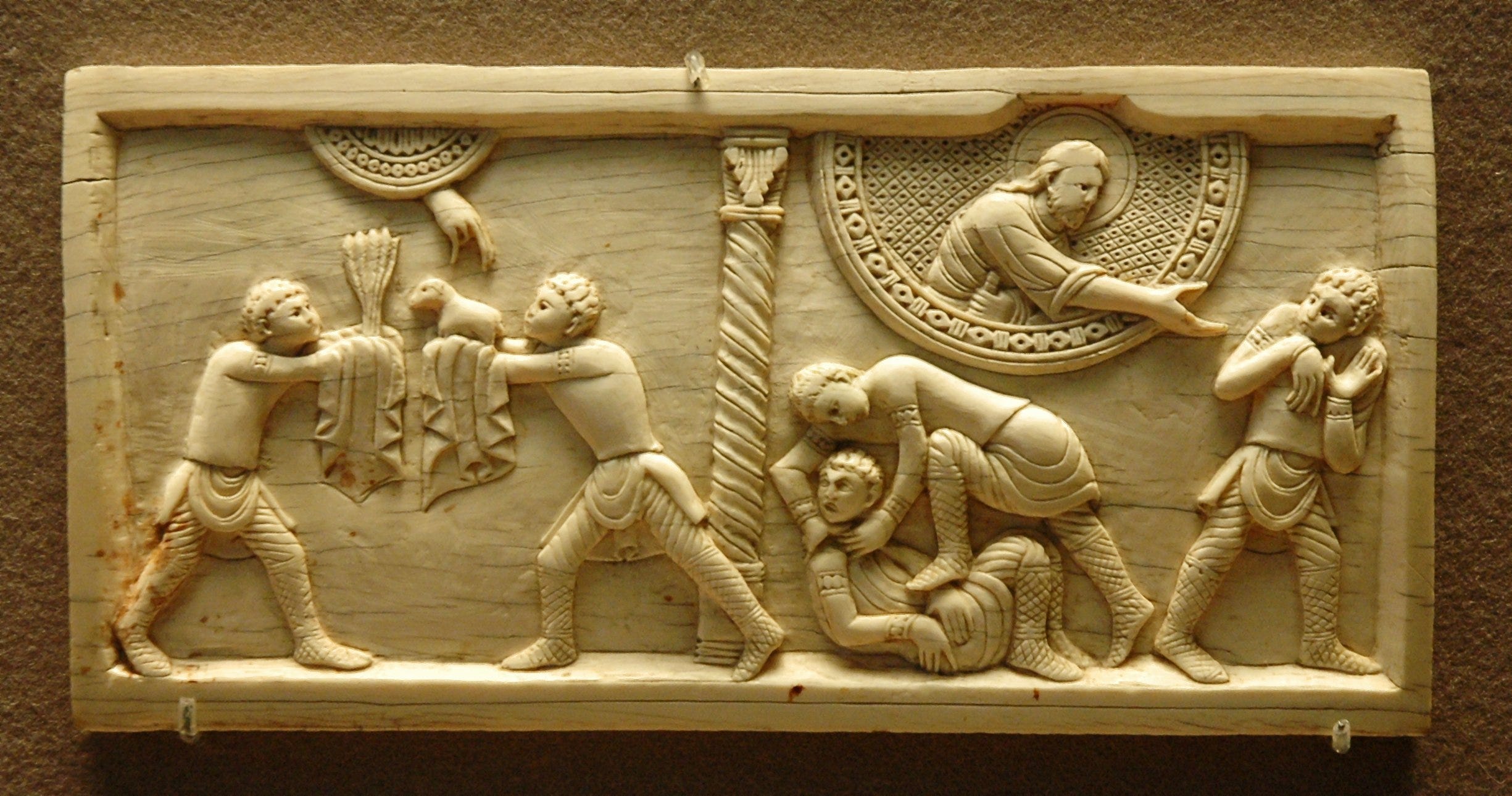

There’s a great deal of interest in these lines – in particular, ‘ogres, elves and Orcus-corpses’ (eotenas, yfle ond orcneas), on which I hope to say more in a later post. For the time being, though, all that concerns us is the portion in bold: “since the Creator had erst condemned him [i.e. Grendel] midst the kin of Cain” (siþðan him Scyppend forscrifen hæfde in Caines cynne). By condemnation is meant, presumably, a ban of exile that forces Grendel to haunt the wilderness; the word used in the text is the relatively uncommon forscrifen ‘forshriven’, past participle of forscrifan ‘forshrive’, defined by Wiktionary and the Bosworth-Toller dictionary as ‘to proscribe, to condemn’.
There are two puzzling things about this phrase.
First, the surface meaning seems to suggest that God has passed His proscription directly upon Grendel (and, recalling the preceding line, that his haunting the moors began from the date of this event). This, of course, is not so; as the rest of the passage clarifies, the proscription was passed upon Cain alone and inherited by his descendants. Since Grendel has a living mother who is said elsewhere in the poem to have ruled her realm for ‘a hundred seasons’ (hund missera), that is to say fifty years, he clearly stands at the tail end of this line of descent and would not have been around to follow Cain into exile at the beginning of the world.
Such objections can become a bit obtuse, at least in cases where the approximate meaning is not in doubt. As Frederick Klaeber explains, “originally, of course, it was Cain who was proscribed and exiled, but, being one of Cain’s offspring, Grendel is included in the condemnation”. And indeed this is implied by the phrase in Caines cynne, which means what it appears to mean: ‘in Cain’s kin’. This is usually interpreted as equivalent to mid Caines cynne ‘among Cain’s kin’.
There’s a problem here as well, though, albeit an ‘academic’ one.
Without going into too much detail, Old English verses (i.e. half-lines) are shaped according to regular metrical categories known as Sievers Types. These are usually respected by the Beowulf-poet, and can thus be used to gauge the likelihood that a given verse is authorial or corrupt. The half-line in Caines cynne happens to be extremely strange in metrical terms (though not technically illegitimate); according to Leonard Neidorf in his article on ‘Cain, Cam, Jutes and Giants’, the verse is “an anomaly, finding no secure parallel in any of the other 6000-plus verses in Beowulf”. He finds it so strange that he is prepared to read it instead as in Cames cynne ‘in Cham’s kin’ – that is to say, among the kin of Ham, the son of Noah who was banished by his father for ‘uncovering his nakedness’ and identified in several traditions as the progenitor of a cursed race. This corrects the metre all right, but at the price of making the poem contradict itself, since as we have seen the phrase in Caines cynne is directly followed by a reference to the murder of Abel.1
Might there not be a better solution?
The simplest one that springs to my mind would be to lop the final -e off the word cynn ‘race’, so that the verse reads in Caines cynn. This, I think, would produce a wholly normal type of verse according to Sieversian scansion.2 But how would it alter the meaning of the phrase?
Again without going into too much detail, the function of the final -e on the noun cynn is to mark it as a location (for which the dative case, signifying the indirect object, was used). We are assuming here that the -e was added by the scribe because he didn’t understand what he was copying, saw the preposition in and made a wrong assumption on the basis of its most common usage.3 Deleting -e turns the noun cynn into a destination (for which the accusative case, signifying the direct object, was used), and this alters the meaning of in from ‘in [a location]’ to ‘into [a destination]’, so that the phrase now carries the meaning ‘into Cain’s kin’.
Siþðan him Scyppend forscrifen hæfde in Caines cynn would thus come to mean “since the Creator had ‘forshriven’ him into the race of Cain”. Does this make any sort of sense?
The answer depends on what we make of the verb forscrifan, and whether we accept the limitation of its meaning to ‘proscribe, condemn’. “Proscribed into the race of Cain” makes little sense; “condemned into the race of Cain” is a little better; but something like “forlotted, ill-ordained, malignly assigned into the race of Cain” would be the most desirable interpretation. Although the dictionaries tell of no such meaning for forscrifan, the base word scrifan ‘to shrive’ could mean ‘allot’, ‘ordain’, ‘assign’, etc., and the usual function of the for- prefix is to add a negative or pejorative meaning that is quite appropriate in this case.4
The authorial meaning, then, could be that Grendel has haunted the moors ever since his Creator (Scyppend, a word nowhere else used for God in this poem) doomed him to the race of Cain – that is to say, ever since he was born to his Cain-descended mother. Doubtless the phrasing is strange, and I do think it likely that the poet wished to evoke the idea of a divine proscription or banishment passed on Grendel himself, but this is not the literal meaning of his words.
Let’s see how this might work in translation:
...Fifelcynnes eard
(...That fief of monsters)

wonsæli wer    weardode hwile
(He had haunted awhile,    a wight unblest,)

siþðan him Scyppend    forscrifen hæfde
(After his Creator    had erst fordoomed him)

in Caines cynn.    Þone cwealm gewræc
(To the kin of Cain –    whose killing of Abel)

ece Drihten,    þæs þe he Abel slog.
(Had been punished thus    by the Eternal Lord:)

Ne gefeah he þære fæhðe,    ac He hine feor forwræc
(He frowned on the bloodshed;    far did the Measurer)

Metod, for þy mane,    mancynne fram...
(Banish the murderer    from the brood of men...)
We might well have used condemned or just doomed instead of coining the word fordoomed, but the point is to evoke the meaning of foredoomed – that is to say, ‘pre-doomed’, or predestined. And here we encounter the final obstacle to our argument, one that obliges us to negotiate it by going beyond the text.
Grendel is described by the Beowulf-poet as an ‘enemy of God’ (Godes andsaca), who ‘bore God’s anger’ (Godes yrre bær) on the night of his death, after which he laid down his ‘heathen soul’ (hæþene sawle) and was received by hell (him hel onfeng). At no point is it suggested that any sort of redemption is available to this reprobate creature. He acts according to the ways of his kind, and gets his just deserts when God decrees that his bloody sojourn on earth should be ended by a hero (i.e. Beowulf).
That Grendel was nevertheless brought into the world by the will of God is an almost inescapable inference from the general worldview of the poet, who attributes even the coming of spring to the will of God. But to imply, as we have done, that he consciously conceived of Grendel as having been doomed to hell from the time of his being ensouled on earth is as much as to say that he was a believer in ‘double predestination’ – the idea that some are brought into the world to be saved and others to be damned. And this is associated, at least in the modern mind, with Puritan-Calvinist doctrines that far postdate Anglo-Saxon England.
But there is no difficulty in proving that the basic idea of double predestination (at least, we might say, the embryo from which the Calvinists developed it) was formulated early on in Christianity and would certainly have been available to English Christians in the Anglo-Saxon era. And as it happens, there is also reason to think that they would have closely associated it with the story of Cain and his descendants.
Prior to researching the matter of this post, I was aware that the subject of predestination had been treated in St. Augustine’s City of God, but was not sure whereabouts in this huge tome to find it. An internet search pointed me to Book XV, Chapter 1, which begins with a clear statement of the doctrine:
Yet I trust we have already done justice to these great and difficult questions regarding the beginning of the world, or of the soul, or of the human race itself. This race we have distributed into two parts, the one consisting of those who live according to man, the other of those who live according to God. And these we also mystically call the two cities, or the two communities of men, of which the one is predestined to reign eternally with God, and the other to suffer eternal punishment with the devil.
On these two cities, Augustine goes on to say the following:
Of these two first parents of the human race, then, Cain was the first-born, and he belonged to the city of men; after him was born Abel, who belonged to the city of God. … Accordingly, it is recorded of Cain that he built a city, but Abel, being a sojourner, built none. For the city of the saints is above, although here below it begets citizens, in whom it sojourns till the time of its reign arrives, when it shall gather together all in the day of the resurrection; and then shall the promised kingdom be given to them, in which they shall reign with their Prince, the King of the ages, time without end.
Cain is thus identified as the founder of the earthly city and the first progenitor of the damned – specifically, the pre-Flood or ‘antediluvian’ generations. In the apocryphal Book of Enoch, these antediluvian Cain-descendants are identified as giants, and it is clear that the Beowulf-poet also identified them as such (hence his wry statement that the gigantas got a lean or ‘reward’ from God, that is to say the Flood).5 Although Augustine denied the canonical status of the Book of Enoch, he goes on (in Chapter 9) to lend some support to it on this point:
Wherefore no one who considerately weighs facts will doubt that Cain might have built a city, and that a large one, when it is observed how prolonged were the lives of men, unless perhaps some sceptic take exception to this very length of years which our authors ascribe to the antediluvians and deny that this is credible. And so, too, they do not believe that the size of men’s bodies was larger then than now, though the most esteemed of their own poets, Virgil, asserts the same… thus declaring his opinion that the earth then produced mightier men. And if in the more recent times, how much more in the ages before the world-renowned deluge? But the large size of the primitive human body is often proved to the incredulous by the exposure of sepulchres…in which bones of incredible size have been found or have rolled out. I myself, along with some others, saw on the shore at Utica a man’s molar tooth of such a size, that if it were cut down into teeth such as we have, a hundred, I fancy, could have been made out of it. But that, I believe, belonged to some giant. For though the bodies of ordinary men were then larger than ours, the giants surpassed all in stature. And neither in our own age nor any other have there been altogether wanting instances of gigantic stature, though they may be few.
This passage is relevant to Beowulf on three points. First, as we have said, it identifies the antediluvian Cain-descendants with giants (albeit cautiously, but the identification is strengthened in later passages6). Second, it identifies them as city-builders; and although the building of cities might seem quite foreign to the savage Grendel and his mere-dwelling mother, it is well known that the traditional (or literary?) Anglo-Saxon imagination associated the ruins of stone cities with the ‘old work of ents’ (eald enta geweorc). Third, it mentions relatively gigantic men in later history, two examples of which would be Beowulf and his uncle Hygelac (a real king of huge stature whose bones were supposedly preserved and shown to travellers).
Later on in the discussion (Chapter 20), Augustine returns to the subject of Cain, and says that the direct line of his descent was wholly extinguished by the Flood:
Some one will say, If the writer of this history [i.e. Genesis] intended, in enumerating the generations from Adam through his son Seth, to descend through them to Noah, in whose time the deluge occurred, and from him again to trace the connected generations down to Abraham, with whom Matthew begins the pedigree of Christ the eternal King of the city of God, what did he intend by enumerating the generations from Cain, and to what terminus did he mean to trace them? We reply, To the deluge, by which the whole stock of the earthly city was destroyed, but repaired by the sons of Noah. For the earthly city and community of men who live after the flesh will never fail until the end of this world, of which our Lord says, “The children of this world generate, and are generated.” But the city of God, which sojourns in this world, is conducted by regeneration to the world to come, of which the children neither generate nor are generated.
The line of the damned who belong to the ‘earthly city’ is thus interrupted by the Flood, which destroyed the giant descendants of Cain, and continued afterward by the sons of Noah (dicussed in book XVI). These are of course Shem, Japheth and the cursed son Ham, whose descendants Augustine identifies with the Jews, the non-Jewish nations and the ‘tribe of heretics’ respectively. Except for some references to Ham’s descendant Nimrod, the ‘giant on the earth’ who founded the city of Babylon, the discussion of giants falls away after this point. Assuming (as seems likely) that the Beowulf-poet was influenced by Augustine, it could be argued that he conceived of the ‘kin of Ham’ as a continuation of the giantish ‘kin of Cain’, but it seems more likely that he associated giants and other inhuman entities with the latter and believed some part of their race to have survived the Flood.
I envisage at least two sequels to this post. One will investigate the various creatures encompassed by the ‘kin of Cain’ (e.g. eotenas ond ylfe ond orcneas, ‘ogres and elves and Orcus-corpses’), and may take some time to research and write. Another, which will likely get done a lot sooner, will reinterpret another part of the text that seems to refer to Grendel’s congenital inability to turn to God.
The JSTOR article is free, but for anyone who doesn’t want the hassle of registering on the site, here is Neidorf’s full argument as far as it pertains to metre:
Metrically, the verse in Cāines cynne is an anomaly, finding no secure parallel in any of the other 6000-plus verses in Beowulf. The scansion of this verse (xSxxSx) classifies it as Type Ai with anacrusis, and there are a handful of verses in Beowulf that are classified thus. Yet as A. J. Bliss observes, in Cāines cynne would be the only verse of this sort in Beowulf where the caesura falls in Sievers’s position (i) Sx | Sx; the other anacrustic Ai verses uniformly have the caesura in position (ii) S | xSx or (iii) Sx | xSx. So while verses like nu hæleð ne moston (2247b) conform to an allowable pattern, verses like *nu gomban gyldan (or in Cāines cynne) were studiously avoided by the Beowulf poet. We would have to believe in an incredible coincidence if we were to believe that the poet’s lone deviation from his regular metrical practice occurred in a verse where scribal alteration also happened to be visible. Furthermore, if monosyllabic Cam (with a short root vowel) is substituted for disyllabic Cãin, then 1.107a becomes an acceptable verse. In Cames cynne scans as a regular Type C2 verse, consisting of an unstressed syllable, a resolved disyllable, and a trochaic word (xSSx). This verse conforms to a pattern exhibited throughout Beowulf and is closely paralleled in verses such as on grames grāpum (765a), on weres wæstmum (1352a), and on sefan sende (1842a). Metrical considerations plainly support Cam as the authorial reading here.
Unfortunately, these same metrical considerations compel Neidorf to read a second instance of the name as Cāin and not Cam, leading to a continuity error (as if the self-contradiction introduced by the introduction of Ham’s name just before a description of the murder of Abel by Cain wasn’t jarring enough). He defends the position as best he can (with reference to other Old English manuscripts that confuse the two names), but I can’t see it becoming widely accepted; no-one wants to see more difficulties and enigmas introduced into a text that has quite enough of them already.
Specifically, a ‘B2’ type verse (xSxxS), equivalent to e.g. sum sare angeald (‘one paid dearly’), line 1251b. See Geoffrey Russom, The Syntax of Beowulf (pp.34-7), which contains a very useful chart of metrical and unmetrical types.
This scribal habit of adding final dative -e is found at other points in the text, and has not gone unnoticed by scholars. In lines 1830-31 Beowulf says Ic on Higelace wat, Geata dryhten (‘I know as regards Highlock, the Gautish leader”), mixing an indirect object Higelace in dative case with a direct object dryhten in accusative case. In Klaeber’s Beowulf Fourth Edition, the lack of concord is noted, and the following explanation is offered: “Since the acc[usative] is unanticipated, it may be that the scribe mechanically wrote the dat[ive] form that he expected”. Note that the Old English preposition on was equivalent to in and is the most likely reason for the scribe’s expectation.
Then there is the more debatable example of line 684, in which Beowulf says (regarding his decision not to wield weapons against Grendel) that he will secge ofersittan – ‘oversit the sword’, by which is meant ‘spurn the sword’. As far as I know – and perhaps I am missing something – the final -e on secg ‘sword’ in this line constitutes the sole scrap of evidence for the contention of the dictionaries that this rare word is to be regarded as a feminine noun (which would account for its taking a final -e in accusative case), even though secg ‘man’, secg ‘sedge grass’, garsecg ‘ocean’ and Old Norse seggr ‘man’ are all masculine nouns. I think it more likely that the scribe interpreted authorial secg ofer sittan as a literal reference to sitting on a sword, a man or a bed of sedge grass (i.e. a stationary location), and ‘corrected’ the grammar in his usual uncomprehending way.
According to Dorothy Whitelock (in The Audience of Beowulf, p.6) the Old English word forscrifan was directly modelled on the Latin proscribo (‘proscribe’), which does not seem to carry the meaning of assigning or allotting. Yet scrifan does, and while this word undoubtedly comes from Latin scribo ‘to write’, there seems no reason to believe that an Old English poet would have felt constrained to use forscrifan as if it were Latin proscribo instead of just interpreting it as for + scrifan. Then there is the German cognate verschreiben, which is used today in the sense of ‘to prescribe’ (medicine etc.), but carries the older meaning of ‘to sign over’, ‘to assign’ (property etc.); this can apparently be used (see here) in the sense of selling one’s soul or selling oneself to the devil, sich dem Teufel verschreiben. As far as I can gather, the Middle High German ancestor of this word (verschrîben) was used in the sense of transferring property but is not known to have been used in the sense of signing over a soul. Clearly the meaning of ‘assign’, perhaps ‘sign over for good’ is prominent here, and note also that Old English forscrifan has a literal meaning to do with writing or carving letters.
The influence of the Book of Enoch on Beowulf is a subject for another post, as is the Old English Genesis A, which as far as I know is the only other poem in the corpus that makes direct reference to Caines cynn.
For example, this one in Chapter 23, which discusses the union of the ‘sons of God’ with the ‘daughters of men’ (understood to be descendants of Cain):
There is therefore no doubt that, according to the Hebrew and Christian canonical Scriptures, there were many giants before the deluge, and that these were citizens of the earthly society of men, and that the sons of God, who were according to the flesh the sons of Seth, sunk into this community when they forsook righteousness. Nor need we wonder that giants should be born even from these. For all of their children were not giants; but there were more then than in the remaining periods since the deluge.
The context is Augustine’s rebuttal of the Book of Enoch’s account of this event, in which the ‘sons of God’ are not the corporeal sons of Seth but fallen angels. He rejects this interpretation as well as the canonical authority of the Book of Enoch. But the Beowulf-poet seems to have had more respect for this work than did Augustine, and if he conceived of the ‘kin of Cain’ as descendants of antediluvian giantesses and fallen angels, this might explain why Grendel and his mother are described as ‘spirits’ or ‘demons’ (gastas) and seem to act as weird semi-incorporeal entities (emerging only at night, killing men only in their sleep, etc.)
Interesting as always. Been reading the Iliad lately (Fitzgerald and Lombardo translations), and I believe some mention is made of the heroes being larger then; this is, I think, made more of in Virgil (and even more in other posthomerica, like Quintus of Smyrna), just as Augustine says - and then at random today I turned to the book of Samuel, where I was struck how Goliath behaves like a perfectly homeric hero! So the "pagan hero --> gigant" link seems pretty well established in Homer, the Bible (and other places, if we can take Irish legend and the story of Hygelac's bones, and possibly Wade, as being similar expressions).
The Beowulf-Augustine link is a bit frustrating for the reasons you describe: Augustine is careful to say that the big heroes of (postdiluvian) pagan legend are not *actually* giants, but one wonders then what the relationship is between them (if any), and what the Beowulf-poet would have thought about Augustine's categories (if they are really so neat). I guess Enoch (or something similar) is the most reasonable way to get from the Bible to Beowulf (WRT giant-lore, at least). But I suspect too that some of these associations would have been just vaguely felt. When I was young my grandmother used to amuse us kids by referring to the "little people" who used to hang their laundry out on the dew-covered spiderwebs you could see on the morning grass. Later, wanting to pin down her stories a bit more precisely, I asked her who those "little people" were. She looked a bit taken aback: "Oh, elves, I suppose," she said, not too certainly. Surely Grendel and the biblical giants have a more robust tradition than that behind them, but on the other hand, there was probably a pretty broad grey area too, of people who knew bits and pieces and just lumped together what they had.
Not sure if you've come across a couple of youtube channels with some interesting interviews: the Uppsala Books channel had a discussion between Neidorf and Russom, on the latter's Syntax of Beowulf (which I haven't gotten to reading yet); and Graham Sheper has quite the backlog of interviews with AS scholars. Maybe these will provide some useful listening!