
How The Libs Owned Us
According to the report of Herr Karl Ludwig von Haller

There’s a lot of speculation in dissident-traditionalist circles as to how we got here. What was the genesis of the modern, revolutionist, anti-traditional ruling class, and how did it manage to ascend to power and establish its destructive preferences as the default settings of the state? We have good reason to focus on this question, and it’s important to get the answer right, for only an accurate diagnosis can possibly serve as the basis for an effective treatment.
Unfortunately, there’s another application of this principle – which is that an inaccurate diagnosis can furnish the justification for a useless or harmful treatment, even after it has been tried umpteen times and found wanting. Quack reports serve as advertisements for quack remedies – and both are constantly being hawked in the chaotic informational black market that is the internet.
Thus, cargo-cult activism keeps being tried in spite of its failures, due to the perception that revolutionists achieved power by rioting, rallying and commiting random violence. Conversely, quietist inaction justifies itself with the rival argument that the current ruling class originates from a “march through the institutions”. Now that certain sheep-in-wolves’-clothing have decided that they can safely retire from principled dissent, because Trump got elected again, no doubt we shall soon see the whole fall-of-the-West story reduced to the electoral victories of FDR.
One imagines that the persistence of quack diagnoses and treatments is caused by a pre-existing desire to pursue them regardless of whether they are true or effective. This becomes most obvious where money is involved – activists get donations, quietists don’t lose their jobs – but extends also to those paid in subtler currencies, such as hero-status or feelgood cope. There is no need to assume insincerity here. Once a sincere but mistaken diagnosis leads to a wrong treatment that hardens over time into a habit, it is all too natural that those who invest their credibility in it should become resistant to second opinions.
Still, there is something odd about this. Despite their evident desire to be activists, to be infiltrators, to be political players and nationalist rebels and so on, the vast majority of dissidents and traditionalists and other critics of the current regime spend most of their ‘on time’ writing essays on the internet. Despite the (relatively recent) appearance of paywalls on some of these essays, it’s fair to say that this work is generally underpaid and undervalued, since it does not count for most people as ‘doing something’. In light of what has just been said, one would expect some bright spark to have long ago come up with the proposition that revolutionaries conquered the West by sitting around thinking and writing all the time.
Funnily enough, as we shall see, that diagnosis might actually hit the spot.
And to a certain extent, it has been grasped, albeit at the wrong end of the stick. There’s a lot of emphasis nowadays on the power of the mass media to sway the populace, and the need for dissidents to counter it – by playing just as fast and loose with the truth. Similarly, we often hear the call to reverse the pollution of arts and culture with leftist propaganda – by counter-polluting them with rightist propaganda. In short – leftists won the West by bamboozling the masses with slop, so let’s do what we’re already doing and churn out more slop. If there’s a pre-existing desire motivating this quackery, it’s not to specialize as writers and thinkers, but to continue lazily treading water in this position while awaiting some grand opportunity to ‘do something’.
What we do not so often see is the argument that the revolutionary cause took power by taking authority – that is to say, by storming intellectual heights, and becoming more trusted and relied upon for truth, accuracy and good ideas than the informational organs of the old regime. Such a diagnosis would lead to a crystal-clear treatment plan (at least for the first steps of a prospective ‘restoration’): to take advantage of the ongoing haemorrhage of authority from the mass media, social science, leftist ideology, etc. and attain to the superior position ourselves. This does not mean propagandizing the masses, seductively flattering the ‘elites’, dressing up political manifestos as Holy Writ, or pronouncing anathemas on abstract ideas (“don’t immanentize the heckin’ eschaton!”); to pursue authority in such ways is to chase and fight with shadows. It means, first and foremost, raising our game in the task that we are already performing, and ceasing to distract ourselves from it.
Obviously this will ring very dully to those long accustomed to magic bullets and cunning plans, so let’s get to the diagnosis.
One route to it is via the work of Mencius Moldbug (Curtis Yarvin). Although he never clearly spoke of authority as distinct from power, he always located the role of the media and bureaucracy downstream from that of academia, and spoke of this whole intellectual establishment as a ‘cathedral’ or ‘brahminate’ occupying the old position of religion and the priesthood (i.e. that of the authority structure and knowledge-bearing class.) I’ll assume that most readers are somewhat familiar with Moldbug’s memetic evolutionary theory of progressivism, in which he traces its origins from the radical wing of Protestantism through a virus-like process of mutation, conditioned by the imperative to infect the vital organs of the state.
It’s a theory designed for the Anglophone world, in which the agenda that we would nowadays recognize as ‘progressive’ shades into religious forms and guises that were retained into the twentieth century.1 But it never had much to say about the secular, European, ‘enlightened’ strand of the same agenda, which infamously erected a Cult of Reason during the French Revolution.2 And it is this case, I think, that shows more clearly the way in which writers and thinkers can siphon off authority from established institutions and influence the direction of a new power structure.
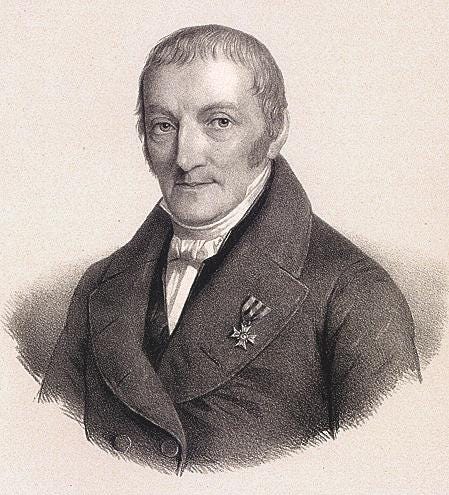
I don’t intend to tell this story myself, but rather to delegate it to a suitably arch-reactionary man of the time: the Swiss political theorist Karl Ludwig von Haller. Those who got something out of Moldbug’s ‘redpill’ ought to be interested in Haller’s project, because the aim he pursued was essentially the same: to dismantle the dogmas of liberalism, purge them from our conception of the state, and defend the traditional order on non-liberal terms. The difference is that Haller started earlier, proceeded more consistently, and went deeper, rejecting many components of the modern state that are taken for granted in Moldbug.3
The resulting theory was expounded in Haller’s Restoration of Political Science, the first volume of which has recently been translated by Jack Vien. (According to the publisher, Imperium Press, the subsequent volumes will not be forthcoming until the first one covers its costs; so if you want to support important intellectual work in this sphere, you know where to start.)
Other than the promise of a critique of liberalism that is not beholden to its immediate predecessor, absolutism, one thing that interests me in Haller is that he is not some warrior-worshipper (like Nietzsche or Evola) bent on denying the legitimate social role of the authority-bearing class. We can get a taste for this in a footnote (ROPS vol.I, p.66) on Denis Diderot’s notorious lyrical flourish about “strangling the last king with the entrails of the last priest”:
“The atrocity of these words jumps at the eyes; allow me to demonstrate their absurdity. If the last king is to be strangled, whoever was able to strangle him with impunity would incontrovertibly be king; for in order to have succeeded, he would have needed assistance and obedience from others. By the same token, if one would slaughter the last priest, it could only be done by establishing a new doctrine able to crush the old one, strip it of credence, and put itself up in its place. But then the heads of the new doctrine, e.g. Diderot, d'Alembert, et al. would be the true priests.”
The underlying idea here is that there will always be ‘priests’ – i.e. bearers of knowledge and wielders of authority looked to for instruction by others – and that any move to annihilate established doctrines can only end up with the establishment of new ones in their place. In the quotations that follow (all taken from Chapter VII of ROPS vol.I, pp.45-110), Haller shows how just such a transfer of authority was brought about in 18th-century Europe, to the benefit of liberal ‘philosophists’ who presented the people as sovereign and rulers as their delegates.
“Nowhere else than Europe would it be harder to find a man, a bit educated, who hasn’t read a thousand works of this [liberal] system variegated to infinity, here in one form, there in another, with bold conclusions or timid explication, but in principle, always similar to itself. But this purely historical knowledge does not suffice to shed light on this topic. It remains for us to explain this strange phenomenon: how could a theory, so strongly in contradiction with the course of nature, universal experience, and even the most pressing interests of men, have nonetheless entered the minds of scholars, perpetuated itself for several centuries, spread itself so widely, and ultimately gained near-total dominance?
…
“[I]n tracking back to the original seed of this error that has since developed such deep roots and such far-reaching ramifications, it cannot be pretended that the exclusive study of Roman literature, the widespread use of Latin among scholars, and a certain idolatrous reverence for Roman law, weren’t the first and almost imperceivable causes of misconstruing the essential difference between monarchies and republics (seniories and corporations), and positing the idea of a social contract as foundation of all rule. For since the Latin language has little non-republican terminology, at least when it comes to States, it is these that writers employed most often; consequently these same terms wound up being applied to all sorts of unrelated things and to relations of a completely different nature. Thus, since Roman citizens formed a corporation between themselves, an electorate, a true civil society, it was imagined that all other human aggregations, all mutual relations between men are likewise civil societies or unions of citizens. … Hence it imperceptibly became habitual to use the same words to express radically antithetical ideas and relations, subsequently confound them with each other, and from there draw a host of erroneous conclusions.
This is an important corrective to the Moldbug theory that locates the ideological pathogenesis solely in the field of religion, and looks to monarchical absolutism to solve it (Henry VIII-style). It is well enough known that what Haller calls the “idolatry of Roman law” was an important centralizing tool in the hands of early modern rulers of kingdoms who sought to increase their own autonomy and power. Yet the absolutism of this legal structure conceals a latent revolutionism, inherited from the usurpation of the Roman Republic by the Empire, like a trait that skips a generation. According to the Institutes of Justinian, “the will of the Emperor has the force of law since, by the lex regia which regulated his imperium, the people conceded to him and conferred upon him all their authority and power”. Moreover, in practical terms it is only natural that a ‘top-heavy’ state should expand with the growth of its responsibilities and shed its dependence on the will of individuals and small groups, until (given enough time) it at last reaches the modern decadence in which its helm is squabbled over by a democracy of officials and a pestilence of client-groups.
That said, Haller did not fail to recognize the connection between religious and political revolutionism, and even the priority of the former:
“In the second place, it cannot be denied that the ecclesiastical revolution commonly called the Reformation, and for that matter an all-too-hasty comparison between the Church and other social relations, powerfully contributed to the propagation and adoption of this erroneous idea of social contract. For as the Christian Church represents (not in every respect, but relative to the faithful between them) a religious body, in which every Christian, in that capacity, has the same rights, the same duties, and the same hopes: several theologians, above all among the Protestants, and other scholars still, misled by a false analogy, transposed this idea, which only applies to the Church, to other, altogether different temporal relations. They regarded every mass or multitude of men who, with no ties between them, serve a great territorial lord or prince in highly variegated statuses, as forming a body, and thus sought to give the State the form of the Church. In fact, this idea, as well as the conclusions that supposedly follow from it, can’t even be applied to the Church; for, properly speaking, the Church is by no means an association, but an aggregation of a great number of disciples around a supreme teacher. It isn’t the disciples that made the master, but the master that gathered the disciples; it wasn’t particular Churches that founded their pastors, but rather the pastors that, in the beginning, founded Churches.
Haller (who ended up converting from Protestantism to Catholicism) traces the secular form of the revolutionary theory in 18th-century Europe to the semi-religious 17th-century English one, which he in turn traces to the tendency of Protestants to try to solve their disputes by Anglican-style “Caesaro-Papacy” on the one hand and Puritan “spiritual democracy” on the other. The main transmission of ideas to Europe, however, was made through secular and deist writings:
Hobbes paved the way with his proposal to abolish the Christian Church altogether, along with other impious principles. Bolingbroke, Shaftesbury, Collins, Tindal, etc. spread this same spirit of irreligion in well-known books. But, having been attacked in a great many learned and profound works, their triumph was only fleeting, and religion in England cast itself deeper roots than before. On the other hand, this unbelief came to France, chiefly through the efforts of Voltaire. It was constituted according to the idea that had taken shape in the chimerical project of making all men independent of all higher authority in spiritual matters [Haller’s emphasis] …the horrible project of destroying all religion, above all Christianity, and throwing off, as d’Alembert, Diderot, and Damilaville put it, the yoke of all external authority in spiritual matters, so that each man shall obey nothing but his own reason. In fact, this enterprise was, by its very nature, as deranged and as impossible as it would be to seek to bring about a world with neither masters nor servants, where men would have no need of one another for their physical existence, and where they could all be equally free and independent. To hope to free men from all external authority in spiritual and scientific matters, is to presuppose in each individual such superiority of mind, knowledge so vast and varied, and such a degree of perspicacity and judgement, as to render him able to do without guidance, see everything by his own wits, and serve as his own authority… Thus the foolish endeavour of making men depend on nothing but their reason in spiritual matters cannot be achieved, and would effectuate no other result than putting the reason of Voltaire, and that of his acolytes, in the place of the reason of every scholar and wise man hitherto, dethroning the doctrine of the latter in order to give the scepter to themselves.
This is presented not as an unintended consequence, but as a successful bid to monopolize authority, which seems to have been the objective of the philosophists from the beginning. In order to achieve this, they employed repressive tactics concealed by hypocrisy, in much the same fashion as their modern ideological filiates:
But judging from the facts and the behaviour of these sophists, it is beyond doubt that a monopoly over minds was the goal of their sect, which had absolutely no parallel in history. For they certainly preached incredulity towards the doctrines received until then – but, ever-inconsistent with themselves, they demanded faith in their own principles with more arrogance and fanaticism than any sect ever did. Reason was their battle-cry; but by this word they understood the set of their own personal opinions alone, and nobody was in possession of reason, if they didn’t adopt their doctrines with blind trust; nobody was to see, with the aid of this Divine light, anything other than what the sect saw. They talked a great deal about tolerance, when they still needed to; but from this time on, they were the most intolerant of all towards those who opposed their opinions. They indignantly demanded general and unlimited freedom of the press, but wanted it only for themselves, in the interest of being able to spread their own doctrines more easily and safely; for even when they were just a militant sect, they already sought, by means of their acolytes and secret intrigues, to prevent the publication of all the works of their opponents, denounce them, and have them banned.
One point of common ground between the religious and secular forms of revolutionism is that they focused their initial attacks on the Catholic Church, which represented the traditionally-established structure of intellectual and spiritual authority. Only after this locus of authority had been weakened – often with the help of secular rulers, who had every interest in freeing themselves from theoretical subjection to the Church, and identifying their own interests with those of the people as a whole – were the revolutionary principles turned upon the sphere of temporal power. Yet as Haller points out, this transition from spiritual to temporal revolutionism was natural and inevitable:
From the chimerical idea of making each man’s reason independent of all authority, or destroying all faith whatsoever, to the no less ridiculous project of freeing all men from all temporal authority, or destroying all external servitude, even voluntary, there is but one easy and unavoidable path. … If there should be neither teachers, nor disciples, authority, or belief, why should the world still have masters and servants, leaders and followers? If, for spiritual authority, and above all in religious matters, every individual could or should be a sage of the first order, an independent high priest, why couldn’t he likewise be a temporal sovereign, taking no orders from anyone on Earth? And if it were to be thought possible to make men perfectly equal in reason and intellect, by extension independent of one another, why shouldn’t or couldn’t they be equal in external power, in wealth and other gifts of fortune? The natural association of ideas drew these conclusions by necessity; and this also explains how the war against altar and throne, against Church and State, against priests and kings, always marched along the same path, led down it simultaneously by the same men and on the basis of the same principles. In fact, Voltaire doesn’t seem to originally have had the intention of attacking temporal superiors; his fortune, tastes, and inclinations didn’t lead him there, and he plausibly seems to have wanted all lords of the earth to go on existing, as long as he could succeed in laying low or destroying all intellectual authorities. But it is well-known that his first disciples already reproached him for his inconsistency in this respect; and that either the natural analogy between principles, self-interest, or fear of losing his status as patrician of self-styled philosophers, convinced him to turn his weapons against thrones as well.
…
Even though [Montesquieu’s] Spirit of the Laws and [Rousseau’s] The Social Contract contradicted one another on almost every page, they nonetheless essentially worked towards the same goal: the vilification of all superior authority. The one seduced the lords and nobles; the other, the middle and lower classes. The one was, so to speak, the milk one gives to the weak, the other the more substantial nourishment reserved to the strong. And the same principles, the spirit of a doctrine subversive of States and religion, were soon to be found in almost every book. An infinite number of writers who successively attached themselves to the leaders of the new school, among which Helvétius, Mably, Raynal, Boulanger, La Mettrie, etc. above all distinguished themselves, drew ever-increasingly bold conclusions from the social contract or the principle of the original sovereignty of the people. … One is astonished by the audacity with which the acolytes of this school were already expressing themselves, an audacity that wasn’t even surpassed by their revolutionary disciples.
…
But how could such doctrines find credence, and even become dominant? How is it possible that they were even tolerated?
I would say that Haller has answered his own question. Had the revolutionary worldview posed an immediate and equal threat to established authority and power alike, the ‘immune system’ of the old regime would have reacted against it – either by forcibly suppressing it, or making serious efforts to refute it in writing, or by some combination of repression and refutation. But by beginning with a purely intellectual attack on the authority structure (into which parts of the power structure were drawn by their own interests), the philosophists avoided this fate, and the full conservative reaction came only after the Revolution had broken out in France. This passivity of the old order extended even to the person of Louis XVI, who was so deeply charmed to sleep by the authority of liberal ideas as to put up hardly any resistance against them, even when they ended up taking everything from him.4
This is not to say (as counterrevolutionary accounts often imply) that the philosophists planned out the Revolution as a detailed conspiracy, with everyone involved fully indoctrinated.5 The effect of a transfer of authority from one locus to another – in this case, from Catholicism and divine-right monarchism to revolutionary liberalism – is much more subtle and indirect than that. Outwardly the old tree continues to stand, but the sap has been sucked from it, and the next storm-wind – occasioned by social frictions, human errors, the course of accidental events, or anything else – is liable to send it toppling and bring its successor into the sun.
As Haller makes clear, on the eve of the Revolution, the transfer of authority was already far advanced:
Emboldened by powerful protectors, the sophists undertook a gigantic work, a would-be dictionary of every art and science, to which they gave the name, Encyclopedia, and hence called themselves Encyclopedists; a work in which sarcasm and insults were hurled at Church and State with both hands, and the principles of the sovereignty of the people preached all the way through to the articles least related to political matters. The Encyclopedia was nevertheless advertised as the result of the labours of the most illustrious scholars, and as the triumph of the most enlightened century, so that almost all previous books and all in-depth study would be rendered useless, and that there would henceforth be nothing left to do other than draw the most important knowledge from this vast reservoir of human science. … Little by little, thanks to favours from certain ministers already imbued with their principles, they came to exercise such a despotism over the French Academy that, in spite of an express provision in its founding statutes, the religious sentiments hitherto a rigorous condition of admission became grounds for exclusion, which culminated in nobody being inducted into this body except for those who were called philosophers – that is to say, as the term was then understood, atheists and avowed enemies of the royal power. Hence all young people just starting out in literary careers, and who aspired to celebrity, saw themselves forced to serve the sect and its doctrines if they wanted to avoid being condemned to obscurity or torn to pieces by slander.
…
D’Alembert in particular managed to arrogate to himself such influence that, by means of an employment agency, he single-handedly nominated the tutors of almost all noble households, and throughout the realm controlled a great many appointments in the field of public instruction through his referrals, bestowing this favour only on the acolytes of his sect. The philosophists even formed, in Paris, a network of organizations dedicated to writing, editing, and distributing at very low cost, through affiliated vendors, an infinite number of irreligious or revolutionary writings – that is to say, premised on the sovereignty of the people or tending towards the vilification of all kinds of authority – all the way down to the most humble workshops and the hovels of the poor. The near-universal empire of their doctrines readily explains how they ultimately managed to infiltrate other secret societies, long-established and, one might say, perhaps innocent in certain respects, notably Masonic lodges, insinuate the principles of self-styled liberty into them by means of a new and specious interpretation of Masonic symbols, and then take advantage of the organization of these highly widespread societies in order to propagate the new systems unhindered, and have a great number of partisans at their disposal for the first time. It thus comes as absolutely no surprise that, owing to half a century of using all these methods, they wound up gaining the upper hand, and effectuating a complete transformation of the mentality of the French nation, a certain tendency to dissolve all the social and religious bonds that had existed until then.
The empire of the French language became almost universal in the courts, and elsewhere as well, from the reign of Louis XIV, the predilection for French books, vaunted as masterpieces of intellect, taste, and freedom from every type of prejudice; the personal ties between the leaders of the sect itself (Voltaire, D’Alembert, and Diderot) and several princes and ministers; the favour they enjoyed from them; and the great many instructors and tutors they shrewdly, through their referrals, placed in the employ of courts and noble households, all contributed to making these principles quickly become fashionable, and producing for them a great number of partisans in almost every State in Europe. It is well-known that in Spain the Dukes of Aranda, Alba, and Villa Hermosa, ministers of the King; the infamous Pombal; and in Italy, several other noblemen, figured among the acolytes and protectors of the French sophists. In Denmark, King Christian VII; in Sweden, Gustavus III, later fallen by an assassin’s bullet, and his mother Ulrika before him; in Poland, King Stanislas Poniatowski; and in Russia, Empress Catherine II, were in intimate correspondence with the French philosophists, and gave their wholehearted assent, if not to their political doctrines, at least to their anti-religious doctrines. The latter, which were to free sovereigns of all spiritual authority, were no doubt more attractive to them than the former, according to which it was likewise necessary to destroy all temporal authority, and put the sovereign power in the hands of the people. But even though they regarded these political errors as so many unworkable chimeras, they nonetheless sucked in the revolutionary venom right along with the anti-religious venom, and their subjects gulped it down with even more enthusiasm. As with lordship of any kind, the empire of evil by no means builds itself up from low to high, but rather descends from the great to the middle and lower classes. Everywhere irreligion shows up first, and revolutionary error immediately follows as the natural corollary.
Given that the authority-bearing class is placed above the power-wielding class in many traditional societies (including that of medieval Europe), we might even say that the revolutionary “empire of evil” descended from above the great, if by this term we are to understand the noblemen, ministers and rulers who looked up to the doctrines of the philosophists.6 In this special sense, those who merely thought and wrote made themselves superior even to their patrons.
Anyway, I could go on quoting and commenting, but I think you get the idea. The revolutionary programme was built up in the realm of the intellect long before it irrupted into reality, and whoever would replace it with something better must first reconquer this same intellectual realm. That is the task to which Haller set himself, and which ought to be continued by us today.
Might the result of such an endeavour be a ‘cargo-cult’ of the liberal theoreticians, resembling so many rightist cargo-cults before it? Very possibly – but only if no actual work were being done, and a cloud of pretentious chatter were being conjured up in its absence in order to hoodwink people. Yet I cannot imagine that the maintenance of such a fraud would take less effort than the sincere pursuit of the truth. Admittedly, to speak of ‘becoming worthy’ and ‘taking authority’ is to make a concession to the typical rightist mindset, which is always chasing shadows that would follow after it if only it were to turn towards light.
As Jack Vien has argued, the success and vindication of liberalism in the Anglo world owed much to the distinction between ‘public’ state and ‘private’ society, which allowed the artificial Leviathan-state to exist in symbiosis with some of the natural and traditional institutions that preceded it. Now that liberalism has degenerated into democratism, that state is increasingly inclined to act not as symbiote but as parasitoid, cannibalizing these social vestiges in the arrogant assumption that they can be replaced arbitrarily. At the same time, the natural resources that fuelled the modern way of life are being wasted along with the cultural resources that fed it, and both are ultimately irreplacable. This does not mean that the total state is in danger of the sudden ‘collapse’ imagined by neo-barbarist types. But it is safe to say that the modern system is breaking down; that this will become more obvious and agonizing as time goes on; and that the world will cry out for some set of ideas by which humanity can step off its madding chariot, and return to something better resembling the ways of life that sustained it for millennia.
Those ostracized from official politics, released from obligations of loyalty to dependents and patrons, and granted easy access to the sum total of knowledge and the freest press that has ever existed, have had every opportunity to work out those ideas and build upon them a new locus of authority. And what have they chosen to do instead? To deplore their situation, instead of making the best use of it. To convince themselves that the sword is mightier than the pen, and make no end of wretched attempts to snatch it by the sharp end. To compromise with the ideology of the regime, in order to appeal to its brainwashed populace, and divest themselves of any ideas too large and outlandish for political manifestos. This is not to say that no-one has taken steps in the right direction; plenty have done so, and will surely continue to do so. But the overwhelming collective tendency of the ‘dissident right’, and the right in general, has been to stampede in the opposite direction whenever the slightest temptation to power presents itself. It is like a fool who cries on the shoulder of the pure-hearted girl who is patiently awaiting an advance from him, only to pick himself up and make another attempt on the sociopath who is only stringing him along.
Still, there’s not much point in haranguing people about this, least of all now that so many of of them think they’re finally in with a chance.7 What would perhaps be more amusing is to imagine how the original prophets of revolution might have acted, had they too been afflicted with the strange delusion of being temporarily-embarrassed warrior aristocrats. Perhaps they would have nagged each other to quit the quillstand and muster their meagre strength in the streets, making a blatant nuisance of themselves to throne and altar alike. Having failed in this, some might have adopted a masquerade of Catholicism, in order to seek the election of a sympathetic pope; others might have stooped to repeating every peasant and plebeian delusion, as long as it were voiced with vague resentment of the established order. They wouldn’t have bothered to write any encyclopedias, and their theoretical works would have been abandoned after the first volume for lack of interest and funding. Would that they had been as foolish and distracted as we are today – alas!
See, for example, Murray Rothbard’s article on American progressivist activism during World War I, in which he notes that:
Most of these intellectuals, of whatever strand or occupation, were either dedicated, messianic postmillennial pietists or else former pietists, born in a deeply pietist home, who, though now secularized, still possessed an intense messianic belief in national and world salvation through Big Government. But, in addition, oddly but characteristically, most combined in their thought and agitation messianic moral or religious fervor with an empirical, allegedly "value-free" and strictly "scientific" devotion to social science.
Moldbug might say that the ‘virus’ has here been caught in the act of mutation.
Specifically, Moldbug referred to the secular-enlightened strand of revolutionism in at least three posts: this one, this one, and the one linked in the main text. In these posts he assimilates it to his Protestant-descent theory, apparently on the basis of very little thought (“Puritanism and secularism are simply the same thing”; “Rousseau, of course, hailed from Geneva [like Calvin]”), and as memory serves has little to say about it thereafter. As we shall see, Haller had some different and some similar ideas on this subject.
As one leftist critic recently noted in scathing fashion, Yarvin tends to accept absolute despotism as natural, and overlook its culpability in paving the way for liberal democratism and the modern state of ‘anarcho-tyranny’. This lacuna does not appear in Haller, who has much to say on the role of power-hungry princes in building up their own scaffold.
This, at least, is the account of Louis XVI given in J.F. Bosher’s The French Revolution, epitomized by passages like the following (p.131):
“At this point it would have been easy to disperse the Third Estate with a small body of troops. After all, ten years later the Bonaparte brothers had no trouble in driving out the Five Hundred elected deputies assembled at Saint-Cloud. Neither Louis XVI nor any of his ministers took such a resolute step in June 1789 partly because Louis was as usual restrained by his own decent, liberal inclinations [my emphasis], partly because he was very much upset by the death of his eldest son on 14 June, and partly because his councillors were divided in their views. Four of them…urged the king to be flexible and to adopt a compromise. In the Council meetings General on 23 June, Louis adopted the firm conservative views of the other three councillors…and of the royal family, but when he was informed that the Third Estate refused to disperse even after his disciplinary speech at the royal session, he suddenly gave way, as he had so often given way before. “Eh bien, foutre! qu’ils restent! [Oh well, fuck it, let them stay!]” he said wearily, oblivious of where such weakness might lead the kingdom.
Such suicidal behaviour by those who command might, but are fatally weakened in their capacity to assert right, can hardly be accounted for by those who acknowledge no other social powers than ‘force, folkishness and filthy lucre’.
In Bosher’s history of the Revolution, he sets out to debunk various long-established narratives about its origins, such as the Marxist notion that it expressed the class interests of the bourgeoisie. One of the items on his hitlist is of course the traditional counterrevolutionary historiography that influenced Haller, but once the smoke has cleared he doesn’t exactly show us the body. This is what he has to say (on p.48) about the main project of the man who fantasised about strangling kings with the guts of priests:
Among the most celebrated intellectual groups of the pre-revolutionary generation was one of some 200 contributors to the Encyclopédie directed by Denis Diderot and Jean le Rond d’Alembert. This great work, which they published between 1751 and 1772 in seventeen volumes of articles and eleven volumes of engraved illustrations, was not revolutionary and could be interpreted as such only by people who believe informed and independent thought to be revolutionary. One of Diderot’s three main purposes was to work out a natural morality as an alternative to the prevailing Christian morality, a common endeavour in the eighteenth century which some historians have seen as revolutionary, but on that view nearly all modern philosophy must be included in a vast and meaningless indictment.
This is a bit like saying that it would be meaningless to indict the rise of Abrahamic monotheist thought in the downfall of pagan belief-systems and those who represented them in society. In any case, leaving religion aside, you can read for yourself what Diderot wrote about ‘political authority’ in his Encyclopedia. “The crown, the government, and the public authority are possessions owned by the body of the nation” – nope, I really can’t see how this would have motivated anyone to try to sack the king.
One gets the distinct impression throughout the rest of the discussion that Bosher, like a fish that has no concept of drowning in water, is so steeped in modern liberalism as to severely underestimate its revolutionary potential in a Catholic absolute monarchy. This can be seen, for example, on the next page, where he calls the Masonic movement “a good school of liberal citizenship for its tens of thousands of members” in the same breath with which he denies that it had “any political programs or policies at all”. At the end (p.59) he practically confesses this in the following statement:
Malesherbes was not revolutionary when, as government supervisor of the book trade in the 1750s, he tempered the censorship of books and treated such authors as Rousseau and Diderot with indulgence. Nor was Condorcet [an enlightenment intellectual who actively participated in the Revolution] when he “sacrificed the hope of private wealth to his passion for the public good” or tried to work out a science of citizenship. Nor was Rousseau when in 1762 he published an abstract academic treatise on the social contract [i.e. The Social Contract, which famously refers all sovereignty to the ‘general will’]. There is good reason to beware of the temptation to assume that the French Revolution must somehow have been thought out in the Enlightenment that preceded it. After all, the Enlightenment also preceded the great civilizing movements of the nineteenth century, and its basic notions of tolerance, humanity, and social utility are with us to this day.
Indeed they are, and so too is revolutionism – intolerant, inhuman and socially-destructive.
It must be said that the ‘empire of good’, i.e. Christendom, arose in much the same way from the husk of late-Roman paganism – by a transfer of authority that appealed to the higher classes of society, and was only intermittently persecuted and eventually supported by those holding power. According to Rodney Stark (The Rise of Christianity, p.456):
Had Christianity actually been a proletarian movement, it strikes me that the state necessarily would have responded to it as a political threat, rather than simply as an illicit religion. … It is far from clear to me that Christianity could have survived a truly comprehensive effort by the state to root it out during its early days. When the Roman state did perceive political threats, its repressive measures were not only brutal but unrelenting and extremely thorough – Masada comes immediately to mind. Yet even the most brutal persecutions of Christians were haphazard and limited, and the state ignored thousands of persons who openly professed the new religion… If we postulate a Christianity of the privileged, on the other hand, this behaviour by the state seems consistent. If, as is is now believed, the Christians were not a mass of degraded outsiders but from early days had members, friends, and relatives in high places – often within the imperial family – this would have greatly mitigated repression and persecution. Hence the many instances when Christians were pardoned.
Leaving otherworldly concerns aside, it seems obvious that the indifference of early Christianity to temporal power would have helped to keep its believers from straying onto the doomed path of challenging the Roman state. You might want to remember this when some warrior-worshipper with no power at all tries to tell you about the supine weakness of Christians (or, for that matter, of enlightenment liberals).
That is to say, now that Trump has been reelected and is backing up some of his talk with action, those who have spent the last decade surgically attached to his coat-tails consider themseves vindicated. Naturally, I see things rather differently. Since much of what Trump and his administration are doing (governing by executive orders, attacking the bureaucracy) appears to be a haphazard and watered-down implemention of the ideas laid out by Yarvin at Unqualified Reservations, it is clear in retrospect that the work of real importance for dissidents was to engage critically with those ideas so as to clarify and improve upon them. For what is more apt to be misconstrued than a sprawling, rambling blog that floated many ideas of widely varying quality? To ask someone in power to carry it into action is like asking a film director to make a Lord of the Rings movie, based not on the completed books, but on the mass of unfinished writings left by Tolkien in his desk drawer. Yet when prospective power-players came seeking instruction we had precious little else to offer.
So, according to this theres two reasons why liberals could take authority: 1) The ancien regime didnt fight back soon enough 2) Their criticism of the priests was convenient for the nobility. I dont see why this makes you optimistic for trying the same, since reactionaries have neither. Retire All Government Employees was invented to be something like 2), in exactly the way an economist would come up with, but you disagree with that in another thread here.
Its also not like this hasnt been tried. Anyone acculturated to the mainstream will try argument as the first line of attack (at least until the last decade or so), and at least initially wont use BS arguments that they dont fall for themselves. In fact, even people who already explictly believe that this doesnt work, often continue to do it, because someone is Wrong On The Internet (or the news, or the family dinner, etc). The right had figures like youre calling for. Not as many as the left, but enough, if its more than a pure numbers game, and sure they werent reactionaries exactly, but they agreed on many points, and didnt exactly win on those either. And the exact reactionary ideas were around also, if with fewer defenders. Moldbug had some new ideas, but not in the realm of object-level things to convince people of. Im not even sure there are fewer reactionaries playing for authority today, in an absolute sense.