
The House Always Wins
...So is the populist right sick of losing yet?

This time last year I posted an essay, centred on the allegory of a fraudulent casino, in which I expressed some less-than-optimistic views on Trump’s electoral victory and coming presidency.
One was that the failure of Trump’s first term had paradoxically generated the demand for his second, because his empty threats against the US permanent government had provoked it into destructive backlashes that now required some sort of correction. Another was that Trump had been allowed to take office (i.e. without legal obstruction from the permagov) precisely because he had proved himself an empty threat, and could thus be safely entrusted with clean-up duty. Another was that Trump probably understood this quid pro quo and would choose a conciliatory path upon taking office. My overall conclusion was that anyone still expecting anything like a genuine regime change from Trump was deluded.
Well, it’s now one year to the day, and the writing has been on the wall for some time. The DOGE assault on the permagov held back on the accelerator, and ended up slowing down and sputtering well short of its destination. By way of consolation, the Kirk assassination might have sparked a campaign to do to antifa more or less what was once done to the Ku Klux Klan, but instead set off a retarded right-wing internecine war between conspiratards and cuckservatives. I remember saying in my post of last year that the regime had been prudent to conduct a tactical retreat, and indeed it seems that the outcome has been to give MAGA just enough space in which to fall apart. I try to limit my exposure to Xitter, but it’s one way to take the temperature of ‘the movement’ and the signs of terminal sickness are all there.
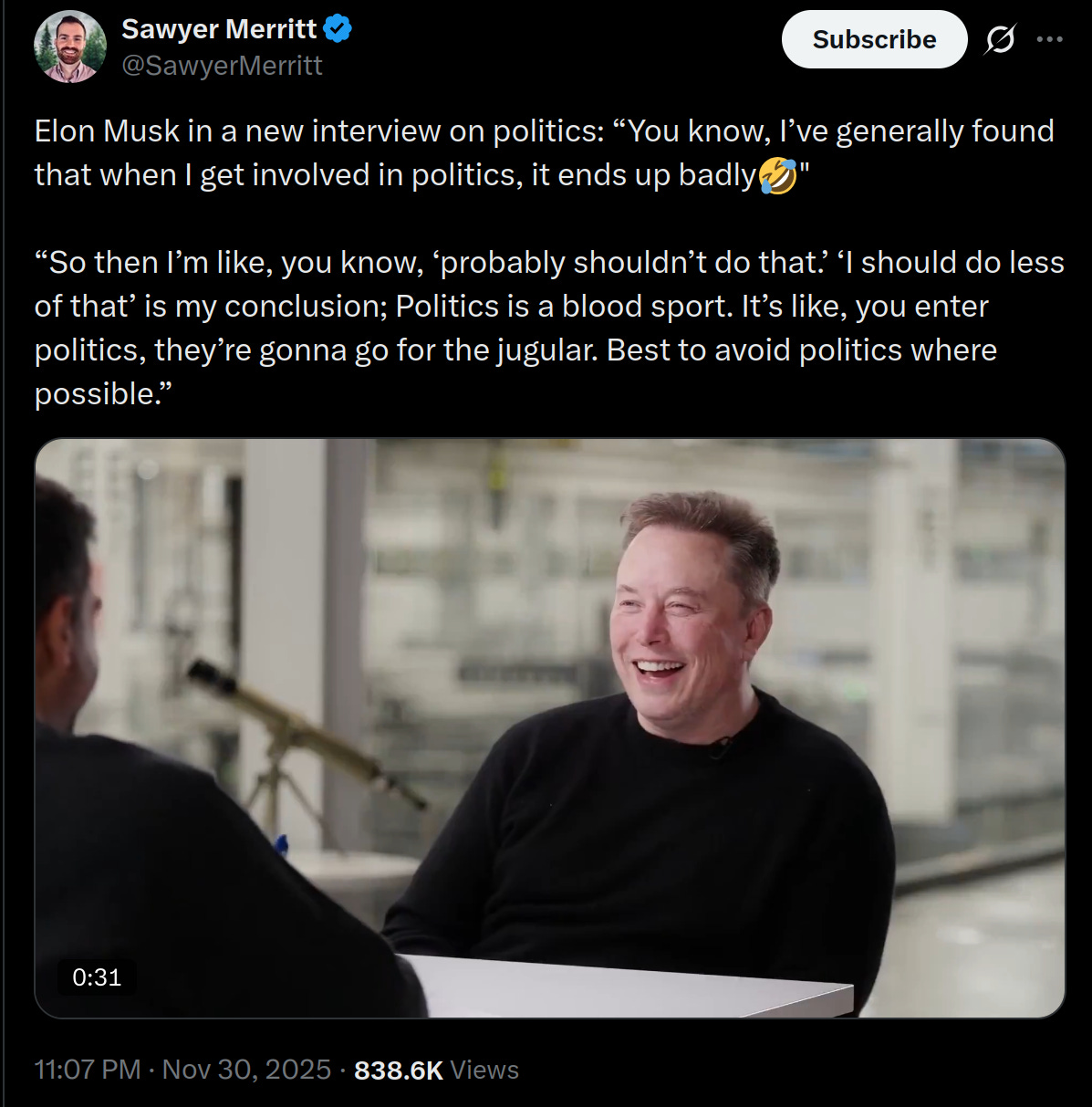
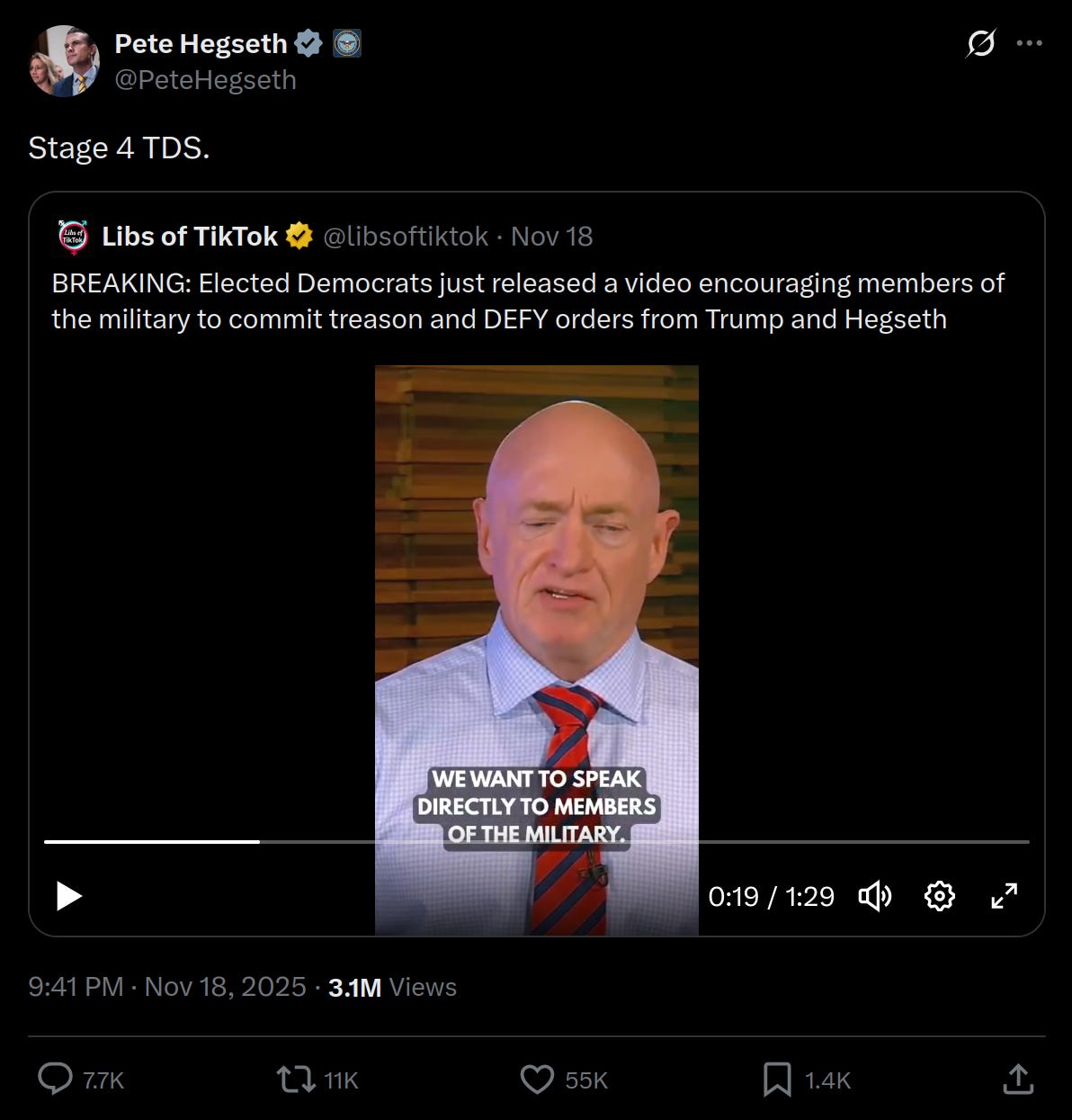
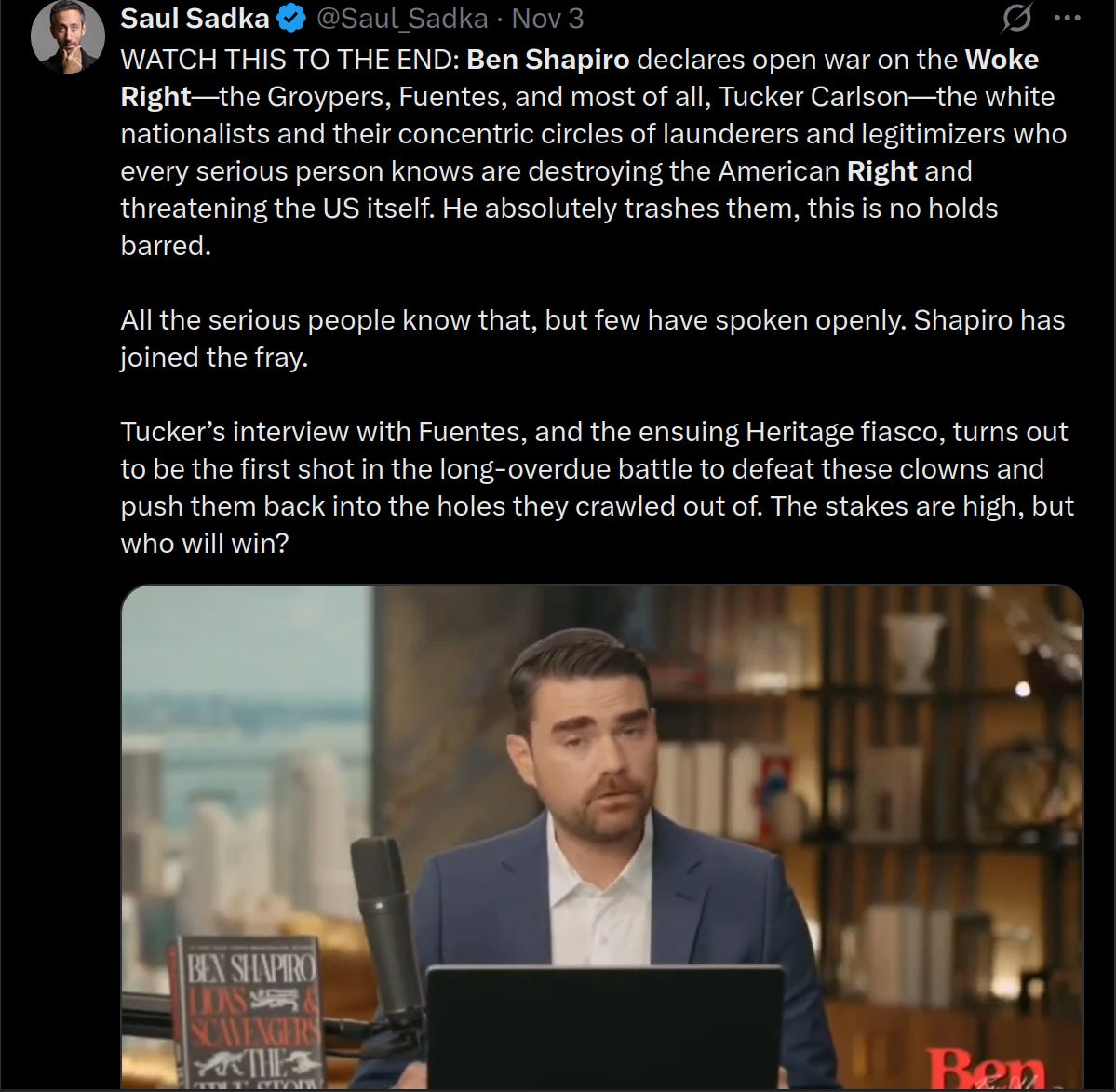
Telling the unfortune of Trump 2.0 in a broad-brush sort of way was no great achievement on my part; the political blackpill is always a safe bet. And it is important to note that my more specific prediction – that Trump would choose to conciliate the permanent government once in office and confine himself to cleaning up its excesses – proved to be wide of the mark. Trying to gut the US federal government, however limitedly and haphazardly, wasn’t very conciliatory. In the early days, it must have seemed that those who declined to obstruct his election had made a big mistake; consider what it must have felt like to be on the other side in early February, when John Carter could write the following breathless commentary:
The people on the inside of the Trump administration…are executing a detailed, thorough plan. They’ve identified the enemy nerve centres and are neutralizing them precisely, rapidly, and ruthlessly. Handpicked squads of very competent young men have been turned loose inside the Beltway... DOGE’s application of AI algorithms has cut through their castle walls like cannon shot, an ultima ratio regum that has left the deep state speechless. The networks are effortlessly mapped, the flows of capital are traced, the corruption is exposed, the swamp creatures left naked and shivering.
The enemy have been left disoriented, and far more so than those of us cheerleading from the cheap seats, and they are demoralized to boot. The Trump admin is so far inside the blob’s OODA loop that it’s flicking the unclean beast’s dangling tonsils with its insolent middle finger. In a matter of weeks the left’s entire world has cracked apart at its foundations. They did not just lose an election – they lost everything.
This, of course, was pure delirium. Yet blood in the water is dangerous – or at least it would be, if Trump were not apparently leading an athumotic pack of krill who are more wont to be sated than whetted by the taste of it. This, I am sorry to say, is the prematurely complacent climax of Carter’s post:
It isn’t only the left whose world has come undone, practically overnight. Our world, too, has changed irrevocably. For long, desperate years we have been as hunted animals in the wilderness, partisans hiding in the badlands of the Internet, launching culture jamming raids to harry the enemy at his points of weakness. We have become accustomed to our role as outsiders locked in permanent guerrilla war with the Regime…
By and large that’s over now. The legacy media is simply irrelevant to the public discourse now. The libs are mostly shocked into silence... We’ve won. We’re not partisan raiders, but an occupying force. We aren’t being hunted, but are the hunters. We are not at war with the Regime, because we are the Regime. It will take time to adjust to this, and many will not adjust well.
We don’t need hindsight to know that this was even more delirious, since the leftist political clerisy were and are still in charge of almost everything. But what hindsight does make clearer is that Trump never thought of himself as a military commander annihilating an implacable enemy; rather, he was trying to do what he said he was trying to do, to cut waste and stop fraud and make the permagov more responsive, efficient and economical. Can anyone really blame this arch-Boomer for not knowing what time it is, when the takeaway from a dissident right post on his streamlining efforts with hundreds of likes and approving comments is literally “we’re the regime now”? It’s hard to exert enough force to smash an enemy when both you and your most hardline supporters have acquired the nasty habit of identifying with it.
Unfortunately, the enemy are not krill but sharks – or, at least, lampreys – and are long used to conducting existential political wars under flimsy economic justifications. They are likely to interpret Trump’s attempt at discipline as attempted murder, and retaliate accordingly. Thus one might say that my post of last year was insufficiently blackpilled – since conciliation would at least have averted what may now be coming the way of Trump’s aides, allies and supporters.
One might also say that it was better to try and to fail than to fail to try at all. But as the saying says, if you strike a king, you must kill him; or, if you are going to charge halfway down the throat of an “unclean beast”, you had better do a lot more from that position than flick its tonsils with your “insolent middle finger”. For some reason this logic is lost on many people in the dissident right. As long as Trump is seen to be ‘doing something’ – on DOGE, on immigration, on foreign policy, on transgenderism, on the price of fish – they feel duty-bound to pump the pom-poms, regardless of whether that something involves damaging the regime or needlessly provoking it or correcting its excesses to its own benefit.
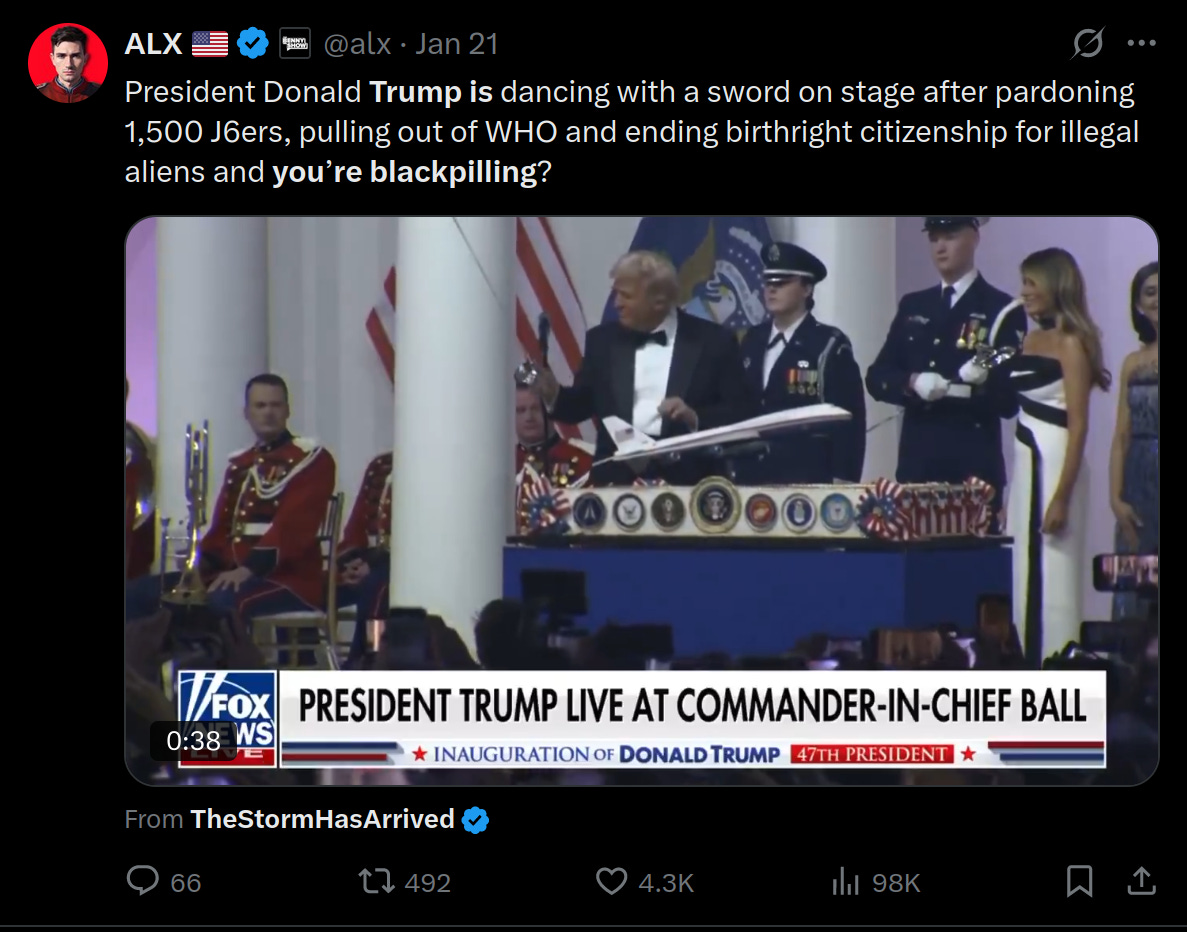
The real whitepill in all of this1 is the same one as always: that the failures of Trumpism constitute a learning experience. And while the dissident right can be slow to learn, one cannot say in all fairness that it never learns. By the pre-Trump era it had learned to spot ‘cuckservatives’ by their milquetoast rhetoric and ineffective actions; then, during the Trump 1.0 years, it had to learn the difference between strong rhetoric and effective action. And by the time Trump 2.0 is over and done, one hopes that it will have learnt to distinguish two distinct categories of effective action, which we shall here christen janitorialism and abolitionism.
Janitorialism, as the name suggests, has two faces and two functions. One of these is so-called cuckservatism, which resigns itself to the dominance of the left and at times seems to obstruct it no more vigorously than a corpse blocking a pass. But when leftist excesses start to threaten the democratist regime as a whole, the janitor shows his other face and springs into action – cutting taxes and bureaucracy, cracking down on crime, rolling back the tide of social and sexual lunacy being vomited out of the universities, and generally righting the ship of state. These actions are by no means illusory or irrelevant, nor are they devoid of benefit to the people. But they should not be confused with the sort of actions that would bring about a fundamental change in the power structure.
This same point was made at NonZionism not long after Trump’s election:
Conservatives achieve plenty of things. Eisenhower purged the American state of Russian agents of influence (formal and informal) who had successfully handed over eastern Europe to Stalin, China to Mao, and the A bomb to communism. Reagan ended stagflation, cut the top rate of income tax by two thirds, smashed union power, and saved social security. Giuliani and Bloomberg slashed murder in New York by 80%, beat the mob, and cleaned up the subway.
If we look at the lasting achievements of conservatism, we find that they have two things in common: (a) they are plainly good things absolutely and (b) they are good things for the democratic system. If we look a bit closer, we find another common thread: they are all things that parties of the Left tried to do and failed because of insurmountable opposition from internal interest groups. Callaghan and Carter were the original monetarists; Truman knew well the full horror of what Harry Hopkins and Harry Dexter White had done and tried to correct; Ed Koch was a ‘liberal with sanity’ fatally hobbled by liberals with insanity.
This sort of active janitorialism may seem and feel much more exhilarating than cuckservatism. In reality it is just a variant of the same, in which the perpetually cucked and abused husband temporarily forsakes the padded chair and the wank-flannel, and throws out the uppity bulls before cleaning up the mess of a fuck session that went a bit too far for his better half to handle. To speak more plainly, were it not for the services of janitorial conservatives, leftist elites would have to discipline their own midwit ideologues and client kakistocracy at the expense of their own political capital and coalitional cohesion. This sets the lack of resistance to Trump’s election in its proper context; someone had to chastise the left, reconcile the right, get a grip on the border, and restore the dignity of a presidency that had become an all-too-true representation of geronto-gynocratic uselessness.
What, then, is abolitionism? Again as the name suggests, this is simply the position that the current political order ought to be totally abolished and replaced. From the abolitionist viewpoint, correcting problems and excesses that were manufactured or grossly exacerbated by the regime is at best an ultimately pointless exercise, and at worst a form of protection-racketeering. It is like treating the viruses while sparing the HIV; like cleaning up the carnage while leaving the criminal at large; like prudently steering the crazy hijacked bus out of crashes so that it can carry on driving all its passengers towards the edge of a cliff.
Abolition means dismantling the modern administrative state, breaking the power of the political clerisy that rules through it, and ending the system of special-rights clientage through which it controls the subject populace and ceremonialized electoral system.2 The reason for doing all of this is not to save money, not to run things more smoothly with less disorder, but to save humanity from the fate of a dwindling domesticated species under a perverted tutelary despotism. Of course there is much scope for disagreement on the question of what sort of society would follow the abolition of the modern structure; but for now let us only say that the preferences of the various squabbling right-wing cults of liberty, nationhood, personal leadership, patriarchy, morality and religion on this are not as mutually-contradictory in practice as is usually assumed in theory, since they all point to an alternative order that better resembles the one that existed before the rise of bureaucracy and democratism.3
Yet the mere fact that these ideologies point to an older order does not necessarily make them abolitionist as opposed to janitorial, because the modern regime is a parasite on the remnant of that order and requires its maintenance in order to survive. Like the unevenly-sized fragments of something that has been shattered, some of them contain more abolitionist content than others; and even in the event that one of them begins from an uncompromisingly abolitionist position, this need not prevent its being whittled down and turned to janitorial ends upon being tossed into the fray of democratist politics. The prime example and cautionary tale would be libertarianism, which is radically (if unrealistically) abolitionist in theory, yet has long served as the jewel in the janitorial-conservative crown.
It is important to note that the ‘radicalization’ of the right, by which is meant its conversion from faux-libertarianism to ethnonationalism and conspiracism, has not necessarily made it more abolitionist than it was. Nationalist ideology has little to say about the constitution of the state4 (other than that our present arrangements would work just fine were it not for all those bloody foreigners), and conspiracists tend to deflect the problems of clerical democratism onto tales of personal villainy that can at best serve as their ‘mythological’ expression. Perhaps there is a mounting abolitionist sentiment behind the escalation of rhetoric, but it seems no less easily redirected into janitorial dead ends than it always was.
This bewrays no grand conspiracy to delude the people. The natural appeal of abolitionism is to two small minorities on the right: the intellectual autists who can work it out in theory, and the men of action (not ‘activists’) who might one day put it into practice. Between them lies the vast majority of ordinary and basically decent folks who are happy to vote, patch things up, declare peace and forget about politics at the earliest opportunity. As we have said, this preference does not change when those people become ‘radicalized’; and it seems natural enough that it will resist change as long as the democratist regime is basically stable, sufficiently competent, and not terribly repressive by modern historical standards.
Having said all this, without laying claim to any especial fortunetelling talent, I can foresee one way in which the political situation in the US might develop so as to open the way to a mass abolitionist movement.
Let us assume that, as Yarvin argues, the Trump admin has shot its bolt and has no more surprises up its sleeve. Let us further assume a worst-case, ‘blackpilled’ scenario – that the con party loses the coming congressional elections, that the prog party retakes the presidency in 2028, and that this sets the stage for a wave of lawfare against Trump and his associates as well as repression and censorship against the ‘extremists’ in the wider MAGA movement. Much of the con party proper has despised Trump from the start and can be expected to go along with a purge-and recapture-operation, and it seems likely that at least some of those waging internecine war against the ‘woke right’ have smelt the wind and are manoeuvring themselves into a position from which they can hope to emerge unscathed as a sort of client-leadership of the wider movement. With Trump disbarred from running for a third term, all of this will be an easier sell to the voters than it was after 2020, especially if some pretence of continuity is made (e.g. leaving Vance on the presidential ticket while purging anyone around him with an appetite for more than edgy tweets).
Obviously none of this is a foregone conclusion. But we might assume it as such for the sake of argument, as an extreme form of what seems likely to happen after Trump: a return to janitorial business as usual, albeit with an alt-lite rhetorical style divorced from any capacity for transformative action. In as many words, hubby will be going back to the cuck chair, with all sorts of fetters on any future attempt to make himself master of the house. Inglorious as this may be, it is by no means the worst-case scenario (which is why it is perhaps too optimistic); that would be a renewed cycle of provocation, failure and backlash, with little damage done to the government but plenty suffered by the people. If you can’t or won’t kill the king, then your best option is to remonstrate politely and keep your hands to yourself.
But some would not be able to forget the taste of blood in the water, the sweet delirium of the victory that might have been. These disappointed ones might do as they have always done – bite down the slight sting inside and vote for the ‘least worst option’. Alternatively, they might become the kernel of an abolitionist movement.
The most natural beginning of such a movement (especially in a climate of betrayal and repression) would not be the formation of a new party or a switch of voting allegiance to a new candidate. Abolitionism must begin with a non-party and a non-vote – or, as I prefer to call it, a No Vote. Yes, you’ve guessed it – this simply means abstaining from the vote, building up a crowd of abstainers around you, and making it clear that you are abstaining because modern democratist politics is a fraud that serves to rubber-stamp a usurpatory power. And it means remaining unmoved in the face of the argument that you are preventing the ‘least worst option’ from pushing back against the ‘worst worst option’.5 Worse does not make better; but peoples (including the Americans) have suffered wars for questions of political principle, and can surely forgo the services of an unreliable protection racket that generates demand for itself by provoking those it claims to fight.
Indeed the concept of the ‘least worst option’, aside from being a grammatical clusterfuck, is open to serious question. When you take sides between prog and con, you are contributing to a political war that is responsible for a much of the social and cultural destruction deplored on the right. On the prog side, it is at least in part the incentive to create dependent votebanks that motivates the creation of ‘empowered’ special-rights groups, as well as the ongoing campaign to scapegoat and outnumber the Global Minority. Voting against these votes, in the full understanding that victory can never bring an end to the special-rights regime, is like engaging in an endless bidding war that ensures the continued high value of votebank dependency to the state. On the con side, economic and military elites (i.e. the ‘military-industrial complex’ who might pose a potential threat to the political clerisy remain invested in its rule because their interests are represented by janitorial conservatives, who are in turn dependent on the support of the people. Only when it becomes clear that a significant number of those people will no longer support janitorialism will it be possible to convince these elites that their real interest lies in the abolitionist cause.
Finally, there is the spiritual clarity that comes with not willingly perpetuating a deception or serving your enemy’s cause. This, in principle, stands above considerations of strategy and calculations of utility – but it is important to note that it is not truly in conflict with them.
Yet here we must note that while individuals (such as myself) may choose not to vote as a kind of renunciation, this would not be the spirit of a mass No Vote movement. The act of abstaining (or, if legally forced to vote, spoiling one’s ballot) would be understood as a virtual vote for the as-yet-impossible option of Abolition, and the ultimate object of the No Vote would be to convert this virtual vote into a real one. I can see no other way than this initial withdrawal to bring the abolitionist option to the table, given that participation in two-party politics simply results in the perpetual extortion of popular consent.
Initially, the No Vote would act as a purely negative political force – a black hole sucking away votes, people and political energy from the official democratist system. Only after garnering wide and high support could it hope to take upon a positive shape – perhaps an Abolitionist Party, or perhaps a conversion of either the con or prog party to its cause.6 Although the withdrawal of a large groundswell of support from the official political system would not of course prevent the two-party game from continuing, perhaps in perpetuity, it may well present a tempting prospect for alliance that can then be utilized as a route to power – especially if the state is suffering a crisis of legitimacy and both parties are being infiltrated up to the gills.
I would be the first to admit that this strategy is, in some ways, intended to take advantage of the dominant tendency of most people on the right towards sloth and low political agency.7 But in other ways, and for a smaller group, it would require a great amount of work. The case for Abolition would have to be worked out to the last legal detail. So too would the strategy, which would of course not be viable without converts or infiltrators in key areas of the structure. The extended bureaucracy or ‘broad state’ would have to be entirely mapped out and exposed, so that no confusion could exist as to what each node is doing and what is to be done with it. Since we are not pie-in-the-sky libertarians, much thought would have to be devoted to replacement governing institutions, which would be obliged to run with far fewer personnel (since clerical democratism thrives upon institutional bloat); and though in many areas power can and should be devolved back to society, for this to work, citizens long-accustomed to domesticated dependence would have to have learned the requisite skills and virtues to wield that power effectively.
Even with all of these additions and caveats, the idea is still fraught with a thousand problems and dangers, and I have no intention of denying any of them. Looking at what I have just written, in all honesty I think there is much to be said for the alternative option – as long as we are agreed that this option is nothing more or less than perpetual voting for janitorial conservatives, with an ever-decreasing chance of getting anything more into the bargain, and that any pretence to the contrary is the most wretched cope and self-delusion. Nevertheless, this is the safer and perhaps in some ways the more rational option – like the decision to wait out a hostage situation day after day instead of trying a risky escape.
Although my own sympathies should be obvious, I am not so much trying to convert people to abolitionism as to honesty. Abolitionism or janitorialism – take your pick. By means decide on the latter if you believe it to be the better option. And by all means, hold out hope for some sort of outside deliverance – but consider also the proposition that God helps those who help themselves.
Consider how close the ‘whitepill’ as encapsulated in that John Carter post is to the ‘blackpill’ as commonly defined on the dissident right; that is to say, both of them are about giving up a hostile and dissident stance toward the regime, and the only real question is whether this shall be done out of premature complacency or excessive despair.
In case it should need saying, my linking to articles that address these problems from an American constitutionalist perspective is not meant to imply that they cannot also be identified in more or less the same form outside the US (as far as I am concerned, everything that I say here applies mutatis mutandis to Britain and most of Western Europe), or that they might not be addressed from an entirely different ideological perspective.
It occurs to me that there is also a ‘left’, ‘futurist’ or more precisely ‘mechanicalist’ approach to abolitionism, which would seek to clear away the current regime in order to replace it with something much less reminiscent of older social forms. Consider for example Moldbug’s early ideas for a crypto-locked surveillance state, or the idea of a bureaucracy, legislature and judiciary run almost entirely by artificial intelligence.
An exception might be made here for national-secessionism, but not if the object is to recreate the clerical-democratist state on a smaller scale.
Some might make an exception here for local politics, which is less tied up with questions of fundamental political legitimacy.
However great the difficulty of infiltrating and ‘turning’ it, the prog party is arguably the better option, given that it at least has a functioning will-to-power and habit of commanding obedience (and thus has been known to make limited cuts to bureaucracy without provoking mass hysteria).
Nobody on the right wants to admit to such tendencies, but surely it should not be controversial to suggest that the limitations of most of our people must be factored into any realistic assessment of what we can expect to do. A typical James Bond mission, involving at the very least casinos, martinis and seduction, could not be entrusted to an alcoholic gambling-addict incapable of keeping his head straight around a pretty woman. Yet some aspiring rightist strategists expect feats of political infiltration and manoeuvre that rather resemble Mission Impossible.