
The Lordless Warrior
Tackling what Tolkien called the toughest crux in Beowulf

In our last post on Beowulf, we noted that the monster Grendel seems to be conceived by the poet as cut off from God and predestined to damnation. There’s another couple of lines elsewhere in the poem that we might have cited in support of this interpretation, but these require a post to themselves. They form a notorious crux, or disputed passage, one that J.R.R. Tolkien called “perhaps the most difficult in Beowulf”.
The couplet appears in the second ‘fitt’ or chapter, which narrates the terrible descent of Grendel upon Heorot, the hall of King Hrothgar of the Danes. We are told that Grendel visited the hall every night and killed anyone he found there; that men avoided the hall thereafter; that Grendel would not accept tribute from the Danes or pay recompense for the men he killed; that he ruled the misty wastelands inhabited by initiates of hell; and, finally, that he haunted the empty hall in the dead of night. And then, just before a change of subject to the suffering of King Hrothgar, the poet adds the following enigmatic words (lines 168-9):
No he þone gifstol  /  gretan moste
maþðum for metode  /  ne his myne wisse
The first line is the simpler. A certain he, presumably Grendel, may not (no…moste) address or approach (gretan) the ‘gift-stool’ (gifstol), by which is almost certainly meant a throne. It is the second line that complicates things. This begins with the words ‘treasure for the measurer’ (maþðum for metode) – with for perhaps used in the sense of ‘before’ and perhaps in that of ‘for’, and the word metod used apparently without regard to the context, since it is ordinarily a word for the Christian God. And it adds the phrase ne his myne wisse, literally “nor did [he] know his mind”, which is perhaps to be taken as meaning that Grendel lacked knowledge of God.
There is thus an apparent shift of emphasis, and even one of scene, from the first of these lines to the second. In the first line, we are still in King Hrothgar’s haunted hall, with Grendel for some reason unable to approach the throne despite having taken over the building in every other respect. In the second, it seems that the throne Grendel cannot approach is no longer that of Hrothgar but that of God. But which of these understandings is the correct one?
Before we lay out an answer, let’s see what scholars have made of the couplet. In his early, posthumously published translation of Beowulf, Tolkien came down on the side of the theological interpretation and rendered the lines as follows:
Never might he approach the precious Throne of grace in the presence of God, nor did he know His will.
Other translators and editors tend to favour this interpretation, although they disagree on lesser points such as the translation of myne. Howell D. Chickering, for example, translates the lines thus:
He could not come near the gift-throne, the treasure,
Because of God – he did not know His love.
And Tom Shippey’s new translation, which one imagines will be regarded as the authorized one for some time to come, produces yet another variant on the theme:
The Lord would not let him go up to the gift-throne,
Nor did he know the favour of the Lord.
Before we set about revising this interpretation, let’s take a deeper look at the reasoning behind it. For this we need look no further than Tolkien, who gives a detailed account of the crux in the scholarly notes appended to his translation (which were written much later than the translation and are much more representative of his considered views on the poem).
He begins by noting that the passage does not appear to be corrupt or otherwise in need of emendation:
This couplet is perhaps the most difficult in Beowulf. ... But the couplet does not appear to be corrupt: no one has seriously attempted to find relief in emendation, at any rate no emendation worthy of consideration has ever been proposed. The crux is one of translation. ... The difficulties are these: what are the references of hé [in line] 168, his [in line] 169? hé = Grendel, Hrothgar, Metod, gifstól, maþðum? Also the exact sense of grétan, of maþðum, and of myne wisse are all in doubt.
Now at first sight it looks as if hé was Grendel, and the gifstól was Hrothgar’s throne, and a contrast is intended between the normal behaviour of a loyal thane in the hall and the conduct of the wicked intruder who did not recognize the lawful authority of the king. And in favour of hé = Grendel is the fact that Grendel has been the subject since [line] 164.
Here Tolkien touches on an aspect of this poem that merits more emphasis and explanation. It is not just in this passage that the poet seems to draw a contrast between the behaviour of Grendel and that of a loyal thane; the same idea recurs in many others. Earlier in this fitt, line 142, he is called a healðegn (‘hall-thane’); much later on in line 790, when he draws near to the hall to attack Beowulf and his men, he is described as a rinc siðian (an ‘adventuring warrior’, or more idiomatically, an ‘errant knight’); when he wrestles Beowulf, in line 770, the two are called renweardas (either ærnweardas ‘hall-guards’ or regnweardas ‘wonder-guards’), a turn of phrase that almost equates the one to the other. The idea seems to be that Grendel is a shadow, antitype or degraded parody of the wandering hero, and a reference to the fact that he cannot hail the throne like a ‘normal’ thane would certainly fit the established pattern.
grétan means fundamentally ‘hail, address, greet’, but in Old English, through the usages ‘accost, address oneself to’ it may be used (as a litotes) for ‘assail’; or it may come to mean or imply ‘set hand to, touch’... But we perceive that the most natural sense of gifstól grétan is not ‘touch’ but ‘hail, address the throne (of gifts)’. maþm means a gift, and so can of course repeat or refer to the gif-element in gifstól; but it cannot refer to the whole gifstól – it cannot mean ‘the throne’. Maþm is a thing given in exchange or as reward (‘a precious thing’ only secondarily); and kings, even in fairy-story, do not give away their thrones. It is however a thing that a king on his throne might give...
Here Tolkien departs from the many translators who take maþðum to be a circumlocutory repetition of gifstol, that is to say another reference to the throne. And I would say he is correct in this. The Old English word maþm (restored by Tolkien to modern English as mathom) refers to the sort of movable property that can be hoarded as a treasure or given to someone else as a gift; that it should refer to a throne set into a hall and regarded as an inviolate symbol of kingship is out of the question.
myne is a noun related to munan as cyme [‘coming’] is to cuman. munan means ‘think of, have in mind or purpose’. myne thus means ‘thinking of (a person or thing) – intention, will – recollection’. Actually elsewhere it is mostly recorded in a good sense, so that contextually it may mean ‘good will (towards), kind thought (of)’. Now witan in Old English can be used with verbal nouns in the sense ‘know, feel’: as witan ege ‘feel fear, fear’. So witan myne could be taken to mean ‘have thought or memory (of).’ But the usual sense in verse is purpose, wish... So that clearly ne his myne wisse is most likely to mean ‘and did not know his purpose/wish’. But it might mean ‘and did not have thought for/of him’. ...
We shall return to this phrase witan myne below; for now let us only note that, according to Tolkien’s account of its components, its meaning could be interpreted as ‘feel goodwill towards someone’ or ‘have a kind thought for someone’ in addition to the other options such as ‘know somone’s mind’.
With these preliminaries it will at once be found that the throne cannot be Hrothgar’s. ‘Grendel could not touch (or approach) the bountiful throne, receive a gift in the presence of (or because of) God, and knew not His purpose (or took no thought of Him).’ ... But could it be? Why could Grendel not approach the throne, when he was in sole control of Heorot all night? There was no magical or divine protection over the throne any more than over the hall or its inhabitants, and no doubt Grendel could have sat in the king’s throne and gnawed bones there... And it is no solution to reply that what is meant is that Grendel could not come before the throne and get a maþum, like an honest þegn [thane]. For he could have done so, if he wished. ... Had he desired peace or truce the Danes would have welcomed him…
It becomes plain therefore that the language is theological. gifstól is God’s throne, and is an example of the frequent use of heroic language with theological import; gif- (and its equivalent maþum) refers to divine grace or mercy…
Try again. ‘Never (or in no wise) could he have recourse to the gracious throne and its bounty in the presence of God (or because of God, i.e. because God did not allow this); and he knew not His will.’
We need follow Tolkien no further than this explanation of his old translation, because from this point on he throws it out and embarks on a radical reinterpretation of the couplet in which it is Hrothgar who cannot approach the throne of God. This has not convinced the majority of Beowulf scholars, and I am not convinced by it either. But nor do I find the usual translations convincing; and I can see why the older Tolkien might have been dissatisfied with his early conclusions, aware that something was not right, and willing to entertain more tenuous suspicions about the couplet (specifically, that some monkish scribe saw a chance to have a dig at a heathen king and clumsily interpolated it).
Having allowed The Don to lay out a basic map of the territory and provide some interpretative tools, let us take what we can and leave what we must, and embark upon a new solution1 to the crux. We shall have to cross some rather thin ground, and I am not as expert guide as I would like to be, so any constructive criticism is more than welcome. When there’s a will, though, there’s always a way.
One word that neither Tolkien nor anyone else seems to want to dispute is metod, the standard translation of which is ‘measurer’, and which in practically all interpretations of this couplet is simply assumed to mean ‘God’. Admittedly, there is a good reason for this: practically all instances of the standalone word metod in Old English verse refer to God, and the only other attested meaning of the word in compounds is ‘fate’ or ‘destiny’ (as in e.g. metodsceaft, ‘fate-decree’). The Old Saxon word metod is used throughout the Heliand in the same dual sense of ‘God’ and ‘fate’, whereas the Old Norse cognate mjǫtuðr seems to mean ‘fate’ and has been extended from this meaning into that of ‘bane’, ‘death’. In the face of such a chorus of corpus readings, there is surely no case for saying that opinion is divided on this subject.
The problem with this logic is that poets – particularly those gifted with skill and subtlety, as the Beowulf-poet was – do not always use words according to their common meanings, or at least do not always use them solely in accordance with these meanings. Perhaps in nine cases out of ten the ‘democracy’ of the corpus will give the right judgement; but in the case of a crux that has vexed scholars for two hundred years, one would think that it is high time we consulted the minority report. That is to say – it is time to engage in the risky business of applying logic, reading between the lines, niggling over details and haggling over interpretations, and so on.
To lay out my conclusion before my argument, I suspect that metod could technically be used to in the sense of king or ruler, and that the gifstol that Grendel cannot approach is therefore technically that of King Hrothgar. In support of this, I appeal first to the same corpus that has given us the majority verdict. This is a sample of what the Bosworth-Toller dictionary gives us by way of examples for the use of metod in the sense of ‘God’:
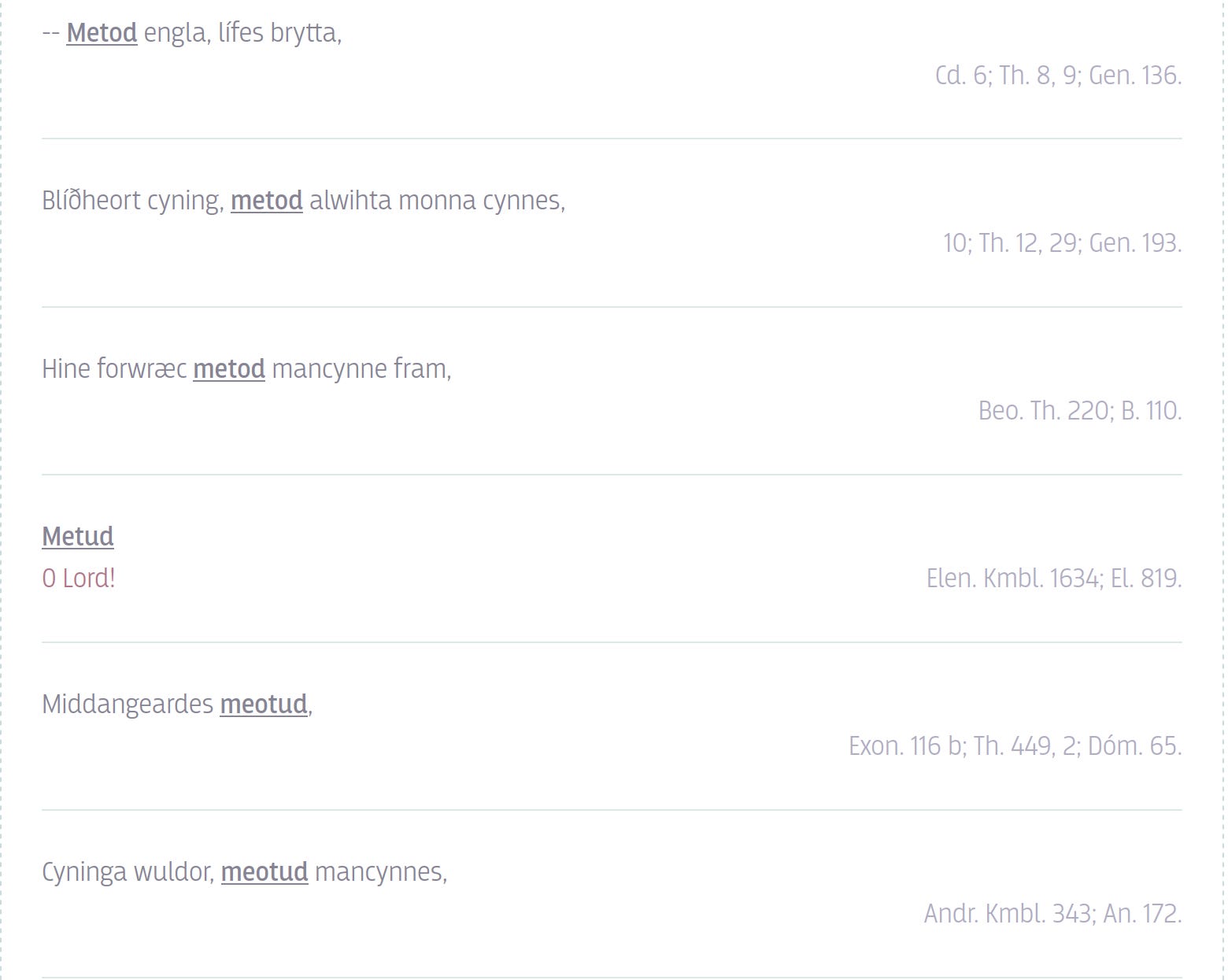
The first example, metod engla, lifes brytta ‘measurer of angels, dispenser of life’, strongly resembles formulaic expressions describing kings (to make up a typical example, drihten Geata sinces brytta ‘ruler of Geats, dispenser of treasure’). The second is found next to cyning ‘king’, as though the meanings were equivalent or similar, and the same basic word association is found in the sixth. But how are we to understand the fifth example, middangeardes meotud ‘middle-earth’s measurer’?
The real question is, what is the literal meaning of metod? The old translation ‘measurer’ is obscure and ambiguous, hence often confused with ‘maker’, ‘creator’, or ‘divine architect’. But what it really means is dispenser (in the sense of ‘one who measures out’); a closer translation yet would be meter, in the sense of ‘one who metes out’, since the noun metod comes from the verb metan ‘to mete’. The Bosworth-Toller entry for this word is also quite enlightening:
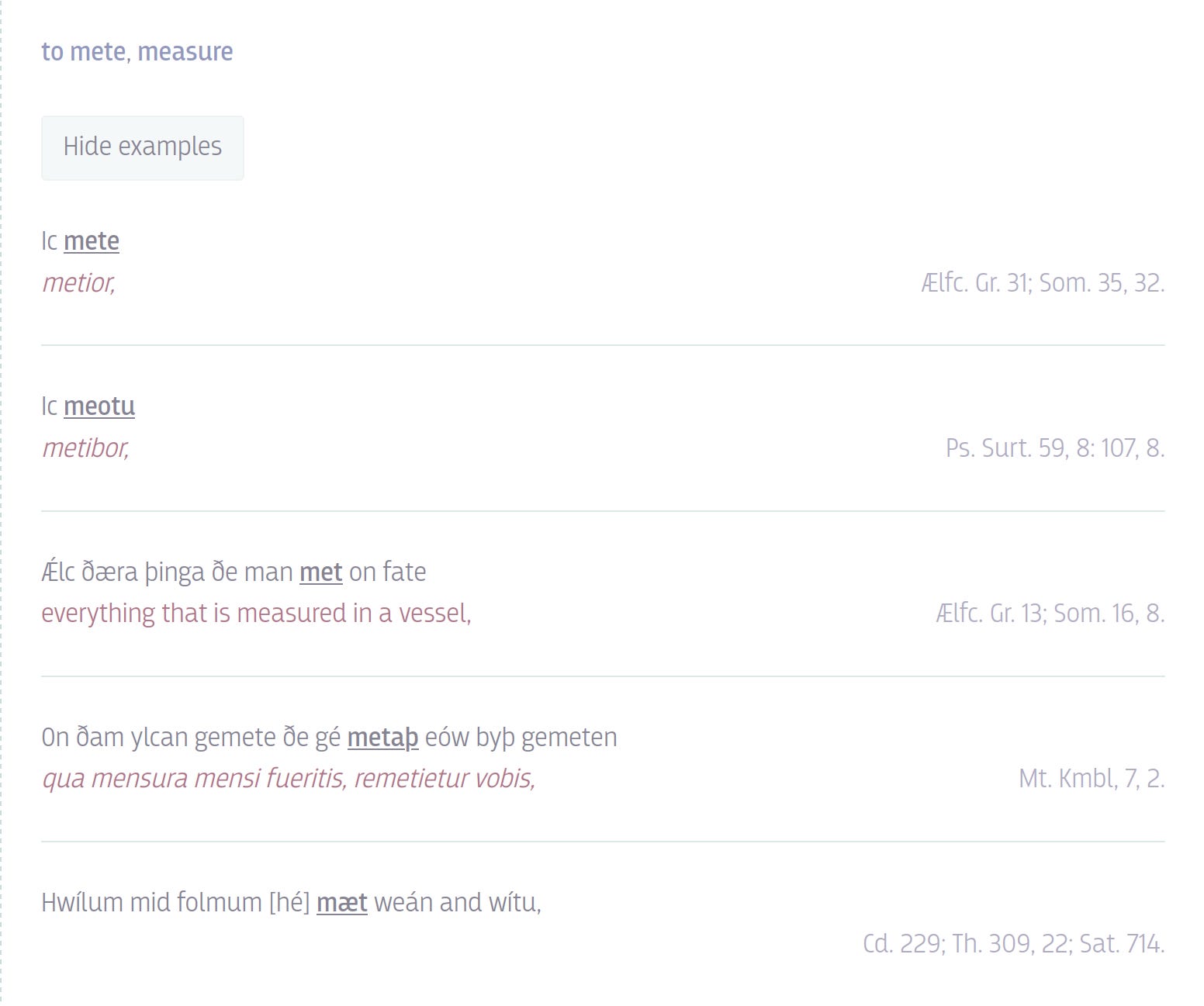
In the second example from the Anglo-Saxon Psalter, the Latin metibor comes from Psalm 59:8 in the Latin Vulgate, and refers to Solomon’s intention to “divide Shechem and measure off the valley of tabernacles” (partibor Sichimam et convallem tabernaculorum metibor). Here, then, metan is used of a king’s parcelling out land in his role as a dispenser of all things within his kingdom; and so also the fifth example, which reads ‘sometimes with his hands he [i.e. Satan in hell] meted out woes and afflictions”. Even the fourth example, has some relevance to the proper role of a ruler, since it comes from Matthew 7:1-2: “judge not, that ye not be judged, for with what judgement ye judge ye shall be judged, and with what measure ye mete it shall be measured unto you”.
It would seem, then, that the act of meting or dispensing was associated with (among other things) the distributory and judicial roles of a ruler, and that a meter or dispenser would have been implicitly understood as being synonymous with a ruler. Thus middangeardes meotud (used of Christ on the cross in the poem Judgement Day) could be translated as ‘middle-earth’s measurer’, but also as ‘middle-earth’s lord’ (or, if we want to retain the chime of sounds, its master or commander), albeit in the specific aspect of dispenser of goods unto its inhabitants. Indeed the change in sense of Old English metod from earthly to divine power may well be said to resemble that of modern English lord, although the lack of written material from older pre-Christian society would have ensured that the shift was more decisive.
We could continue scrutinizing the fine sense of metod as applied to God, or seek out more usage examples for metan, but let us confine ourselves to just one more example. The poem called the Wanderer opens with the following words:
Oft him anhaga / are gebideð
(The one who is alone ever waits for favour)
Metudes miltse…
(The measurer’s kindness…)
A close reading of this poem (I’m afraid my own translation is far from adequate, though I have done better with the Seafarer) will show that it consists of one long analogy between the traditional lordless exile and the fallen seeker of God, in which the heroic exile theme gradually falls away to reveal the underlying Christian homily. Except (apparently) for this early use of metud, direct references to God are avoided through the beginning and middle of the poem, so that it reads like a heroic lament from an exiled warrior mourning his lord, friends and feast-hall and seeking out new ones. Then the perspective shifts to a meditation on worldly impermanence – also couched in traditional themes of ruin, desolation and heroic moral wisdom – and only at the very end do we find an unambiguously Christian statement of faith in the ‘Father in heaven (Fæder on heofonum). From this point we can look back on the earlier verses and, perhaps, conclude that not all of them are what they seem to be.
Quite clearly, this poem has been crafted with care according to a definite plan, by a skilled poet whose purpose may or may not have been to ‘hook’ the readers of pagan lays into a disguised Christian homily. Are we to suppose that such a master cackhandedly gave his game away at the beginning with a word, metud, that unambiguously meant ‘God’? Is it not more likely that he hinted at his true purpose with a word that could mean either God or a dispenser of goods?
This little discussion of metod would not be complete without a brief look at its Old Norse cognate, mjǫtuðr (and since I know next to nothing of Norse, I am indebted to Konrad Rosenberg for clarification of the meaning). The Wiktionary entry for this word, which originates from Geir Zoëga’s Old Icelandic dictionary, presents us with a tempting red herring:
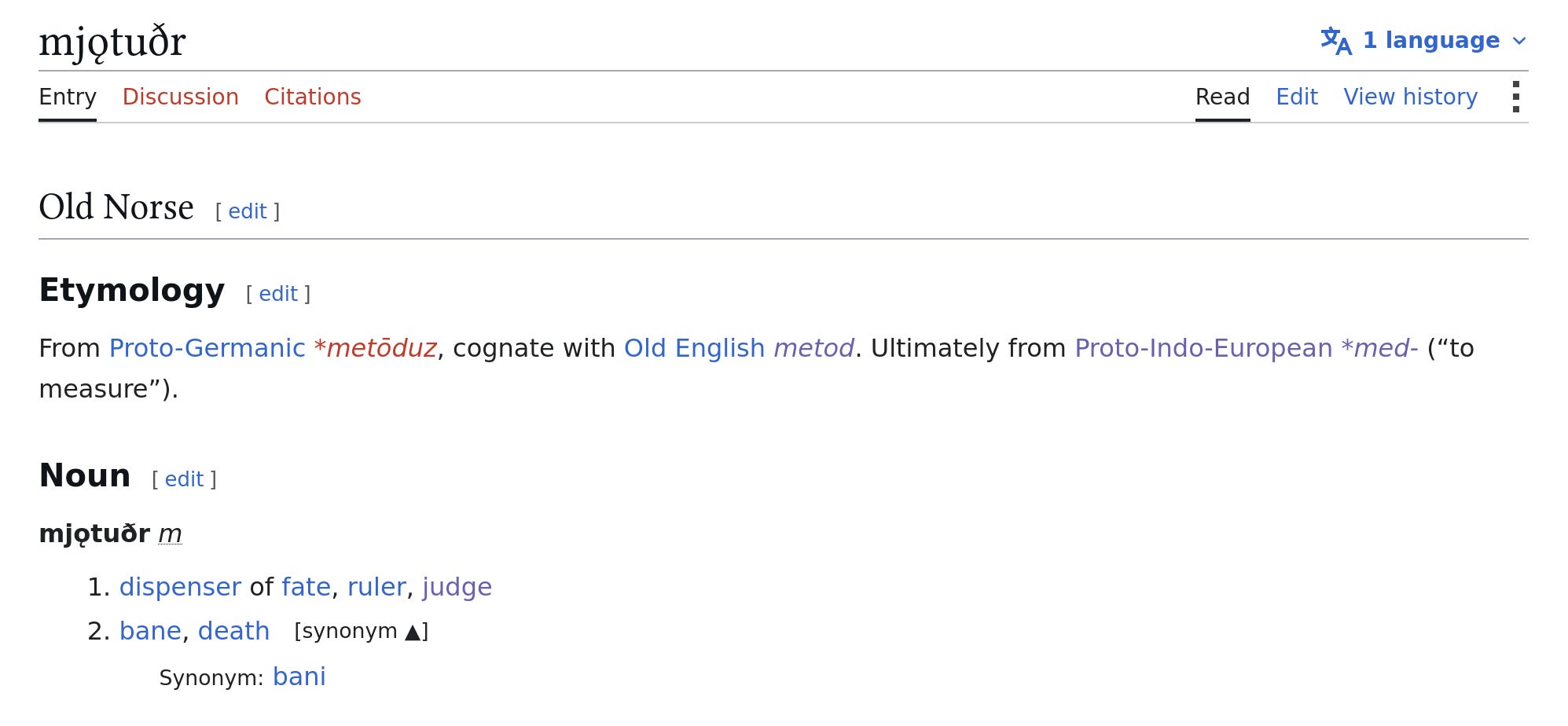
‘Ruler’? ‘Judge’? Confirmation bias intensifies. Alas, Zoëga’s dictionary gives no examples for these latter two definitions, and it would seem that only the first one ‘dispenser of fate’ stands on any sort of firm ground (perhaps the latter two were meant to read as appendages to it, in the sense of ‘dispenser of fate, ruler thereof, judge thereof’). The Cleasby-Vigfusson dictionary gives some inconclusive examples, but some of these (according to Rosenberg) most likely refer to the mjǫtviðr ‘measure-tree’, i.e. Yggdrasil; and although Johan Fritzl’s Old Norwegian dictionary defines the word as ‘ruler, one possessing power’, it cites Anglo-Saxon material in support of this. Mjǫtuðr in Old Norse seems if anything more obscure than metod in Old English, and I would rather not hang any part of my argument directly upon it.
What I will say is that the divergence in meaning between the Old English/Saxon cognates and the Old Norse one is interesting, and suggests that the the original of both (reconstructed as Proto-Germanic *metōduz) had some concrete meaning that was abstracted and analogized in different ways. Either this was simply fate (i.e. the noun was an abstraction like Old English wyrd ‘eventuality’ and orlæg ‘fate, destiny’), or else it referred to a personage (as does its descendants), in which case the referent could be adumbrated as one on high who dispenses things good and ill. A god, perhaps? Or, as I suspect, a ruler in some pre-Christian sacral aspect (such as sacrifice) that was wiped from Germanic culture after Christianization and survived only in analogies? At this point we are in the realm of wild guesses.
This is about as far as we can come to proving our case, and I would be the first to admit that we are not all of the way there. So let us rather show that the proposed meaning ‘king, lord, dispenser’ for metod, once granted provisionally, gives us the best possible chance of making sense of the Beowulf couplet.
Of course there is no question of the poet’s randomly choosing to use the word in such an obscure sense; in all likelihood, he knew what he was doing. What we have here is not an awkward turn of phrase, nor a cackhanded shift from narrative to homily, but a case of intentional ambiguity. At the lower, physical level, Grendel cannot approach the throne of King Hrothgar in Heorot; but at the higher, spiritual one, it is the throne of God in Heaven that is denied to him. This, perhaps, can be entered into evidence for the theory that Grendel is predestined to damnation. But according to patristic lights, a spiritual meaning does not abolish a literal one; and so how, as Tolkien asks, is Grendel disbarred from approaching a throne in a hall over which he exercises sole and total mastery?
In my view Tolkien’s case for the unlikelihood of this is quite overstated. In the Beowulvian world, it is God’s ban on Cain and his kind that has hitherto kept Grendel confined to the ‘moors’ (moras, possibly ‘marshes’), despite his being invulnerable to weapons and apparently strong enough to take on any number of armed men. For some reason known only to the Lord, Grendel is permitted to overstep his bounds and to attack Heorot and its inhabitants for a time; but something, presumably the divine ban, prevents him from ranging further to devour the men in their own houses (which, as we find out when Beowulf finally visits God’s vengeance on Grendel, stand close enough to the hall for those within to hear the noise of battle). For all his monstrous physicality, Grendel’s behaviour resembles that of an evil spirit hemmed in by invisible borders, and there seems no reason why one of these should not prevent him from defiling a symbol of kingship (especially one that may have had sacral elements).
Having said all that, there may be a more prosaic reason why Grendel cannot ‘greet the giftstool’. If gretan means just ‘touch’ or ‘approach’, surely only God could prevent Grendel from doing that during his nightly hauntings; but if it entails some sort of ritual salute to the throne for metode ‘[be]fore the measurer’, and extends also to at least one maþðum ‘treasure’, then the obvious reason why Grendel cannot do it is that King Hrothgar has vacated the hall and probably taken his hoard of maðmas with him.
These arguments would suffice to make basic sense of the couplet; but since the extension of gretan to a single maþðum is awkward, I would go further. Although, as Tolkien remarked, emendation has never been a popular solution to this crux, it seems to me that a change of maþðum (singular, subject) into maðþmum (plural, indirect object) would result in much better sense. This entails the restoration of a single m, which might have been dropped by the first Beowulf-scribe due to his notorious incomprehension of what he was copying, or else due to his carelessness (note that he misspells Grendel as Gredel in line 591, brimwylf ‘sea-wolf’ as brimwyl ‘sea-wool’ in line 1506, etc.) The result in the present context is first that Grendel is no longer unable ‘to hail the giftstool, the treasure’, but is rather unable ‘to hail the giftstool with treasures’, and second, that for metode can now be interpreted as ‘for [the sake of] the measurer’ as well as ‘before [in front of] or because of the measurer’.
Does this make sense? Some might say it is more natural to assume that Grendel, were he an “honest þegn”, would be going to the gift-throne to get a mathom rather than in order to give some to the king. But there is at least one ritual occasion on which a good thane would be giving the mathoms rather than getting them, and this is of course after victory in battle and taking of spoil. Moreover, since the king was not to then hoard this loot for himself but to distribute it according to merit (a convention most likely settled upon in order to prevent an army on the battlefield from degenerating into a mob of looters spoiling the dead), it is precisely in this context that his role as ‘dispenser’ might be emphasized. It is in accordance with this tradition that Beowulf, after triumphing over Grendel and his mother and receiving a wealth of horses, weapons and gold from Hrothgar, relinquishes almost all the treasure to his own king Hygelac and receives his own lands, hall and throne in return.
Recall that at the beginning of this fitt, or chapter, Grendel has made his first attack on the Danes and slaughtered thirty of them before carrying some away. As he makes his way back to his moorland lair, he is described as huðe hremig ‘exulting in spoil’, a darkly ironic reference to the corpses that he will feed upon at his leisure; and when the sun rises on the blood-stained Heorot, it is said to reveal Grendel’s guðcræft ‘war-craft’ or ‘battle-might’ to men. Thus, as we have said, does our poet portray Grendel as a shadow or degenerate parody of a bold young warrior.
The idea that this anti-thane cannot, after all his victories, offer his grisly prizes to King Hrothgar and receive the proper gifts in return would be fully in keeping with this theme. The only slight difficulty is that Hrothgar would probably like to have some of his liegemen’s corpses returned so that he can give them proper funeral rites, and might be willing to pay for them quite handsomely. But the very nature of Grendel (which extends to his whole race, and is ultimately a result of the divine ban) makes this an impossibility, and so it remains true to say that it is not granted him to offer gifts before the throne or to participate in any of the other rites of warriorhood.
And this brings us nicely to the last piece of our puzzle: ne his myne wisse.
The Bosworth-Toller entry for the word myne gives three definitions: ‘the mind’, ‘desire’, ‘will’ or ‘purpose’, and ‘love’. Note, however, that the sole two occurences of witan myne – which one would think to be a set phrase with an idiomatic meaning – are arbitrarily split across two of these definitions, the ‘will’ or ‘purpose’ one and the ‘love’ one:
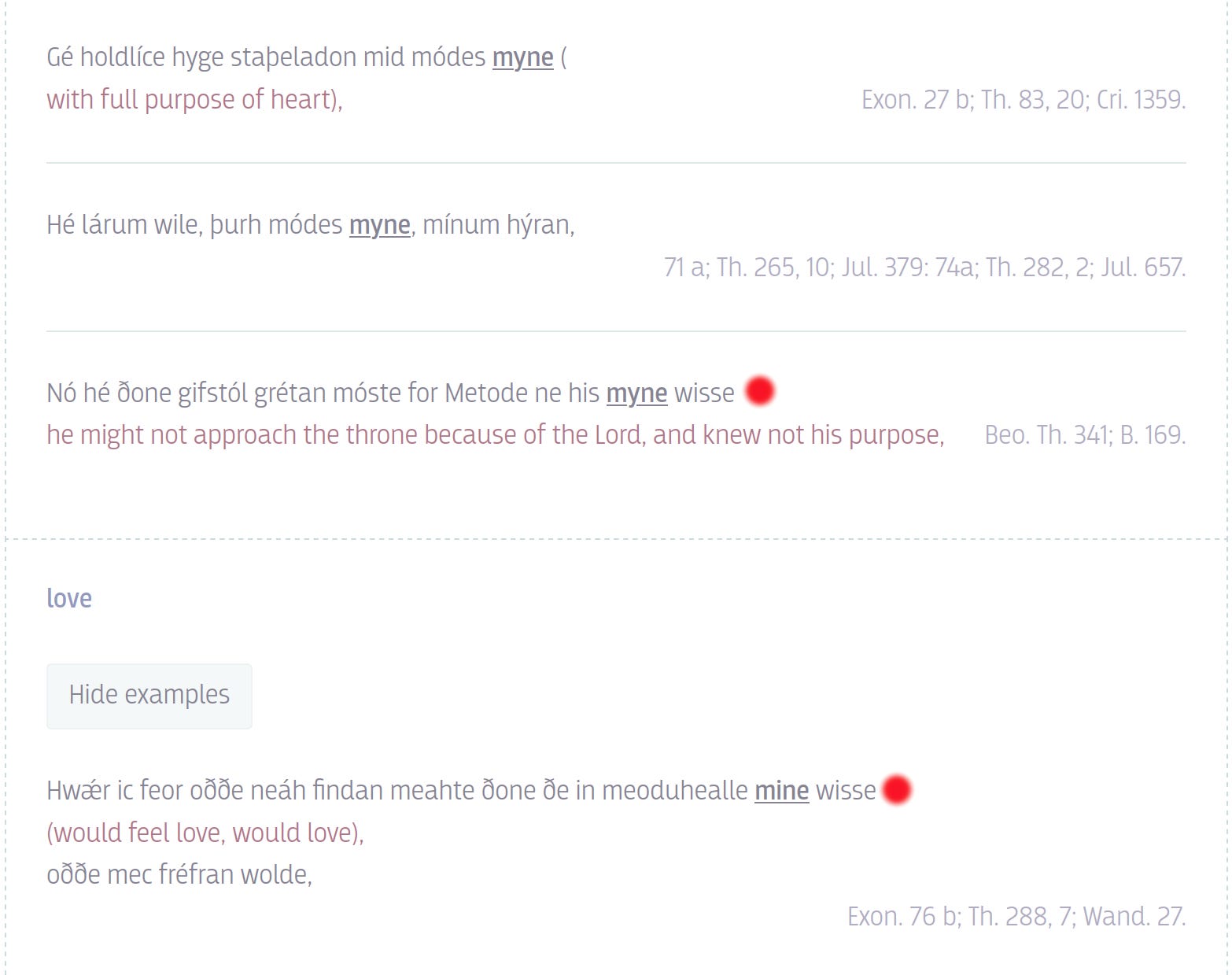
The first instance is of course the one from Beowulf, and the second is from the Wanderer, which as we have said consists mostly of a sombre meditation on the theme of heroic exile. The phrase appears in the context of the exiled protagonist’s long, apparently fruitless search for a new lord and new friends (by which we are, perhaps, to understand religious conversion and monasticism):
Sohte seledreorig / sinces bryttan
([I] sought, hall-sick, a sharer of treasure)
hwær ic feor oþþe neah / findan meahte
(Where’er I might find one, or far or near)
þone þe in meoduhealle / [min2] mine wisse
(One who in the mead-hall [my] myne wisse)
oþþe mec freondleasne / frefran wolde
(Or wished to comfort one quit of friends)
Whatever the dictionary says, it seems unlikely that min myne wisse in this context means ‘felt love for me’, and nor is it likely to mean ‘knew my purpose’. The exile is unlikely to find anyone who loves him in a world of strangers, and his purpose is not at all unclear to others; what he is searching for is someone who feels sorry for him, who is kindly disposed towards him, who has a care for him. If this was the idiomatic meaning of witan myne, it is one that applies just as well to its use in Beowulf – since, as we have said, Grendel can neither greet the throne of King Hrothgar nor that of God, and Grendel has no care either for King Hrothgar or for God.
At this point we have written some 5000 words on these two lines, and done about all we can to shed light on them. All that remains is to retranslate them according to our new understanding. First, we might try a relatively literal translation:
Though he was never allowed    to salute the gift-stool
With goods for the measurer –    not gave any thought to him.
This is not ideal, because the word allowed is not right, and the double meaning of metod is obscured by that old fossil measurer. Goods also does little to emphasize the ritual giving of precious gifts. Let’s try again, then:
Though it behooved him not    to hail the gift-throne
With presents for the lord –    nor did he pay any mind to him.
Better, perhaps; but while lord might seem suitably ambiguous in theory, it does not actually reproduce the effect of metod, because lord in the secular sense is far less obscure and unlikely to lead to any double takes. Perhaps, then, we should choose analogy over literalism, which in this case means giving an old mistranslation a second chance. Although metod does not mean maker, this word carries the same strong association with God, yet also applies to King Hrothgar in this context since he is the maker of Heorot and its gift-throne (having ordered the building of the hall early on in the poem).
Here’s how this might work:
Though he was never privy    to approach the gift-throne
With presents for its maker –    nor paid any mind to him.
Although the phrase is not quite as lucently ambiguous as for metode or for the lord, in speech (at least in my dialect of English) it is an easy matter to erase the audible difference between for its maker and for his Maker. And it should go without saying, easy as it is to forget, that writing is secondary to speaking when it comes to poetry.
I am thus inclined to plump for the third of these translations, but I would be interested in hearing the opinions of others, as well as (to repeat myself) any critiques of the arguments outlined above.
That is to say, as far as I know it has not been proposed before, and I have read quite a few editions and scholarly translations of Beowulf. But even Tolkien a hundred years ago already despaired of reading everything that has been written on this poem.
The manuscript reads simply mine wisse after in meoduhealle, but min ‘my’ tends to be supplied by emendation. It is a likely one, since the phrase requires a pronoun in possessive (genitive) case, and a scribe might well have dropped the min from min mine wisse having mistaken it for a dittograph. I mention this because it shows us that the phrase witan myne had become obscure in Old English by the time our extant manuscripts were written down.
I can't find any fault with your argument for the ambiguity of 'metod' - and your reinterpreting it as such in the context of The Wanderer is very interesting. At a quick glance, then, the first *un*ambiguous reference to God in The Wanderer would be 'aelda scyppend' in l. 85 (and I can't help but notice that it appears right near the 'ent' reference at 87: 'entas' and God, the original odd couple) .
Grende as a bad thegn who can't approach Hrothgar's throne - not because he is supernaturally prevented from approaching, but because he's unable to approach *as proper thegns do*, that is, because his own actions make that kind of gift-exchange impossible - seems like another example of the ironic understatement that is used elsewhere. So this interpretation fits the tone of the poet, a great point in its favor!
Incredible. I'm in awe. Easily the most convincing interpretation I've seen.