
The Republic's Crowned Ghost
The surprising antiquity of the cult of popular sovereignty

It’s becoming increasingly fashionable these days to dunk upon the work of Curtis Yarvin, a.k.a. Mencius Moldbug. Much of the criticism confines itself to his recent chilly takes on Corona, American death camps, etc., while sparing his old writings at Unqualified Reservations. But those of us who took the time to read through that blog are well aware that none of the major ideas contained therein have undergone any great change from then to now, and that some of them remain open to serious challenge. The only reason, as far as I can tell, why more fundamental attacks on UR are relatively few and far between is that the bloviating style in which it was written serves it as a sort of protective blubber-layer.
This could be a fine preamble to a thrust of the harpoon. But I would rather think of this post along the lines of a sculpting operation – that is to say, a constructive contribution to the body of non-democratist political thought that Yarvin was trying to create, or more precisely to rediscover. As my own project can attest, the rediscovery of what has been long forgotten can be a haphazard process, and ideally one that requires the work of many hands over much time. I would like to think that someone who takes up a pioneering role can be forgiven some errors, but such errors should not persist uncorrected almost two decades afterward.
Having said that, let us take aim at an early UR post, “Democracy as an adaptive fiction”. This, I believe, is the post in which Yarvin coined the concept of demotism:
Let’s define demotism as rule in the name of the People. Any system of government in which the regime defines itself as representing or embodying the popular or general will can be described as “demotist.” Demotism includes all systems of government which trace their heritage to the French or American Revolutions—if anything, it errs on the broad side. The Eastern bloc (which regularly described itself as “people’s democracy”) was certainly demotist. So was National Socialism—it is hard to see how Volk and Demos are anything but synonyms. Both Communism and Nazism were, in fact, obsessed with managing public opinion.
As Yarvin goes on to say, modern Western political taxonomy divides all states into the categories of ‘democratic’ and ‘non-democratic’ (for which ‘oligarchy’ and ‘dictatorship’ are common synonyms), shunting everything from Elizabethan England to Stalin’s Russia and Hitler’s Germany into the latter category. His own taxonomy instead divides demotism from legitimism, in which power is held by an arbitrary property right. From the Moldbuggian, pro-legitimist perspective, Western democratism has many more traits in common with Stalin’s Russia and Hitler’s Germany than with Elizabathan England ‒ one of these being a constant preoccupation with brainwashing the masses into consenting to the rule of the state.
The modern theory presents a story of evolution from legitimism to demotism, in which states like Russia and China that deviate from Western democratist practices can be explained as regressions to the premodern norm. The Moldbuggian theory tells a contrary tale of degeneration, in which state power sinks from ordered legality into lawless and unstable dependence on public opinion. But how did this degeneration come about, and why was it seen as more just than what came before it? Yarvin offers us the following potted history:
The best way for the monarchies of Old Europe to modernize, in my book, would have been to transition the corporation [i.e. the state] from family ownership to shareholder ownership, eliminating the hereditary principle which caused so many problems for so many monarchies. However, the trouble with corporate monarchism is that it presents no obvious [self-legitimizing] political formula. “Because it does” cuts no ice with a mob of pitchfork-wielding peasants.
So the legitimist system went down another path, which led eventually to its destruction: the path of divine-right monarchy. When everyone believes in God, “because God says so” is a much more impressive formula.
Perhaps the best way to look at demotism is to see it as the Protestant version of rule by divine right—based on the theory of vox populi, vox dei. If you add divine-right monarchy to a religious system that is shifting from the worship of God to the worship of Man, demotism is pretty much what you’d expect to precipitate in the beaker.
This explanation seems plausible. One might even say that it adumbrates, very umbrously, something of the truth. For the most part, however, it is what a hungover British student put on the spot by his teacher would refer to as a blag.
Bear in mind that Yarvin, at this point in mid-2007, still had a lot of reading and thinking ahead of him and may eventually have come to a more sophisticated view. But from what I can gather, this early blag remains to this day his most detailed statement on the specific subject of demotism, a word that would crop up surprisingly little at UR (and has never yet been mentioned at Gray Mirror). The word and concept had plenty of currency in the neoreactionary blogosphere of the 2010s, which went on to exert much influence on modern dissident rightists – most of whom, in all likelihood, have not taken the trouble to investigate the assumption that demotism is a new and essentially arbitrary political formula. All in all, then, the Moldbuggian theory of demotism is that trickiest of things, a weak brick that supports an unknown amount of the structure laid on top of it.
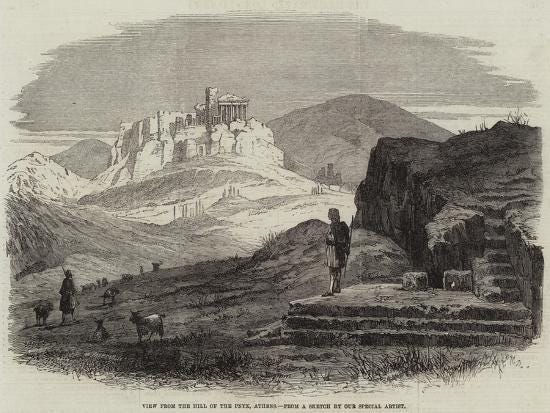
It seems reasonable to begin our own discussion by tracing democracy, demotism, democratism etc. back to their original, which is of course the Greek word demokratia (‘people power’). Demokratia, needless to say, is of impeccable antiquity, being the political system of 5th and 4th-century Athens and many other ancient Greek cities. Yet this alone is of course no refutation of Yarvin.
When Yarvin speaks of demotism, and when he and most others speak of democracy, what is meant by these words is some form of popular sovereignty – an ultimate authority held by the people, originally defined by Jean Bodin as a monopoly on the highest state powers, but watered down to the point of quasi-ceremonialism in every actual demotist regime including Western democratism. This ceremonial quality of popular sovereignty does not make it fake or irrelevant; but it is best understood as a system of belief, morality and ritual, and not as an actual structure of power. Power in a popular-sovereigntist regime might be wielded in practice by an elective monarch (‘dictator’), an elective oligarchy (‘parliament’, ‘senate’), or by any other power structure that happens to develop in it; but none of these can legitimize themselves without gaining the consent of the people, either implicitly or as expressed in some or other popular ritual (‘election’, ‘plebiscite’).
Demokratia, by contrast, is an actual structure of power – not “rule in the name of the People”, but “rule by and for the People”, in which the People (demos) takes up the position of a collective king. The Iron Law of Oligarchy being what it is, it should be understood that this demos can only ever amount to something like 10-20% of the state’s population, and cannot free itself for the business of rule without the reduction to servitude of a much broader mass of subjects. Aristocratic elites and charismatic personal leaders continue to play important roles in a ‘demokratic’ state; but unless they should actually turn that state into a monarchy or oligarchy, their importance in no way detracts from the reality of ‘people power’, any more than the reliance of a despot on advisors, generals and a wider ruling class that might always depose him makes a fiction of absolute monarchy.
I’ve already laid out a descriptive theory of demokratia with primary reference to the workings of ancient Athens, so I won’t repeat myself at length here. Suffice it to say that the ruling class at Athens was constituted by the adult male citizenry (women and children being ‘passive’ citizens without political rights and obligations), and that its people-power was exerted through three main institutions:
The Assembly (ekklesia), the main role of which was to make collective decisions on legislation and executive action, as well as to elect certain officials such as military generals (most official appointments being instead decided by lottery);
The Council (boule), the 500-strong administrative body of the city, which constantly rotated citizens into and out of its ranks on the basis of lottery and familiarized them with the business of rule;
The Jury-Courts (dikasteria), which were tried by unaccountable citizen-juries numbering in the hundreds or even thousands, and played a vital role in exerting power on elites and officials through litigation and accountability procedures.
Other institutions of note include the famous ostracism (by which prominent individuals disliked by the citizenry could be banished for no reason and without appeal), the liturgy (by which rich elites were encouraged or forced to finance the city), and the ‘writ against unconstitutional proposals’ (which granted the demos a very wide justification for dragging officials and prominent citizens before jury-courts). It is also worth noting that Athens had ceremonialized rulers called archons, and an aristocratic senate of ex-archons known as the Areopagus, which continually lost power to the institutions controlled by the demos right up until the Athenian political system was finally suppressed by foreign military power.
I cannot recommend the study of all this highly enough to those who believe that ‘elite theory’ has somehow deboonked the capacity of a mob to control a state. That said, we must move on – for our concern in this post is not with the heyday of demokratia, but with its much longer afterlife as demotism and popular sovereignty.
Let’s start with Democracy: A Life by Paul Cartledge, which purports to tell “the 2,500 year story of democracy from ancient Greece to the twenty-first century”. Some two-thirds of this book is devoted to the history of fourth- and fifth-century Athens, and makes for quite a useful and accessible account of demokratia. It is, admittedly, one that should not be consulted without reference to primary sources (such as the Athenian Constitution), because Cartledge is a bit of a democratist ideologue and likes to downplay the chaos that impressed itself on everyone actually writing at the time.1
For us, the real point of interest comes late on in the book, after Athenian demokratia has finally been quashed by Philip II of Macedon in 322 BC. This, however, is not quite the end of its story. From Cartledge (p.231):
A.H.M. Jones, one of the greatest of ancient historians, specialised in the Later Roman Empire, but in his many excellent publications he covered more or less all the ancient Graeco-Roman world, including the Athenian democracy. In an article on the Greeks under the Roman empire he wrote: ‘The predominant form of constitution in the Hellenistic age was democratic, and the kings imposed their control more by means of governors and garrisons than by constitutional restrictions on democratic liberty’. How paradoxical is that—democracy and democratic liberty, but controlled by kings who imposed governors and garrisons?
To Athenians of an earlier time – the sort who believed that “it would be outrageous if the demos were not to be allowed to do whatever it pleased”2 – a city beholden to a king and governor could not possibly call itself ‘democratic’ no matter how many liberties it granted to its citizens. But the slippery language is that of the time. As we shall soon see, the desire to dignify a monarchy or oligarchy with the mere name of people power is not at all specific to modernity.
After the death of Philip of Macedon, his son Alexander finished up the work of subjecting the Greek cities on the mainland and then crossed into Asia to conquer those ruled by the Persians. As Cartledge says (p.233-4), this campaign was “cast in the mould of a panhellenic Greek ‘crusade’ of liberation”, aimed at changing not only the external allegiance but also the internal constitutions of these cities:
Thus in 334, after he had crossed over the Hellespont into Asia and had won at the Granicus river the first of his set-piece victories, [Alexander] proceeded south along the Anatolian coast as far as the major Greek city of Ephesus in Ionia. Here, according to Arrian (author of our best narrative account, even though composed in the second century CE), he set up a democracy to replace the pro-Persian or at least complaisant oligarchy. But at the same time he sensibly took steps to prevent the empowered demos from wreaking its revenge on the innocent as well as on their oligarchic enemies. Furthermore, he made a general declaration of support for democracies in all the former Persia-subjected Greek cities, including the offshore islands; an illustration is provided by a much later document preserving a letter (really an imperial rescript) of Alexander to the island-city of Chios. Chios had been in a condition of stasis [civil conflict] between oligarchs and democrats since 336, and Alexander weighed in on the side of democracy.
This does not mean, however, that Alexander, a hereditary Macedonian monarch and autocrat, was in any sense a convert to democracy on principle. It was simply that he had opportunistically found a simple way of diverting the Asiatic Greek cities from their Persian allegiance to allegiance to him, by overthrowing the oligarchs’ regimes and promoting the cause of their internal, anti-Persian democrat opponents. If we look forward to 324, by which time Alexander had completed the conquest of the old Persian empire and started to give serious thought as to how he would govern his new empire, we see a dramatically altered picture.
That is to say, Alexander as of 324 had little respect for the autonomy of his pet democracies, and was happy to boss them around with diktats like the Exiles Decree. To be fair, though, in this Alexander was only replicating the policy of democratic Athens in the Peloponnesian War, which had habitually replaced pro-Spartan oligarchies with democracies that it often went on to treat in an imperialistic manner. If a city beholden to a foreign monarch could not be truly democratic, then perhaps the same might be said for a city beholden to a foreign demos.
Yet worse was to come. In the Hellenistic era, Greek city-states increasingly subordinated themselves to vast ethnically-based federations such as the Achaean and Aetolian Leagues. As Cartledge says (p.238), this was driven by “the need for units larger than individual, atomised poleis to resist the potential for unwelcome intervention by their imperial overlords in Macedon.” But this decline of the polis could only spell the obsolescence of demokratia, dependent as it was on the physical concentration of a relatively small number of citizens.
The major source on these two federal states, as indeed on all Hellenistic Greek history from 220 to 145, is the Greek Polybius (born c. 210-220, died c. 120). He came from Megalopolis in Arcadia, a city that was founded in 368 as an anti-Spartan bulwark and served as the capital of the then Arcadian federal state. … But to prolong the suspense no further, it can safely be said that he was no democrat—in any Aristotelian sense. One egregious example of his general historiographical principle that it is permissible to exempt patriotism from the general requirement of objectivity and impartiality concerns the Achaean League, of which his native Megalopolis was a key member: ‘No political system can be found anywhere in the world which favours more the principles of equality, freedom of speech and true democracy than that of the Achaeans.’ It is not merely coincidental that the birth and growth of the Achaean League federal state, control of which was safely in the hands of wealthy or aristocratic landowning elites such as Polybius, coincided with a growing economic immiseration of the poor citizen masses and a consequent loss by the elite of those poor masses’ goodwill.
Here we see the word demokratia applied, in a spirit of flattery, to a state fundamentally incapable of practicing it – clear evidence for the debasement of its meaning. And while individual city-states could still practice demokratia at the level of domestic affairs, the general picture painted by Cartledge is one of oligarchical power consolidation coupled with “purely gestural” references to democratic heritage. He sums up the era as follows (pp.244-5):
Although the polis-form as such retained its legitimacy and vitality, the constitutional trend in political actuality was firmly towards various shades of oligarchy. But for agit-prop and self-reassurance reasons, demokratia came to be used standardly in the Hellenistic Greek poleis both old and new as a slogan both for republic—that is, not monarchy or tyranny…and independence (from the relevant great power or powers). The new emphasis here, promoted by the empowered oligarchic rulers, was on demos as ‘People’, not demos as the mass of the poor citizens [as defined by Aristotle in his Politics], and on independence from direct foreign rule. That is what is meant (and all that can be meant) by talking of ‘free’ Hellenistic Greek poleis. Overall, the condition of this Hellenistic mode of democracy was one of some durability, no doubt, but far more one of decline from an earlier, full-blooded political mode. … Any usage of the term demokratia in such a historical context must necessarily have involved some devaluation, if not actual degradation, of that word’s original force and meaning.
Still worse degradation was to come, as Greece came under the power of Rome and Rome came under the rule of absolute emperors. Cartledge quotes the Greek sophist and orator Aelius Aristides (117-181 AD), a contemporary of Marcus Aurelius, as praising the Roman imperial order in the following words: “There has been established throughout the world alike a democracy under one man, namely the best ruler and controller.” This seems to anticipate the coming extension of Roman citizenship to all free subjects of the empire, made by Caracalla in 212. But all that it says about demokratia is that the term was by this point almost totally emptied of meaning.
This, to my knowledge, constitutes the earliest evidence for the use of ‘democracy’ as a vague intangible concept that serves to legitimize an oligarchy or monarchy. In light of Yarvin’s definition of demotism as “rule in the name of the People”, I see no reason why it should not qualify as an instance of this. What I am not saying is that it was identical to the modern-day concept of popular sovereignty, or that it survived long enough into post-classical history to influence the development of that concept. (What survived was rather Aristotle’s negative account of classical demokratia, which is why the modern word democracy initially had a villainous air about it.)
Yet the resemblance of this Hellenistic pseudo-demokratia to modern popular sovereignty is not exactly coincidental. Athens did not bequeath her political tradition to us, but Rome did. And Rome, which is well-known to have been heavily influenced by Greek culture, went through a transition from real to ceremonial popular power that was largely analogous to the Greek one.
The Roman Republic never had demokratia in the true, Athenian sense. But it had a founding ideology that was in some ways similar to the ‘tyrannicidal’ Athenian one, in that it was based on deep horror of monarchical despotism and self-identification as a popular state. As Cartledge says in his chapter on Rome (p.247):
Our English word ‘republic’ is derived from the Latin respublica, itself a compound of two words: res (‘thing’) and publica (‘of or belonging to the Populus’, ‘People’); crudely translated, they mean ‘the People’s thing’. By ‘People’ was understood the entirety of the Roman citizen population who were entered on the lists held by the most senior elected officials called Censors. In military terms, they were a combination of those citizens who possessed a certain minimum of property and were therefore liable for compulsory service, and those who owned or possessed less than that stipulated minimum. There were five levels of property-owning citizens, quantitatively graded; probably already by 200 BC they were outnumbered by the propertyless.
From the early days Rome had elected its magistrates, passed its laws, and declared war and peace by the vote of popular assemblies. These were open to all citizens, but their functions were much more limited than those of the Athenian Assembly3, and the voting system was weighted in favour of the propertied minority. From 494 BC the interests of the poorer citizens (plebeians) were protected by the powerful Tribunes of the Plebs who could veto the actions of other officials, and by 287 BC they had extracted formal political equality from the aristocratic ruling class (patricians). As Cartledge says (p.256), from this time, “the Council of the Plebs, representing the overwhelming majority of citizens, could pass laws binding on all citizens, patricians as well as plebeians, and the fundamental citizen’s right of appeal against an official’s action was to a People’s jury court.”
According to Jean Bodin, the Roman Republic after 287 BC was a ‘democracy’, in the sense that ultimate state authority – that is to say, his concept of sovereignty – was held by the broad mass of the people.4 Yet ultimate sovereignty is not the same thing as direct power, which continued to be held by wealthy citizens who were able to block and eliminate the more ‘demokratist’ of the tribunes. As Cartledge points out (p.256):
The short acronymic formula for the Roman Republican state was SPQR (Senatus Populus Que Romanus); ‘Senate and Roman People’, in that order, not PRSQ, ‘Roman People and Senate’. The Senate, which consisted of all current magistrates above the level of quaestor and ex-magistrates in good moral and economic standing (eligibility was based on a very high property qualification ), had effective initiative and control in matters of public finance and foreign policy. The board of ten Tribunes of the Plebs…were typically not radical anti-Senate populist politicians but ambitious plebeians on the first rung of the governmental ladder that would eventually lead, they hoped, to membership of an increasingly conservative and reactionary Senate. Tribunes had a veto on all legislation, but custom and precedent demanded that any legislative proposal be vetted in advance by the Senate, and key Senatorial players could even use one Tribune to veto another Tribune… The popular tribunals and law-courts were in practice all staffed by the rich few citizens; they were not People’s courts staffed by allotted jurors of general low economic means and humble social status, as in democratic Athens.
A less disapproving observer might conclude from all this that Rome had checks on outright mob rule as well as on monarchy. The contemporary term for this sort of balancing act was mikte, ‘mixture’ (i.e. of different constitutional forms), a Greek word used by Aristotle in his Politics to describe states like Sparta that seemed to combine elements of monarchy, oligarchy and democracy. Rome’s constitution was described as an exceptionally wise and stable mixture in the influential history of Polybius, whom we have of course already met waxing lyrical about the supposed demokratia of the Achaean League. It seems true to say that republican Rome, in the view of Greeks like Polybius as well as Greek-influenced Roman citizens like Cicero, was already seen as exemplifying something of Hellenistic pseudo-demokratia.
Suffice it to say that the Emperor Augustus was in much the same position as Alexander and other Hellenistic kings and oligarchs when he undertook to convert the Roman Republic into a de facto monarchy. As Cartledge says (p.266), “the other most important constituency for his overall rule besides the army were the plebeian citizen masses of Rome, the plebs Romana.” Thus Augustus assumed the power of a Tribune of the Plebs (an office from which his patrician status technically disbarred him), and lavished benefits on the poor including subsidized grain and urban housing improvements.5 In general he made a great pretence of continuity: avoiding the name of rex ‘king’, preserving the Senate as an aristocratic talking shop, and presenting himself as the saviour of republican liberty while running the state through a cabal of loyal freedmen.6 In his political testament, called Res Gestae, Augustus summed up his career as follows:
In my sixth and seventh consulships [28-27 BC], after I had extinguished civil wars, and at a time when with universal consent I was in complete control of affairs, I transferred the republic from my power to the dominion of the senate and people of Rome. For this service of mine I was named Augustus by decree of the senate, and the door-posts of my house were publicly wreathed with bay leaves and a civic crown was fixed over my door and a golden shield was set in the Curia Julia, which, as attested by the inscription thereon, was given me by the senate and people of Rome on account of my courage, clemency, justice and piety. After this time I excelled all in influence [auctoritas], although I possessed no more official power [potestas] than others who were my colleagues in the several magistracies.
It would seem that Augustus also had powers conferred upon him at popular assemblies – which, as we have said, were traditionally responsible for passing laws and electing magistrates. The earliest evidence for this comes from a legal document conferring various powers upon a later emperor, Vespasian, which are said to have been conferred in the past upon Augustus and his successors. Although none of the surviving passages of the text refer explicitly to the transfer of these powers from the people, the reference to it as a statute (lex) implies its passage by a popular assembly.
The final clauses can be read as granting the emperor very wide discretionary power:
And that whatever he considers to be in accordance with the public advantage and the dignity of divine and human and public and private interests he shall have the right and the power to do and to execute, just as had the deified Augustus and Tiberius Julius Caesar Augustus and Tiberius Claudius Caesar Augustus Germanicus.
And that by whatever laws or plebiscites it has been recorded that the deified Augustus or Tiberius Julius Caesar Augustus and Tiberius Claudius Caesar Augustus Germanicus were not bound, from these laws and plebiscites Emperor Caesar Vespasian shall be exempt; and whatsoever things it was proper for the deified Augustus or Tiberius Julius Caesar Augustus or Tiberius Claudius Caesar Augustus Germanicus to do in accordance with any law or proposed law, it shall be lawful for Emperor Caesar Vespasian Augustus to do all these things;
And that whatever before the passage of this law has been done, executed, decreed, ordered by Emperor Caesar Vespasian Augustus or by anyone at his order or mandate, these things shall be legal and valid, just as if they had been done by the order of the people or of the plebs.
In later Roman law, either this or some even more far-reaching statute that has not survived is called the lex regia (‘royal law’), by which the Roman people formally transferred all of their power to the emperor. The lex regia is explained as follows in Book I, title 2 of the Institutes of Justinian, part of a 6th-century codification of Roman law known as the Corpus Juris Civilis:
A statute [lex] is an enactment of the Roman people, which it used to make on the motion of a senatorial magistrate, as for instance a consul. A plebiscite is an enactment of the commonalty, such as was made on the motion of one of their own magistrates, as a tribune. The commonalty [plebs] differs from the people [populus] as a species from its genus; for “the people” includes the whole aggregate of citizens, among them patricians and senators, while the term “commonalty” embraces only such citizens as are not patricians or senators. ... A senatusconsult [senatusconsultum] is a command and ordinance of the senate, for when the Roman people had been so increased that it was difficult to assemble it together for the purpose of enacting statutes, it seemed right that the senate should be consulted instead of the people. Again, what the Emperor [princeps] determines has the force of a statute, the people [populus] having conferred on him all their authority and power by the lex regia, which was passed concerning his office and authority.
Here we see a conception of monarchical power that is at once maximally absolutist, to the point of granting the decrees of the emperor the force of laws, yet also ultimately dependent on an act of the people (albeit one that was by this point considered irrevocable). As we shall shortly see, this went on to exert great influence on later constitutional thought – notably in establishing the pre-liberal absolutism that Yarvin believed to be pristinely distinct from popular sovereignty. In truth, demotism and despotism in Western tradition are two boles of one tree – the roots of which we have presently exposed to light.
By the time the Institutes were written, the Roman Empire had collapsed in the West under the pressure of Germanic invasions. When the Western imperial title was revived for Charlemagne in 800 AD, it was by a pope whose actions broke with classical tradition, and in a recreated empire that swiftly fell apart after the death of its ruler. This half-abortive revival led to an imperial tradition very different from Roman absolutism, in which the main sticking point was the supposed prerogative of the pope to crown and depose an emperor whose absolute rule had become a legal fiction. At this point the roots of our ‘tree’ become difficult to discern, and its foliage does little to overshadow the legitimist kingdoms and military dukedoms and unrelated republics springing up around it.
But even this form of the Roman tradition had its atavistic moments. The crowning of a medieval emperor had to be accomplished not only by the Roman pope, but also within the city of Rome, with an acclamation by the Roman people.7 Given the history behind this ceremony, and the chronic conflict between popes and emperors (as well as the further complications caused by absentee popes and antipopes), there was always a possibility that some emperor might try to circumvent the pope and take his title directly from the people. This came to pass in 1328, at the coronation of Emperor Ludwig IV ‘the Bavarian’, in which the crown was placed on the German king’s head by a senator who had been elected as ‘captain of the Roman people’.
An account of this coronation and its attendant circumstances (from an unsympathetic pro-papal perspective) is found in the Cronica of Giovanni Vallini. I must beg pardon for the length and excess detail of these excerpts; it took me some work to find and AI-translate the relevant sections, and I think it is worth sacrificing some concision in order to bring this obscure historical episode to light.
First, from Book XI Chapter 20, an account of the popular uprising in Rome that led to the election of Sciarra della Colonna as captain of the Romans:
Of the new things that the people of Rome did upon the coming of the Bavarian, whom they called their king. Upon the arrival of the said Bavarian, elected King of the Romans, almost all of Italy was stirred to new things at once and in that same time. The Romans rose up in tumult and made a popular government, because they had neither the papal court nor the emperor’s court; and they took lordship away from all the nobles and great men of Rome and their fortresses. And they sent some into exile: namely Messer Napoleone Orsini and Messer Stefano della Colonna, who had just been made knights in Naples by King Robert a short time before, for fear that they might give the lordship of Rome to King Robert, King of Puglia. And they called Sciarra della Colonna to be captain of the people of Rome, to govern the city with the counsel of 52 commoners, 4 from each district. And they sent their ambassadors to Vignon in Provence to Pope John, begging him to come with the court to Rome, as by right it should be; and if he did not do so, they would receive as their lord their King of the Romans, called Louis of Bavaria. And likewise they sent their ambassadors to stir up the said Louis, called the Bavarian. And their movement was simulated under the pretext of wanting the papal court back, to draw profit from it, as they had been accustomed in ancient times; but afterward it led to greater consequences, as will be mentioned later. The Pope answered the Romans through his ambassadors, warning and urging them not to receive the Bavarian as their king, because he was a heretic, excommunicated, and a persecutor of Holy Church, and that he himself would come to Rome at a convenient and soon time. But the Romans did not abandon their error, negotiating with the Pope, with the Bavarian, and with King Robert, giving each to understand that they would hold the city of Rome for him, while governing themselves under a popular lordship, and dissembling as if on the Ghibelline and imperial side.
And, from Chapters 55-6, an account of Ludwig’s popular coronation in Rome:
How the Bavarian left Viterbo and went to Rome. In the said year 1327 [i.e., 1328 by modern reckoning], when the Bavarian had arrived in Viterbo, great dispute arose in Rome among the people, and especially among the 52 good men, called 4 per district to guard the Roman people, because some of them wanted to receive the Bavarian freely as their lord, others thought it wrong and against Holy Church, and still others wanted to negotiate terms with him before he was received in Rome. To this third plan they outwardly agreed in order to please the people, and sent solemn ambassadors to treat with him. But Sciarra della Colonna and Iacopo Savelli, who were captains of the people, with the help of Tibaldo di Santo Stazio, great and powerful Romans — these three leaders had been the cause of the revolution in Rome, and had driven out the Orsini and Messer Stefano della Colonna and his sons, even though Stefano was Sciarra’s own flesh-and-blood brother, because he was a knight of King Robert and held to his side. For this reason, all the friends of King Robert left Rome in fear, and Castel Sant’Angelo was taken from the Orsini, and all the strongholds of Rome were seized from them and their followers, under the force and guard of the people. The aforesaid three captains of the people always secretly planned, dissembling with the people, the coming of the Bavarian and making him King of the Romans, out of Ghibelline sentiment and for much money they had received from Castruccio, Duke of Lucca, and from the Ghibelline party in Tuscany and Lombardy. Immediately, they sent secret messengers and letters to Viterbo to the Bavarian, telling him to leave all delay and come to Rome, and pay no heed to the mandate or words of the ambassadors of the Roman people. When those ambassadors arrived in Viterbo and solemnly delivered their embassy with the conditions and pacts imposed by the Roman people, the Bavarian entrusted the reply to Castruccio, lord of Lucca, who — as had been secretly arranged — had trumpets and horns sounded, and proclaimed a ban that every man should ride toward Rome. “And this,” he said to the ambassadors of Rome, “is the answer of the lord emperor.” He courteously detained the said ambassadors, and sent scouts ahead to seize every pass, so that any messenger or person going toward Rome would be arrested and held.
And thus the said Bavarian left the city of Viterbo with his men on Tuesday, the 5th of January, and arrived in Rome on the following Thursday, the 7th of January [1328], at the hour of nones [about 3 p.m.], with his company of well over 3,000 knights, without any opposition, as had been arranged by the said captains, and was received graciously by the Romans. He dismounted at the palaces of St. Peter’s and stayed there four days; then he crossed the Tiber to lodge at Santa Maria Maggiore. And on the following Monday, he went up to the Capitoline, and held a great parliament, where all the people of Rome who loved his lordship were present, and others too. In that assembly, the Bishop of Aleria, of the Augustinian order, spoke on his behalf with fine authorities, thanking the Roman people for the honor they had shown him, saying and promising that he intended to preserve and exalt them, and to place the Roman people in every good state. This pleased the Romans greatly, and they cried: “Long live, long live our lord and King of the Romans!” And in that parliament, his coronation was scheduled for the following Sunday, and in that same parliament, the people of Rome made him senator and captain of the people for one year. Note that with the said Bavarian came to Rome many clerics, legists, and friars of all orders, who were rebels and schismatics against Holy Church, and all the dregs of Christian heretics in opposition to Pope John. For this reason, many Catholic clerics and friars left Rome, and the city and holy city was placed under interdict, and no sacred office was sung nor bell rung, except that his schismatic and excommunicated clerics performed services. And the said Bavarian ordered Sciarra della Colonna to compel the Catholic clerics to say the divine office; but they refused to do anything. And the holy sudarium of Christ was hidden by a canon of St. Peter’s who had it in keeping, because it did not seem fitting that it should be seen by the said schismatics, whence great disturbance arose in Rome.
…
How Louis of Bavaria had himself crowned by the people of Rome as their king and emperor. In the said year [1328], on Sunday, the 17th of January, Louis, Duke of Bavaria, elected King of the Romans, was crowned in St. Peter’s in Rome with the greatest honor and triumph, as we shall describe below. That is, he and his wife, with all his armed men, set out in the morning from Santa Maria Maggiore, where he was then lodging, going to St. Peter’s. Four Romans per district rode armed ahead of him with banners, their horses covered in silk, and many other foreigners, while all the streets were swept and strewn with myrtle and laurel, and from every house hung the finest jewels, draperies, and ornaments they had. The manner of his coronation, and who crowned him, were as follows: Sciarra della Colonna, who had been captain of the people, Buccio di Proresso and Orsino, who had been senators, and Pietro di Montenero, a Roman knight — all dressed in cloth of gold — and with them to crown him were the 52 of the people, and the prefect of Rome always going before him, as his title requires, and he was guided by the aforesaid four captains, senators, and knight, and by Giacomo Savelli, Tibaldo di Santo Stazio, and many other Roman barons. And a judge of law always went before, who carried an extract of the order of the empire. And with this order he proceeded to his coronation. And finding no defect — except the blessing and confirmation of the pope, who was not there, and of the Count of the Lateran Palace, who had fled Rome, who, according to the order of the empire, should hold him when he receives chrism at the high altar of St. Peter’s and receive the crown when it is taken off — provision was made, before he was crowned, to create Castruccio, called Duke of Lucca, count of that title. And first, with great solemnity, he made him a knight, girding his sword with his own hands and giving him the accolade; and then many others he made knights, merely touching them with the golden rod, and Castruccio made seven in his company. And this done, the said Bavarian was consecrated as emperor in place of the pope or his cardinal legates, by schismatic and excommunicated bishops: the Bishop who had been of Venice, nephew of the late Cardinal da Prato, and the Bishop of Aleria. And in the same way his wife was crowned as empress. And when the Bavarian was crowned, three imperial decrees were read: the first on the Catholic faith, the second on honoring and revering clerics, the third on preserving the rights of widows and wards — which hypocritical dissimulation greatly pleased the Romans. And this done, Mass was said. And when the said solemnity was completed, they left St. Peter’s and went to the piazza of Santa Maria dell’Ariacelo, where the meal was prepared. And because of the great and long solemnity, it was evening before they ate. And that night they slept in the Capitoline. And the next morning, he made Castruccio, Duke of Lucca, senator and his lieutenant, and left him in the Capitoline; and he and his wife went to San Giovanni in Laterano. In this manner Louis called the Bavarian was crowned emperor and King of the Romans by the people of Rome, to the great despite and shame of the pope and the Church of Rome, showing no reverence to Holy Church. And note that presumptuous was this damned Bavarian, for you will find in no ancient or modern chronicle that any Christian emperor ever had himself crowned except by the pope or his legate, even if they were greatly opposed to the Church, before or after — except this Bavarian; which was a thing greatly to be marveled at.
This marvel may have owed something to the influence of Marsilius of Padua, who had fled to Ludwig’s protection after being unmasked as the author of the anti-papal and popular-sovereigntist book Defensor Pacis (‘Defender of the Peace’).
This book consists of three ‘discourses’, the third of which is a short summary of the other two. The first is based largely on the Politics of Aristotle, which distinguished benevolent regimes (monarchy, aristocracy, constitutionalism) from degenerate ones of the same type (tyranny, oligarchy, democracy) according to whether their rulers served themselves or the common good. Marsilius reconstrues ‘rule according to the common good’ as necessarily involving the expressed consent of the whole people, or at least its ‘greater’ or ‘prevailing part’ – clearly understanding this along the lines of the old Roman assemblies or the lex regia, in terms of a popular election that imbues a magistrate with legitimate power.
From Defensor Pacis8, Discourse I, chapter 9, part 5:
However, in order further to clarify these words of Aristotle, and also to bring all the modes of instituting the remaining types of principate under one heading, let us lay it down that all principate is either over willing or unwilling subjects. These are the two generic kinds of principate: tempered and flawed. Each of these kinds is moreover divided into three types of modes, as we said… And since one of the types of well-tempered principate, and perhaps the more perfect, is royal monarchy; therefore, picking up the threads again, let us begin our discussion from the modes of this type of principate and assert that a king or monarch is either instituted by election on the part of the inhabitants or citizens, or has obtained the principate in due fashion without election on their part. If without election by the citizens, then this is either because he, or his predecessors from whom he stemmed, first inhabited the region; or because he bought the territory and its jurisdiction, or acquired it in a just war or any other licit way, e.g. through a gift it made to him in recognition of some service rendered. [Note that these are quintessentially legitimist means of acquiring power.] But each of the said modes shares more in the truly royal the more it is over willing subjects and in accordance with a law passed for the common advantage of these subjects; it savours of tyranny, by contrast, the more it departs from these conditions, viz. the consent of those subject and a law established to the common advantage.
The second discourse is a long (and frequently repetitive) polemic against the temporal claims of the church and papacy, including the right to crown and depose emperors, all of which Marsilius rejects as illegitimate and contrary to the example of poverty and submission set by Christ and the Apostles. Essentially he allots the church no legitimate domain other than pure spiritual authority, while asserting the absolute independence of the emperor’s temporal rights – including the right to appoint the pope and other bishops. The relation of this anti-papalism to the popular-sovereigntism of the first discourse is made clear in chapter 25, part 9:
Returning to where we were before, however, it was not an evil or blameworthy custom for the pastors of the Roman church to be appointed by the emperors, as we said. For we read...that this authority (and moreover in a fuller sense than has just been said) was granted by the entire people of Rome, i.e. by the bishop, the clergy and other secular persons, to Charlemagne and to Otto I, king of the Germans and thereafter emperor of the Romans. Hence we read in approved histories, and it is true, that the following edict emerged from the common consent of the Roman people: “Pope Leo in the synod assembled at Rome in the church of the Holy Saviour, after the example of Saint Adrian, bishop of the apostolic see, who granted the lord Charles, most victorious king of the Franks and the Lombards, the dignity of the patriciate and the ordination and investiture of the apostolic see. I too Leo, servant of the servants of God, bishop, together with all the clergy and people of Rome, do hereby establish, confirm, and corroborate, and through our apostolic authority grant and bestow upon Otto I, king of the Germans, and his successors in the realm of Italy in perpetuity, the faculty of electing a successor to himself as well as of ordaining the pontiff of the supreme apostolic see…”9
... In this way it also belongs to the power of the Roman prince and people to appoint the pontiff of the apostolic see… The clergy is not excluded from this people, but included, since it is a part of it. And if it was their will to transfer this power or authority to the prince, either absolutely speaking or in some way determined by law, then the Roman prince assumed it licitly and it cannot be licitly revoked from him by a decretal or law of any Roman pontiff without a decree of the people.
It almost goes without saying that Marsilius conceived of this Roman popular-monarchical sovereignty as extending well beyond the issue of ecclesiastical investitures. He also conceived of the principle of popular sovereignty as extending, at least potentially, beyond the privileged city and people of Rome to the provinces and subjects of its ‘empire’. This is made explicit in the twelfth chapter of his shorter work Defensor Pacis Minor (‘Lesser Defender of the Peace’):
Regarding the first of these topics whose examination is to be undertaken here, we say that the supreme human legislator, especially from the time of Christ up to the present time, and perhaps for some time beforehand, was and is and ought to be the community [universitas] of human beings who ought to be subject to the precepts of coercive laws, or their greater part, in each region and province. And since this power or authority was transferred by the communities of the provinces, or their greater part, to the Roman people, in accordance with their exceeding virtue, the Roman people have and had the authority to legislate over all of the world’s provinces. If this people had transferred its authority to legislate to its rulers, then its rulers may likewise be said to possess such power, so that the authority or power of legislation (namely, of the Roman people and its rulers) has endured for so long a time and ought reasonably to endure, until such a time as it might be revoked by the communities of the provinces from the Roman people or by the Roman people from its ruler. And we maintain that such powers are duly revoked or revocable when the communities of the provinces, by themselves or by their syndics, or the Roman people, have been duly congregated and they, or their greater part, have performed deliberations about such revocation, just as we have asserted and demonstrated in Defensor pacis, Discourse 1…10
Admittedly, Marsilius was way ahead of his time (to the extent that he ended up losing the favour of his master), and Ludwig’s popular coronation would not be repeated by his successors.11 Nevertheless, this episode is no mere historical curio, since it reveals that the seeds of popular-sovereigntism were by no means absent even from the arch-reactionary medieval Ghibelline tradition. By this point, they had already struck roots in other soil far more conducive to their flourishing.
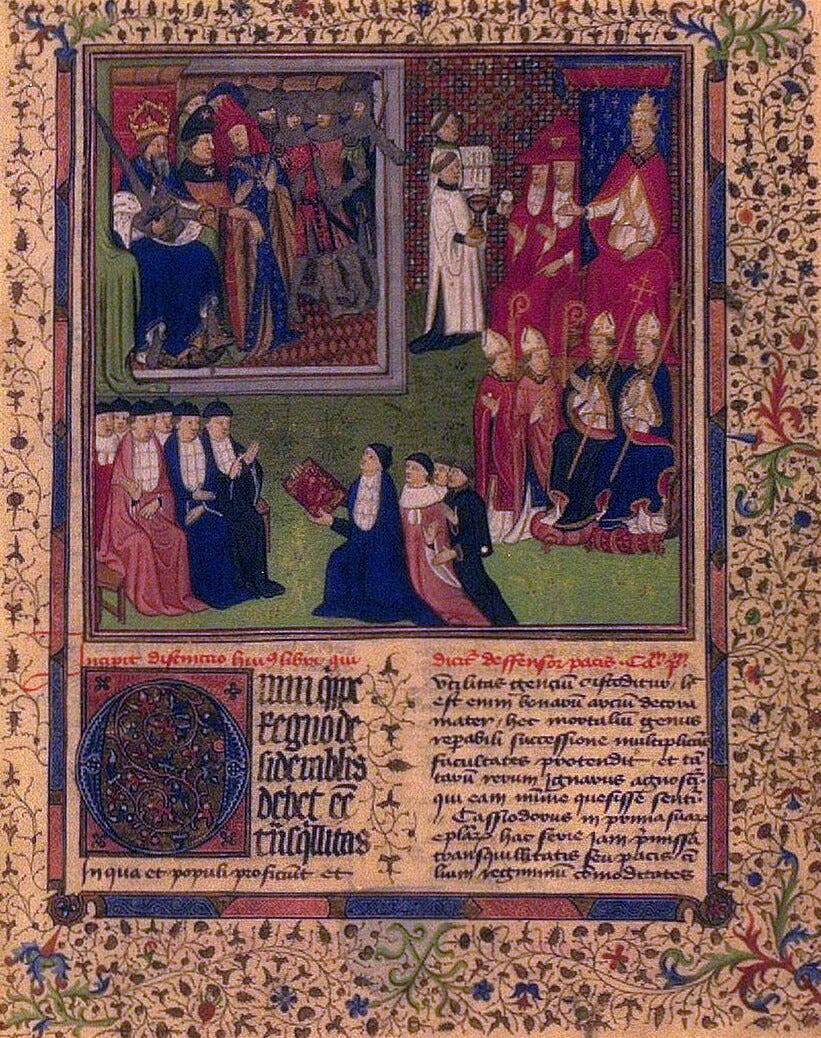
By ‘other soil’ I mean the various kingdoms under the nominal suzerainty of the empire, principally France and England. In theory, the mere king came third in the medieval legal hierarchy behind both emperor and pope, but he turned out to be in a good position to siphon off legal rights from his nominal superiors. One important weapon in his hands was Roman law, specifically the rediscovered text of Justinian’s Corpus Juris Civilis, with the lex regia now reinterpreted to set up each king as ‘emperor in his own realm’ (princeps in regno suo).
This involved not only the assertion of independence by kings, but also a bid for increased power over subjects on the basis of Roman absolutism. For example, a mere feudal king was not entitled to homage or service from the vassals of his own vassals, but according to Roman law all subjects were bound by direct legal obligation to a princeps. Such legal benefits to kings would at the time have far outweighed any perceived risk from the importation of an essentially republican ideology.12 As Daniel Lee says in his Popular Sovereignty in Early Modern Constitutional Thought (pp.59-60):
[That the king recognized no temporal superiors] was the strategy of argument deployed crucially by medieval French jurists writing in defense of the jural independence of the French crown from the Empire, most notably the thirteenth-century Burgundian lawyer, Jean de Blanot, in a commentary on the Institutes. The King of France, Blanot argued, held a jurisdiction over his kingdom that, in theory, imposed a general obligation on everyone within the boundaries of his kingdom, including even those who claimed immunity from service to the king on feudal grounds. Blanot characterized the king’s jurisdiction in the Roman legal language of imperium and enabled him to conclude that the king was, at least within his kingdom, just the same as a princeps. … This de facto argument opened a whole range of new legal possibilities in interpreting the rights and powers of kings in the juridical language of civil law. For, if it can be admitted that kings are de facto independent and free of the emperor, by the norm of non-recognition [of temporal superiors], then perhaps it can also be admitted that kings are, in some sense, legally equivalent to the princeps within the boundaries of their own kingdoms.
After the Reformation, not only the temporal powers of the emperor but also the spiritual authority of the pope could be siphoned into princely hands.13 Naturally enough, along with this movement of power and authority into the individual kingdoms came the political formulas of popular-sovereigntism and divine-rightism, the former of which recapitulates the Roman lex regia and the latter the divine institution of the papacy. For obvious reasons, the ultimate right of peoples to depose their kings was more acceptable to papal apologists than an independent divine right to kingship, which was championed by the Protestant kings of England. Thus the Jesuit cardinal Robert Bellarmine, opponent of James I in a public pamphlet war over divine right, argued in his De Laicis ‘On the Laity’ (Chapter VI) that divine right belonged solely to the church and political sovereignty to the people:
Note...that this [political] power resides, as in its subject, immediately in the whole state, for this power is by Divine law, but Divine law gives this power to no particular man, therefore Divine law gives this power to the collected body. Furthermore, in the absence of positive law, there is no good reason why, in a multitude of equals, one rather than another should dominate. Therefore, power belongs to the collected body. … Note [also] that, by this same natural law, this power is delegated by the multitude to one or several, for the State [i.e. the whole people] cannot of itself exercise this power, therefore, it is held to delegate it to some individual, or to several, and this authority of rulers considered thus in general is both by natural law and Divine law, nor could the entire human race assembled together decree the opposite, that is, that there should be neither rulers nor leaders.
Note [also] that individual forms of government in specific instances derive from the law of nations, not from the natural law, for, as is evident, it depends on the consent of the people to decide whether kings, or consuls, or other magistrates are to be established in authority over them; and, if there be legitimate cause, the people can change a kingdom into an aristocracy, or an aristocracy into a democracy, and vice versa, as we read was done in Rome.
Note [also] that it follows from what has been said that this power in specific instances comes indeed from God, but through the medium of human wisdom and choice, as fo all other things which pertain to the law of nations. For the law of nations is a sort of conclusion drawn from the natural law by human reason; from which are inferred two differences between the political and the Ecclesiastical power, one in view of the subject, for political power resides in the people, and Ecclesiastical power in the individual [i.e. the pope], as it were immediately in the subject (on whom it devolves); the other difference is in view of the efficient cause, because political power considered in general is by Divine law, but considered in particular it is by the law of nations. Ecclesiastical power, however, considered from every point of view, is by Divine law, and immediately from God.14
So much for the “Protestant” theory of vox populi, vox dei.
Yet there was certainly a more openly rebellious and anti-monarchical Protestant version of the theory, worked out among Calvinist sects ruled by hostile Catholic kings – such as the French Huguenots and (anti-Spanish) Dutch republicans. In the opening pages of his Patriarcha, the divine-rightist Robert Filmer equated the views of these monarchomachs (‘monarch-fighters’) to those of Bellarmine and other Jesuits, and laid the blame for the late English civil war and regicide at the doors of the Catholic “Schoolmen” and “Divines of the Reformed Churches”.15 Without denying the influence of either, let us take a glance at some writings of the time, and see if we cannot also trace the usual tendency of the Romanist tradition to mutate into atavistic republican forms under the pressures of political conflict.
The extent of the pre-war escalation of rhetoric on the Parliamentary side can be gauged by a comparison of the 1628 Petition of Right (a protest against abuses of royal power) with the Nineteen Propositions of 1642 (a demand for a far-reaching Parliamentary veto on the actions of the king). The second of these documents clearly amounts to a bid for sovereignty in the Bodinian sense of that term. Yet at this stage, the opposition to the king is still couched in terms of Magna Carta and the English common-law tradition, and it is difficult to see where theoretical justification might be found for abolishing the kingship and transforming England into a republic.
The response of King Charles I to the Nineteen Propositions (also linked above) shifts the terms of debate onto different, Polybian ground. The Parliamentarians are reminded that there are “three kindes of Government amongst men, Absolute Monarchy, Aristocracy and Democracy”, and that the kingdom of England has “the conveniencies of all three, without the inconveniencies of any one, as long as the Balance hangs even between the three Estates”. The existing legal powers granted to Parliament are “more than sufficient to prevent and restrain the power of Tyrannie”, but further disempowerment of the king would destroy the balance of powers and lead to “eternall Factions and Dissentions”, resulting in the opposite evils traditionally attributed to democracy:
Since as great an one in the Church must follow this of the Kingdom; Since the second Estate would in all probabilitie follow the Fate of the first, and by some of the same turbulent spirits Jealousies would be soon raised against them, and the like Propositions for reconciliation of Differences would be then sent to them, as they now have joined to send to Us, till (all power being vested in the House of Commons, and their number making them incapable of transacting Affairs of State with the necessary Secrecie and Expedition; those being retrusted to some close Committee) at last the Common people (who in the meantime must be flattered, and to whom Licence must be given in all their wilde humours, how contrary soever to established Law, or their own reall Good) discover this Arcanum Imperii, That all this was done by them, but not for them, grow weary of Journey-work, and set up for themselves, call Parity and Independence, Liberty; devour that Estate which had devoured the rest; Destroy all Rights and Proprieties, all distinctions of Families and Merit; And by this meanes this splendid and excellently distinguished form of Government, end in a dark equall Chaos of Confusion, and the long Line of Our many noble Ancestors in a Jack Cade, or a Wat Tyler.
For all these Reasons to all these Demands Our Answer is, Nolumus Leges Angliae mutari [‘We do not wish the laws of England to be changed’].
Although the name of Rome is not mentioned (and the phrase nolumus leges Angliae mutari evokes above all medieval common-law conservatism), this is well within the tradition of tacit analogy between the mixed constitutions of England and ancient Rome.16 In hindsight, it is also quite prescient. But at the time, for all of its attempted moderation, it may have been something of a red rag to a bull.
As the conflict escalated, and the rhetoric followed, Parliamentarian pamphleteers took up the toga and the dagger in earnest. The popular-sovereigntist writings of Henry Parker are full of Roman allusions and Latin quotations, and not only the republican tradition but also the faux-republican era of the emperors lends him no shortage of old saws to support the absolute servitude of the monarch to the People. Case in point, Jus Populi (1644), pp.20-21:
We read of multitudes of heathens, both Greeks and Romanes who had great commands, yet lived and died very poore, either by neglecting their own particular affairs, or by spending their own means upon the publick. And therefore as Salvian saies of some of them to our shame, Illi pauperes Magistratus opulentam rempub. habebant, nunc autem dives potestas pauperum facit esse rempub. (“They [i.e., the former magistrates or rulers], though poor [themselves], had a wealthy commonwealth; but now a rich [ruling] power makes the commonwealth poor”).
Adrian the Emperour did often say both to the people, and in the Senate of Rome, Ita se rempub. gesturum ut sciret populi rem esse, non suam (“He [i.e. Hadrian] would so administer the commonwealth that he might know it to be the people’s thing, not his own”). And for this cause some Princes have deserted their thrones, others have bitterly complained against the perpetuall miseries of Soveraignty, as being sufficiently informed that to execute the imperial office duly, was nothing else but to dye to themselves, and to live only to other men. This does absolutely destroy that opinion, which places the good of Kings in any rivalry with the good of States. For if Antonius Pius could truly say, Postquam ad imperium transcivimus, etiam quae prius habuimus perdidimus (“Since we have ascended to the empire, we have even lost that which we previously possessed”); how far distant are they from truth which makes Kings gainers, and subjects loosers by their inthronization? M. Anton Phil. [i.e. Marcus Aurelius the Philosopher], having by law, the sole, entire disposition of the publick Treasure, yet upon his expedition into Scythia, would not make use of the same without the Senates consent, but professed openly, Eam pecuniam, caeteraq; omnia esse Senatus Populisque Rom. nos enim usque adeo nihil habemas proprium, ut etiam vestras habitemus aedes (“That money and all other things belong to the Senate and the Roman People; for we [emperors] have nothing of our own, to such a degree that we even inhabit your [i.e. the people’s] houses”). How diametrically opposite is this to that which our State-Theologues doe now buzze into the Kings eares?
Note here the frequent mention of the Roman Senate, which still pretended to wield its old republican authority in the era of the emperors, and now served as the natural analogue to a Parliament of England that pretended to supreme power. Parker’s views on popular sovereignty, while anti-monarchical, were quite absolutist as regards the rights of this senatorial oligarchy. In the same work just quoted (pp.18-19), he says that “the Parliament is indeed nothing else, but the very people it self artificially congregated, or reduced by an orderly election, and representation, into such a Senate, or proportionable body”; also that “the Parliament differs many wayes from the rude bulk of the universality, but in power, in honour, in majestie, in commission, it ought not at all to be divided, or accounted different as to any legall purpose.”
Much as the unfortunate King Charles had predicted, this pretence of a few hundred men part-elected by some one-tenth of the wider population to ‘represent’ the entire English people was soon challenged by the radically populist Levellers, as was the later neo-monarchy of Lord Protector Cromwell. The writings of these proto-democratists (and proto-communists) need not detain us here; suffice it to say that they drew inspiration from the same mixture of Roman republican tradition with Holy Scripture and English common law.
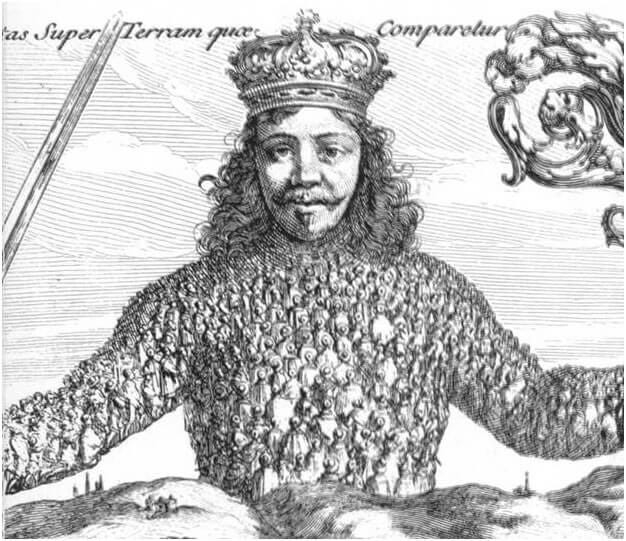
This brings us at last to the famous social contract theory, by which Thomas Hobbes sought to co-opt the idea of original popular election into the cause of an unprecedentedly absolute monarchy. What everyone on the right thinks he knows about this theory is that it is an arbitrary fiction, a mere rational edifice built upon a set of events that never actually happened. But what little the social contract theorists knew about prehistory or New World primitivism is vastly less important than the moulding of their mental habits by classical history and the Latin language. Let us take a look at the theory as expressed in the English version of Hobbes’ De Cive (‘On The Citizen’), Chapter V, and see for ourselves whether we find a puff of hot air or the crystallization of a 2000-year-old political tradition.
Since therefore the conspiring of many wills to the same end doth not suffice to preserve peace, and to make a lasting defence [i.e. in the original ‘state of nature’, described by Hobbes as a ‘war of all against all’], it is requisite that in those necessary matters which concern Peace and selfe−defence, there be but one will of all men. But this cannot be done, unlesse every man will so subject his will to some other one, to wit, either Man or Counsell, that whatsoever his will is in those things which are necessary to the common peace, it be received for the wills of all men in generall, and of every one in particular. Now the gathering together of many men who deliberate of what is to be done, or not to be done, for the common good of all men, is that which I call a COUNSELL.
This submission of the wils of all those men to the will of one man, or one Counsell, is then made, when each one of them obligeth himself by contract to every one of the rest, not to resist the will of that one man, or counsell, to which he hath submitted himselfe; that is, that he refuse him not the use of his wealth, and strength, against any others whatsoever (for he is supposed still to retain a Right of defending himselfe against violence) and this is called UNION. But we understand that to be the will of the counsell, which is the will of the major part of those men of whom the Counsell consists.
...
Now union thus made is called a City, or civill society, and also a civill Person; for when there is one will of all men, it is to be esteemed for one Person, and by the word (one) it is to be knowne, and distinguished from all particular men, as having its own Rights and properties; insomuch as neither any one Citizen, nor all of them together (if we except him whose will stands for the will of all) is to be accounted the City. A CITY therefore (that we may define it) is one Person, whose will, by the compact of many men, is to be received for the will of them all; so as he may use all the power and faculties of each particular person, to the maintenance of peace, and for common defence.
...
In every city, That Man, or Counsell, to whose will each particular man hath subjected his will (so as hath been declared) is said to have the SUPREME POWER, or CHIEFE COMMAND, or DOMINION; which Power, and Right of commanding, consists in this, that each Citizen hath conveighed all his strength and power to that man, or Counsell; which to have done (because no man can transferre his power in a naturall manner) is nothing else than to have parted with his Right of resisting. Each Citizen, as also every subordinate civill Person, is called the SUBJECT of him who hath the chiefe command.
What is this original state of bellum omnium contra omnes (‘war of all against all’) but the Roman civil wars of Sulla and Marius, Caesar and Pompey, Octavian and Mark Antony? What is this ‘council’ but a Roman popular assembly, and what is this ‘union’ and ‘civil society’ but the lex regia and the Roman empire? What is the abstract form of the theory but a reflection of the medieval ‘transference of empire’ (translatio imperii), first to the Germans and then to every independent realm that could defend its claims through Roman law, resulting in the creation of new pseudo-Roman emperors and polities everywhere? What are the later liberal-democratist revisions of the theory but further Romanist atavisms, that push the founding act of the People back to the birth of the Roman republic in the ousting of the ancient kings?
Last but not least – what is Hobbes’ conception of his state as a ‘Mortall God’ (see Leviathan, Chapter XVII), which has every right to suppress any religious doctrine that threatens its rule, but a reabsorption of the rival theory of divine right that had been grafted onto the Roman empire by the early followers of Jesus Christ?
In sum, to adapt a well-known saying of Hobbes about the Catholic papacy, the social contract theory and wider popular-sovereigntist tradition amount to none other than the crowned ghost of the Roman Republic.
Beyond the formulation of social contract theory we need go no further. The path of development from Hobbes to Locke, Rousseau and modern liberal theorists, who retained the idea of the social contract while renegotiating its absolutism and irrevocability, would be obvious even were it not so well-known. Those who would like an especially enlightened account of the origins of this theory, as well as a refutation of it, may consult the Imperium Press translation of Karl Ludwig von Haller’s Restoration of Political Science (a book and publisher that I am always happy to plug).
Our own little history of the cult of popular sovereignty is by no means complete. A more complete account would not only delve into more detail, but also digress into the Germanic and Biblical17 contributions to the tradition. It might also broach the question of whether the idea of rule by popular consent is to some extent perennial – note that I do not say ‘universal’ – and to some extent independent of tradition.18 (In my own defence, I have a book to write, and it’s not on this subject.)
But I think we have said more than enough to prove Moldbug’s mid-2007 blag unfortunately wrong on almost every count. The strand of truth in it, to which I alluded earlier, is that divine-rightism is a dead political formula bound to be supplanted by demotism in a world that has come to worship Man over God. Whatever our adherence to religious tradition can do for us as individuals, it can no longer give us a collectively-accepted political formula.
Nor, it seems, can neoreaction. Yarvin’s solution as of the UR years was to run the state for pure profit, while unwisely throwing the question of its relation to established intellectual authority up in the air. In more recent years, he has taken to quibbling over the minimal difference between two classic popular-sovereigntist maxims, vox populi vox dei (“the voice of the people is the voice of God”) and salus populi suprema lex (“the health of the people is the supreme law”).19 Many of his old followers have abandoned themselves to demotism in a much more overt manner, by slinking back to conservative and nationalist politics in the wake of Trump and Brexit.20 This demonstrates the usual rightist failure to hold to high principles, but perhaps also exposes the unrealism of some of those principles.
The main locus of unrealism in Moldbuggery, which looms largest in early UR, is the notion that a despotic and all-controlling state could be maintained without any reference to popular consent. As we have seen, the Western absolutist tradition is closely intertwined with the demotist one, and the growth of government power has gone hand in glove with the cult of popular sovereignty from the very earliest days. As the old Roman-law maxim goes, quod omnes tangit ab omnibus approbari debet – “what touches all must be approved by all”.
This does not mean that a state cannot be founded in theory and practice on pure legitimist grounds, without reference to demotism or popular sovereignty or other legal fictions inherited from millennia-old republics. It means only that it would necessarily involve the dismantlement of the modern administrative state (not, as Yarvin proposed, the replacement of its bureaucrats with corporate managers) and the establishment in its place of the sort of state defended by Haller – not a “public power” with absolute right over one and all, but rather “a dense network of private contracts, person-to-person arrangements that create patrons and clients, superiors and dependants, and whose paramount node is a proprietor whose wealth and holdings are vast enough for him not to have any superiors or depend on anyone else himself.” This would truly be, in Yarvin’s phrase, casting the Ring into the Cracks of Doom. But I cannot see it happening without some hard external shock to the modern structure, on a par with the destruction of the Western Roman empire.
With no such disaster looming on the horizon (and if you yet wish for it, be careful what you wish for), the will to abolition of the current structure must come from within it. And this means that it must proceed by way of the sole legitimizing principle available to it, the stone on which the structure was once founded: the popular-sovereigntist tradition. Of course this is no new insight, and most neoreactionaries (including Yarvin) long ago resigned themselves to it. But it is difficult to make a serious effort to repurpose this tradition, to detach its essence from modern democratist forms, when you believe that both form and essence are arbitrary nonsense cooked up by early modern religious zealots.
Recall that our own history of demotism began with ancient Athenian demokratia, a political system in which a mob of citizens directly ruled the state and largely dispensed with the ‘oligarchic’ practice of election.21 As I have argued elsewhere, the bloating of the permanent government and legal disempowerment of elected politicians in Western states has led to an atavistic modern form of demokratia, in which those tasked with running and directing the vast and autonomous state-machine act as its true ruling demos. ‘Our Democracy’ is in reality the democracy of the modern political clerisy – of “government bureaucrats, federal workers, scientists, lawyers, judges, journalists, CEOs, academics and leading politicians” – and anything that threatens the collective autonomy of this class is of course defined as a Threat to Democracy.
The preferred self-legitimizing political formula of this demos is not popular sovereignty, but ‘rule of law’. With the laws of the modern state neither conserved by ancient custom nor passed at popular assemblies (nor, in the era of judicial deference and administrative law, even basically accountable to the degenerated mechanisms of popular sovereignty), this sort of law-rule is essentially self-referential: an ever-increasingly expansive and incomprehensible spiderweb of selectively-enforced regulations, spun out by the collective tyrant in order to bind and throttle individuals and rival social forces while allowing him the maximum possible freedom of action. It is, in short, a non-monarchical variant on the old theme of quod principi placuit legis habet vigorem (“what pleases the sovereign has the force of law”). And it shows intriguing parallels with the vital role of litigation, and vitilitigation, to the collective despotism of the Athenian demos.
In one sense we might well say that the demotist tradition has come full circle, to a senility that recapitulates its infancy. Yet if anything still threatens it with death-terrors, it is the tension between the actual rule of this demos and the theoretical reign of the much larger subject populus. The former is necessarily circumscribed as a power-holding minority (as per the so-called Iron Law of Oligarchy), whereas the latter is a more ghostly entity that has been extended to all and sundry in the course of the traditional development that we have just surveyed.
Since popular-sovereigntist ‘democracy’ can never be wholly eclipsed by clericalist ‘rule of law’ (any more than quod principi placuit, the discretionary right of the Roman emperor to make law, could ever fully eclipse the original right of the Roman people), it must instead be construed and interpreted by the political clerisy according to its own lights. Hence the need for the debasement of the suffrage, for the ethnic dilution of the citizenry, for the setting of dependents against contributors, for the identification of non-clerisy whites as a scapegoated racial minority – in short, for the entire ideological panoply of official democratism and ‘social justice’. Of course I am not saying that those in power do not genuinely believe in demotism, that they do not maintain themselves in power by lavishing all sorts of largesse on the People, or that most of those People are anything other than bovinely contented and forbearing – but all of that could just as well be said for past examples of populist despotism, up to and including those of Alexander and Augustus.
Indeed, once the entire history of demotism is taken into account, the only sort of regime that seems to result from it with the force of logical inevitability is some sort of despotism with legalist and populist characteristics. Yet when we begin to step outside mere historical reality, and ask why this should be, the most obvious answer has to do with the principle of quod omnes tangit (‘what touches all’). That is to say, it has become traditional (and is to some extent natural and logical) to seek expressed popular consent for acts that determine the fate of a whole populace, or fundamentally alter the constitution of a state. That is why rituals of popular consent have been so important to the establishment of an unprecedentedly absolute and revolutionary government; and, we should seek to add, why they are also a necessary condition for the abolition of that government. As for the question of the future form and importance of those rituals, this can only depend on the nature of the state that is to come after the current one – a subject for another time.
Cartledge’s liking for mob rule and mass politics does not extend to the present day. In the afterword to the 2018 paperback version, he notes that his book was first published in 2016, in which year the US electorate voted Trump into the presidency and the Brexit referendum returned a vote for leaving the EU. On this, having first reminded us that modern democracy is not the same thing as ancient democracy, he has the following to say (pp.316-7):
Thus, to take the most salient instance for a UK citizen of 2017, referendums (direct democracy) are potentially a disaster waiting to happen in most of our current Western systems of democracy – unless they’re properly prepared for by deep education and are thoroughly debated in principle as well as in detail in parliament (indirect, representative democracy) and their results correctly interpreted and acted upon by politicians and voters alike. The fact of a mere 52 per cent of the actual voting electorate, or palpably less than 40 per cent of the total potential UK electorate, voting a crude ‘Yes’ to leaving the EU in the 2016 referendum, and that borderline, knife-edge outcome’s being taken to equate to the unalloyed, unambiguous, undivided ‘will’ of (all) the miraculously unified ‘people’, is probably the most egregious and potentially disastrous counter-instance.
This arbitrary demand for “deep education” in those who presume to vote on political issues has nothing whatsoever to do with ancient Athens (in which, as Cartledge is well aware, the education of citizens was achieved by their actual participation in affairs of state), but perhaps has much to do with the modern demokratia of the credentialed class.
A shout recorded at the trial of the victorious Arginusae generals by the Athenian Assembly, discussed by Cartledge on pp.120-21 of his book, an instance in which even he has trouble exonerating the demos from the charge of chaotic mob justice. He has little more luck with the trial of Socrates, resorting to the caveat that the hemlock was “self-administered” and thus that “technically, he was not executed” (p.179), which says much for the modern Western concept of consent with regards to the demands of a democratic state.
That is to say, the Athenian Assembly exercised direct power with almost unlimited scope, while the Roman popular assemblies were basically limited to electing officials and voting on proposals set before them by the aristocrats. Note that the practice of popular election was considered in antiquity to be an oligarchical form (which, of course, it was and still is); the quintessentially democratic mode of filling offices was rather the random lottery, which was employed in Athens for all but a limited number of official appointments.
One modern historian who more or less agrees with him is Fergus Millar, who also describes Middle and Late Republican Rome as democratic. Cartledge vehemently disagrees and spends a few pages in his Rome chapter dismantling Millar’s thesis. My sympathies are with Cartledge, though I cannot help noting that he makes no attempt to apply his strict definitions of democracy and oligarchy beyond antiquity.
At this point Cartledge makes the amusing comment that this largesse “controlled” the people as well as benefiting them, and was thus “far from a welfare program” – which in his opinion presumably does nothing of the sort. In general he has a cartoonishly ‘Machiavellian’ view of the motives of populist monarchs like Alexander and Augustus.
These freedmen, as Cartledge points out (p.268), were “first-generation Roman citizens” and would not have been eligible for citizenship in democratic Athens (since ex-slaves there took upon the status of metics, or resident foreigners, as did children with only one Athenian parent after the purist citizenship law of 451 BC). We might note in passing the universality of the alliance between power-centralizers and foreigners or social outsiders.
In the entry for the year 801 AD in the Royal Frankish Annals, the coronation of Charlemagne by Pope Leo is described as follows:
On the most holy day of Christmas, when the king rose from prayer in front of the shrine of the blessed apostle Peter, to take part in the Mass, Pope Leo placed a crown on his head, and he was hailed by the whole Roman people: To the august Charles, crowned by God, the great and peaceful emperor of the Romans, life and victory! After the acclamations the pope addressed him in the manner of the old emperors. The name of Patricius was now abandoned and he was called Emperor and Augustus.
The 962 coronation of Otto the Great, who revived the Germano-Roman imperial title after it had lapsed following the dissolution of Charlemagne’s empire, followed a similar pattern (from the entry in the Chronicon of Regino of Prum continued by Adalbert):
The king [Otto] celebrated Christmas in Pavia. Proceeding from there he was favourably received in Rome and by the acclamation of all the Roman people and clergy he was called emperor and augustus and ordained by Pope John, son of Alberic.
Note that in both of these accounts, the emperor is addressed as such only after the popular acclamations, and that in the second one this actually precedes the papal ordainment.
From the Cambridge edition translated by Annabel Brett.
According to Annabel Brett, this is from a forged document included in the Decretum, a compilation of Catholic canon law.
From the Cambridge edition translated by Cary J. Nederman.
This is not to say that Marsilius was entirely alone in interpreting the lex regia tradition in terms of popular sovereignty. Among the early ‘glossators’ who studied the rediscovered Corpus Juris Civilis in Bologna, Azo Portius held this interpretation, although the majority opinion of his fellow scholars was that the transfer of power had become irrevocable. As for the popular coronation of Ludwig, there was some precedent for this in the 1312 coronation of the previous emperor Henry VII of Luxembourg, who was crowned by cardinals without the approval of the pope. In Popular Sovereignty in Historical Perspective, Quentin Skinner and Richard Bourke ed. (Chap. 4, p.107), the following account of his coronation is quoted from De gestis Henrici VII. Caesaris by Albertino Mussato, a Paduan and friend of Marsilius:
Since the Cardinals denied their consent [to perform the coronation ceremony], Cesar summoned in council the Roman people, or rather, those who supported his party, relating the difficulties of the case and consulting on whatever was expedient. By decree of the people (plebiscitio) it was decided that the Cardinals should crown [Henry] following the exhortations and prayers of the republic; if, however, they refused, they would be forced to do it by the tribunes and the Roman people.
As the author of this chapter, Serena Ferente, remarks: “in Mussato’s narrative…the ‘Roman people’, assembled in a council, become an alternative source of authority that can compel by law (plebiscitum) the cardinals to perform the coronation in the name of the respublica, using coercion if necessary: the ecclesiastical mediation is not eliminated from the ritual, but is subjected to an entirely lay and popular command.”
As Bertrand de Jouvenel observed in his work On Power, the initial concern of French and other late-medieval kings was to control their nobles in alliance with lower-ranked subjects.
This shift of spiritual authority towards kings was not entirely limited to Protestant territories. According to Daniel Lee, Popular Sovereignty in Early Modern Constitutional Thought, p.121:
Some French royalist authors of the sixteenth century, such as Charles de Grassaille (1495-1582), even insisted that the King of France had acquired the same sort of universal authority once attributed to the emperor and the pope, hailing the French monarch as “king of kings” and “vicar of Christ”.
From the abridged version translated by Kathleen E. Murphy.
Specifically, Filmer refers to “zealous favourers of the Geneva discipline”, i.e. radical followers of John Calvin, which I take to mean primarily the Huguenot monarchomachs. According to Daniel Lee, Popular Sovereignty in Early Modern Constitutional Thought (Chapter 4, pp.121-157), the monarchomach critique of ‘tyranny’ and ideology of popular resistance was heavily indebted to the Roman law tradition.
Previous examples of this Rome-England analogy are not hard to find. According to Daniel Lee’s Popular Sovereignty in Early Modern Constitutional Thought (p.49), the 13th-century English jurist Henry de Bracton suggested that the English Coronation Oath functioned as a kind of lex regia, by which the people transferred power to the king while also binding him by the law. On the other side, in De Republica Anglorum (Part II, Chapter 1) the 16th-century humanist Thomas Smith compared the Parliament of England to the Roman popular assemblies, noting that “the consent of the Parliament is taken to be everie mans consent”.
A lot of Stuart-era English writing on popular sovereignty was much preoccupied with the question of whether or not the divine appointment of King Saul (and later, king David) over the United Kingdom of Israel and Judah involved a necessary element of popular consent.
To clarify, a human social form can be called universal on condition that it occurs everywhere, and perennial if it can be found across a wide range of different cultures. Thus absolute monarchy is perennial but not universal, and demokratia (defined, as we have said, as the collective rule of a very large group) would seem to be perennial as well, since it seems to have been found in primitive tribes outside the West as well as in ancient Greek and later Western states.
As regards the perenniality of the basic idea of demotism, i.e. that legitimate rule is conferred by popular support and consent, we need only consult the 4th-century Chinese Confucian sage Mencius (James Legge trans.):
孟子見梁襄王。出,語人曰:「望之不似人君,就之而不見所畏焉。卒然問曰:『天下惡乎定?』吾對曰:『定于一。』
Mencius went to see the king Xiang of Liang. On coming out from the interview, he said to some persons, ‘When I looked at him from a distance, he did not appear like a sovereign; when I drew near to him, I saw nothing venerable about him. Abruptly he asked me, “How can the kingdom be settled?” I replied, “It will be settled by being united under one sway.”
『孰能一之?』對曰:『不嗜殺人者能一之。』
‘”Who can so unite it?” I replied, “He who has no pleasure in killing men can so unite it.”’
『孰能與之?』對曰:『天下莫不與也。王知夫苗乎?七八月之間旱,則苗槁矣。天油然作雲,沛然下雨,則苗浡然興之矣。其如是,孰能禦之?今夫天下之人牧,未有不嗜殺人者也,如有不嗜殺人者,則天下之民皆引領而望之矣。誠如是也,民歸之,由水之就下,沛然誰能禦之?』」
‘”Who can give it to him?” I replied, “ All the people of the nation will unanimously give it to him. [Note: this translation is too Western-influenced, and a more literal rendering of 天下莫不與也 would be “no-one under heaven will not give it to him”.] Does your Majesty understand the way of the growing grain? During the seventh and eighth months, when drought prevails, the plants become dry. Then the clouds collect densely in the heavens, they send down torrents of rain, and the grain erects itself, as if by a shoot. When it does so, who can keep it back? Now among the shepherds of men throughout the nation, there is not one who does not find pleasure in killing men. If there were one who did not find pleasure in killing men, all the people in the nation would look towards him with outstretched necks. Such being indeed the case, the people would flock to him, as water flows downwards with a rush, which no one can repress.”’
Admittedly, this is exceptionally demotist by ancient Chinese standards, which makes it more than a little ironic that the anti-demotist Yarvin chose to style himself Mencius Moldbug!
This of course suggests that Yarvin eventually came to a more defensible position, perhaps by reading some of the sources we have looked at here. But since he has not to my knowledge ever set the record straight on the specific subject of demotism, I still consider this post a necessary correction. As for the idea that salus populi is better than vox populi, because serving the health of the people does not necessarily mean serving their desires, let us just say that it expired in 2020 of aggravated myocarditis.
Here we might also mention the fad for generative anthropology entertained by the ‘neoabsolutist’ school of neoreaction. It strikes me that the attempt to draw political support from this highly speculative academic theory can be understood as a sort of ‘cargo cult’ of the social contract theorists. The difference is that social contract theory was much more than intellectual hot air, whereas generative anthropology is not (at least as far as I can gather, although its devotees are of course welcome to explain its merits to me).
Note that Yarvin’s use of the term ochlocracy ‘mob rule’ (e.g. in this post) for rowdy electioneering is very different from that of Polybius, who would have associated elections with oligarchy and mob rule with Athenian-style demokratia. Although modern elections with a vastly-extended voter base are much more ‘populist’ than ancient ones attended by a circumscribed citizenry, on balance I think that the ancients were right in their associations and that the modern decline of elective political power is a move away from oligarchy (and effective leadership). In ancient Greece, demokratia was associated with sortition, and it seems obvious that the revival of this principle in the modern day would lead to even more herd-mentality and mob rule than has been produced by the emancipation of bureaucratic systems from elective oligarchies.
Leo Strauss has a nice essay on Marsilius of Padua where he portrays him as the villain of intellectual history. Might be worth a look. On that score, Strauss has a lot to say about the relationship of De Cive to Leviathan that is relevant to your argument.
More broadly, if you haven't already read it. Quentin Skinner's 'The Foundations of Modern Political Thought' is good for tracing the different ingredients of European absolutism and revolutionism. His approach is quite philistinical, but in some mays more useful for that.