
An Alliterative Iliad (X)
Who threw the lame god Hephaestus out of heaven?

At last we draw nigh to the end of the first book of Homer’s Iliad, and to our experiment in rendering its contents into a modernized form of Anglo-Saxon metre.
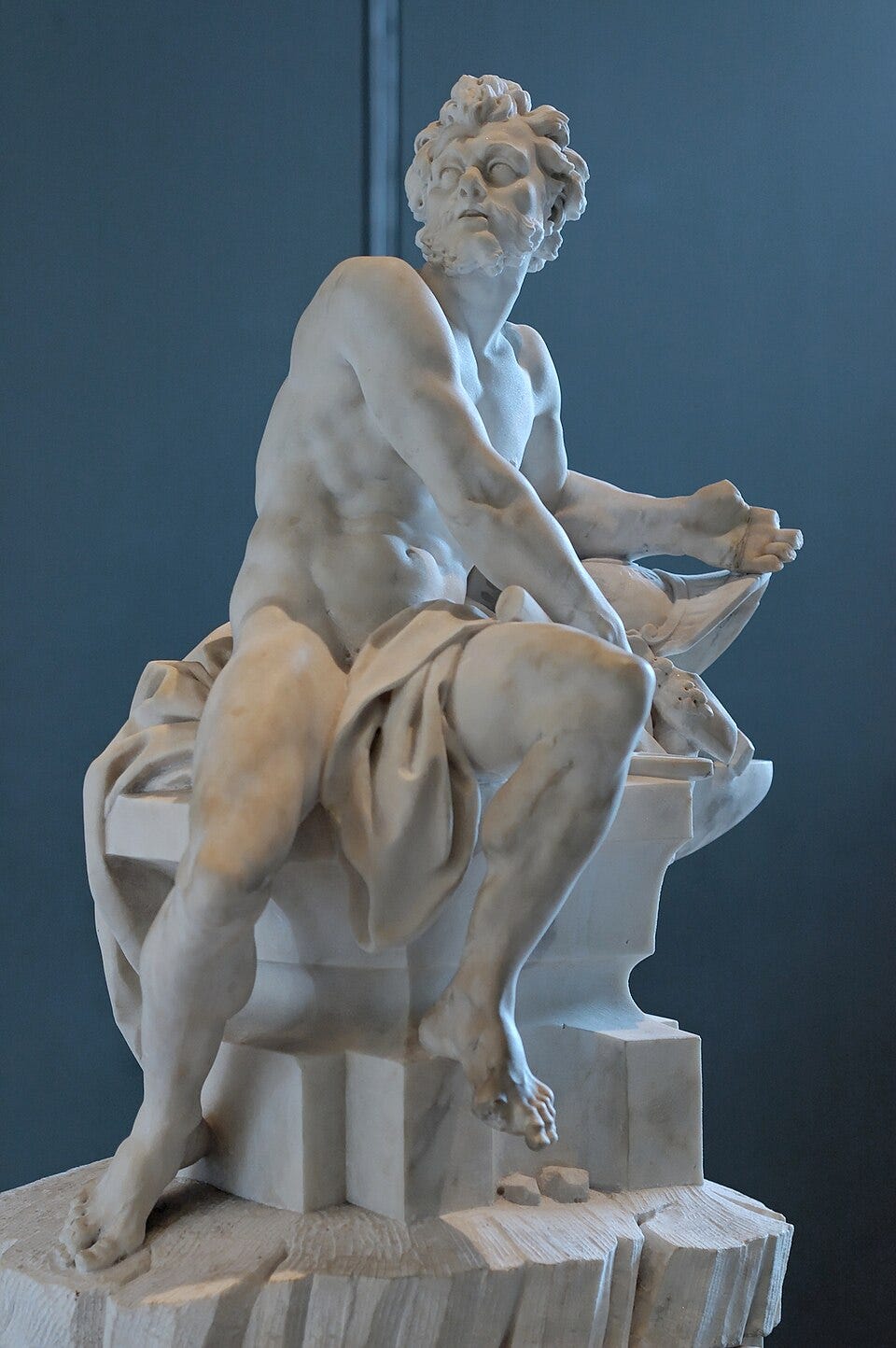
We concluded the penultimate part with Zeus’s threat to lay hands on his wife unless she stop interrogating him about his agreement with Thetis. At this, Hera sits down cowed-eyed, and an awkward silence descends on the house of the gods. The first to stand up and speak is none other than Hephaestus, the lame god of the smithy, who mollifies his mother before giving the other gods some comic relief by limping around the hall serving out the divine nectar.
In H.J. Rose’s Handbook of Greek Mythology, Hephaestus is placed among the ‘lesser and foreign deities’, and the following is said of him (p.p.165-6):
Hephaistos has been pretty conclusively shown to be an Oriental. The distribution of his worship is intelligible only if we assume that he was, to begin with, a fire-god adored by the natives of the region of the Lykian Olympos, which was and is remarkable for the presence of a considerable quantity of natural gas. From this centre, his cult appears to have spread among the Karians, not only on the mainland, but to adjacent islands, notably Lemnos, whose mountain, Moschylos, geologists recognize as obviously volcanic, and in which some traces of volcanic activity seem to have lingered long enough for a memory at least of them to survive in classical tradition. Here also, it would seem, those Greeks who had settled on or near the coast of Asia Minor learned to know of this god… By this time he was no longer, if he had ever been, simply a deity who made fire come from the ground, and was become a divine smith, whose forges were under the earth at sundry places and made their presence known by fire and smoke escaping therefrom. The population of Attica, which was largely industrial, worshipped Hephaistos with considerable zeal, and here and there in other parts of Greece he was honoured…
Hephaestus will make reference to this island of Lemnos, as well as the somewhat mysterious Sintian people who lived there, in the course of his speech to Hera. According to him, this is where he happened to land after being thrown off Olympus by Zeus, having tried to intervene in one of the god-king’s many quarrels with his wife. What is interesting is that in another account, also found in the Iliad (specifically Book XVIII), it is Hera who throws Hephaestus off Mount Olympus after giving birth to him and finding him deformed.
At the level of story, there’s no necessary contradiction here: when Hephaestus was born to Hera (which, according to Hesiod, took place ‘without union with Zeus’), she threw him off Mount Olympus because he was deformed, and on a separate occasion Zeus did the same thing because he intervened in a domestic quarrel. But the duplication of theme leads us to wonder whether they do not originate from one myth rationalized and narrativized in two different ways.
Much more can be found on Hephaestus, his fall, and his landing here.
Just so he spake;    and, shocked to fright,
Cow-eyed Hera    curbed her high heart
And sat down in silence.    Sorely troubled
Was the host celestial    in the house of Zeus.

So Hephaestus spoke –    famous craftsman –
To do favour to his mother,    fair-armed Hera.
"What a horrid business!    And how hard to bear,
"If ye two should quarrel    on account of mortals,
"And bring a brawl about!    The banquet of gods
"Would fall to the fouler,    and be void of pleasure!
"Let me warn my mother –    though full wise she is –
"To gratify our father,    lest again he scold her,
"And stir disturbance up    to spoil our feast.
"Should the Olympian lightning-wielder    list to round on us
"And strike us from our seats,    none could stand athwart him;
"But with soft words soothe him –    who is strongest of all –
"And the Olympian will graciously    be gentle with us."

Just so he spake –    and sprang to his feet,
Took the double goblet,    which he dealt to the hands
Of his dear mother,    and addressed her thus:
"Forbear, mother,    and abide, though vexed;
"Lest mine eyes should see you    being struck – and I,
"As dear as you are to me,    might aid you not,
"For to vie with the Olympian    would be far too painful.
"Once I tried it,    wishing to help you –
"And was caught by the foot;    and he cast me down
"Past the sublime threshold –    and long I hurtled,
"All day, through air!    With the downing sun
"I landed in Lemnos,    and my life was ebbing;
"But I soon had succour    from the Sintian folk."

Just so he spake;    and a smile appeared
Upon the face of the goddess,    fair-armed Hera;
And smiling, from her son    she received the goblet.
Then he rounded, rightwise,    the room of gods,
And drew from the mixing-bowl    the dulcet nectar.
As they looked on Hephaestus,    lame and awkward,
Huffing and bustling    through the hall to serve them,
The blessed ones were stirred    to unstinting laughter.

'Til the sun went under,    for all that day,
To the full they feasted,    with nought found to be wanting –
Not the sheen lyre    in the sway of Apollo,
Nor the singing in exchange    of the sweet-voiced Muses.

When low sank the light    of the luminant sun,
Each left for his own house,    to lay him down –
For the famed Hephaestus    had framed such homes for them
With learned artfulness,    the list-limbed god.
So Zeus the lightning-wielder    sought the rest-bed
He'd oft sought before    when sweet sleep came;
He went up and lay there,    with his lady next to him –
Gold-throned Hera    by the great Olympian.
Thus ends the first book, along with this experiment in translation, at least for the foreseeable future. I would not want to continue the project further without first acquiring a much better understanding of the language, so that I can work more artfully and lean less on crutches. This is a tall order, however, and for various reasons it is unlikely that I will be able to attempt it anytime soon; in the meantime, should anyone else be willing and able to take up the task of retranslating Homer, he or she is welcome to make use of the ideas outlined here.
It must be said that the ‘alliterative’ meter may not be the best choice for a serious, full-length translation. As I noted in the first part, since there exists no obvious English analogue to the Greek hexameter line, translators of the Iliad and Odyssey have had to resort to various metrical (and unmetrical) forms that are quite unlike to the verse of Homer. Thus Chapman had his rhymed fourteeners, which imitate the original hexameters only vaguely; Pope with his pentameter couplets threw away all pretence to imitation; 20th-century translators wrote longer lines with more fidelity to Homeric formulas, but had to resort to free verse for this; and now Emily Wilson has reverted to the 19th-century preference for unrhymed iambic pentameter with formulas rewritten for variation. Do we really need another translation in a meter that forces us even farther from the original poem?
The true neo-traditionalist way, I think, would involve a retvrn to Old English forms but not to the normal metre of Beowulf. In Anglo-Saxon poems there is a second, longer type of metrical line that appears only occasionally, and is called ‘hypermetric’ by modern scholars. Such lines contain six stresses and are governed by very onerous ornamentational rules (worked out in detail by Old English scholar Constance Hieatt; see here and here if you’re interested). The following sample of two such lines is taken from the Seafarer (full translation here):
Dol biþ se þe him his Dryhten ne ondrædeþ / cymeð him se deað unþinged
Eadig bið se þe eaþmod leofaþ / cymeð him seo ar of heofonum
These lines can be rendered in modern English as follows, with Hieatt’s rules preserved (stresses in italics, chiming stresses in bold):
He is dull who dreads not his Lord;    there comes to him death without warning;
He is happy who humbly lives;    there comes to him heavenly grace.
Once we strip these lines of their ornamentational rules, however, we end up with a blank six-stressed line that should be long and flexible enough to render Greek hexameter verses one-to-one. To the above pattern with two half-lines of three stresses each we can add other, equivalent patterns, such as a line composed of three half-lines (third-lines?) of two stresses each. We can illustrate both of these patterns by using them to retranslate the first two lines of the Iliad:
O goddess, sing of the wrath / of Achilles, the son of Peleus –
Catastrophic – / that heaped on Achaeans / pains uncounted...
This comes quite close to the original Greek lines:
μῆνιν ἄειδε θεὰ Πηληϊάδεω Ἀχιλῆος
Meenin aeide thea / Peeleeiadeoo Akhileeos
[Anger sing, goddess / of Peleus’s son Achilles]
οὐλομένην, ἣ μυρί᾽ Ἀχαιοῖς ἄλγε᾽ ἔθηκε,
oulomeneen / hee myri’ Akhaiois / agle’ etheeke
[accursed / that many to Achaeans / pains brought]
This, then, could be the key to translating this ancient poetry into English and linking it with the oldest remnants of our own oral tradition. What might be said against it is that it would threaten to become too exact, to degenerate into a sterile exercise in identifying formulas and replicating them the same way everywhere they are used, without the element of creative variation forced upon the translator by the meter used here.
Notes
The double goblet
The LSJ dictionary is unclear on the matter of whether ἀμφικύπελλος (amphikupellos) should be taken as meaning ‘double-handled’ or ‘double-bowled’ (i.e. having a bowl at the top and the bottom).
The sublime threshold
The word translated as ‘sublime’ is θεσπέσιος (thespesios), which depending on context can take such meanings as ‘divine’, ‘wondrous’, ‘oracular', ‘superhuman’. Possibly we can understand the ‘transcendent threshold’, the boundary between the realm of the gods and that of mortals.
As they looked on Hephaestus, lame and awkward
‘Lame and awkward’ is interpolated metri causa and serves to remind the modern reader why Hephaestus’s cupbearing was a source of such amusement to the gods.
The list-limbed god
The epithet ἀμφῐγῠήεις (amphigueeeis) is obscure in Ancient Greek, and so I have made its English translation just as obscure. According to Wiktionary, it could mean ‘lame on both sides’ (referring to Hephaestus’s legs) or ‘strong on both sides’ (referring to his arms), though the meaning is usually understood to be the former because Hephaestus has other epithets referring to his lameness. Similarly, although list is an old word meaning skill, art or cunning, its primary association is with lopsidedness (as of a listing ship). Of course it could well be that I am overthinking the word, in which case you are free to read it as ‘lame-limbed god’.