
An Alliterative Iliad (IX)
Hera criticizes Zeus in the house of the Olympians

In the last installment, Thetis went to Olympus and managed to extract an agreement from Zeus to help the Trojans gain the upper hand against the Greeks. Zeus was reluctant to grant this request because it would bring him into conflict with his wife Hera – who, it would seem, has been spying on him and Thetis and has overheard what was said. When Zeus returns home, she proceeds to needle him about it, until he loses patience and threatens to lay hands on her.
The relationship between Zeus and Hera is often, notoriously, like this, with many conflicts sparked from Hera’s jealousy towards her husband’s extramarital loves – one of whom, as we have touched upon, was Thetis. In this case, however, Hera has her own reasons for disliking the arrangement made by Zeus, and this simply that she wants to see the Greeks beat the Trojans and raze their city to ashes. And although she is harshly put in her place for now, she will get her way in the end, since even Zeus (despite his sympathy for the Trojan king) cannot or will not go against the decree of fate that Troy is to be destroyed.
Like many other background details of the Iliad, the reason for Hera’s hatred of Troy was explained in the Cypria, the first poem in the literary Epic Cycle that distilled the Greek oral tradition of the Trojan War. Unfortunately, this poem is now lost, along with every other part of the Epic Cycle except the Iliad and the Odyssey (by all accounts the best and longest parts of it, and probably the first to be written down). But the story was still known to later antiquity, and the gist of it is not in doubt.
It begins with the marriage of Thetis and Peleus, from whose union will later come Achilles. All the gods and goddesses are invited to the wedding, except for Eris the goddess of strife. Thus bent on souring the occasion, Eris throws a golden apple (in some accounts, inscribed with the words ‘to the fairest’) among the three goddesses Hera, Athena and Aphrodite, successfully starting a quarrel between them as to which one of them is fit to claim it. Zeus tells the goddesses to seek out Paris, the son of King Priam of Troy, and have him award the apple to whichever one of the three he judges to be the most beautiful.
Once it becomes clear that the goddesses are more or less equally beautiful, this Judgement of Paris descends into a contest of bribery. A detailed account of the event can be found in a work called The Rape of Helen by the 6th-century (A.D.) poet Collothus of Lycopolis. The following excerpt is from the 1928 translation of A.W. Mair, available to read in full at Theoi Classical Texts Library:
...Paris bent a gentle eye and quietly essayed to judge the beauty of each. He looked at the light of their grey eyes, he looked on the neck arrayed with gold, he marked the bravery of each; the shape of the heel behind, yea and the soles of their feet. But, before he gave judgement, Athena took him, smiling, by the hand and spake to [Paris] thus: “Come hither, son of Priam! leave the spouse of Zeus and heed not Aphrodite, queen of the bridal bower, but praise thou Athena who aids the prowess of men. They say that thou art a king and keepest the city of Troy. Come hither, and I will make thee the saviour of their city to men hard pressed... Hearken to me and I will teach thee war and prowess.”
So cried Athena of many counsels, and white-armed Hera thus took up the tale: “If thou wilt elect me and bestow on me the fruit of the fairer, I will make thee lord of all mine Asia. Scorn thou the works of battle. What has a king to do with war? A prince gives command both to the valiant and to the unwarlike. Not always are the squires of Athena foremost...”
Such lordship did Hera, who hath the foremost throne, offer to bestow. But [Aphrodite] lifted up her deep-bosomed robe and bared her breast to the air and had no shame. And lifting with her hands the honeyed girdle of the Loves she bared all her bosom and heeded not her breasts. And smilingly she thus spake to the herdsman: “Accept me and forget wars: take my beauty and leave the sceptre and the land of Asia. I know not the works of battle. What has Aphrodite to do with shields? By beauty much more do women excel. In place of manly prowess I will give thee a lovely bride, and, instead of kingship, enter thou the bed of Helen...”
Not yet had she ceased speaking and he gave her the splendid apple, beauty’s offering, the great treasure of [Aphrodite], a plant of war, of war an evil seed. And she, holding the apple in her hand, uttered her voice and spake in mockery of Hera and manly Athena: “Yield to me, accustomed as ye be to war, yield me the victory. Beauty have I loved and beauty follows me...[”] Thus spake [Aphrodite] and mocked Athena. So she got the prize of beauty that should work the ruin of a city, repelling Hera and indignant Athena.
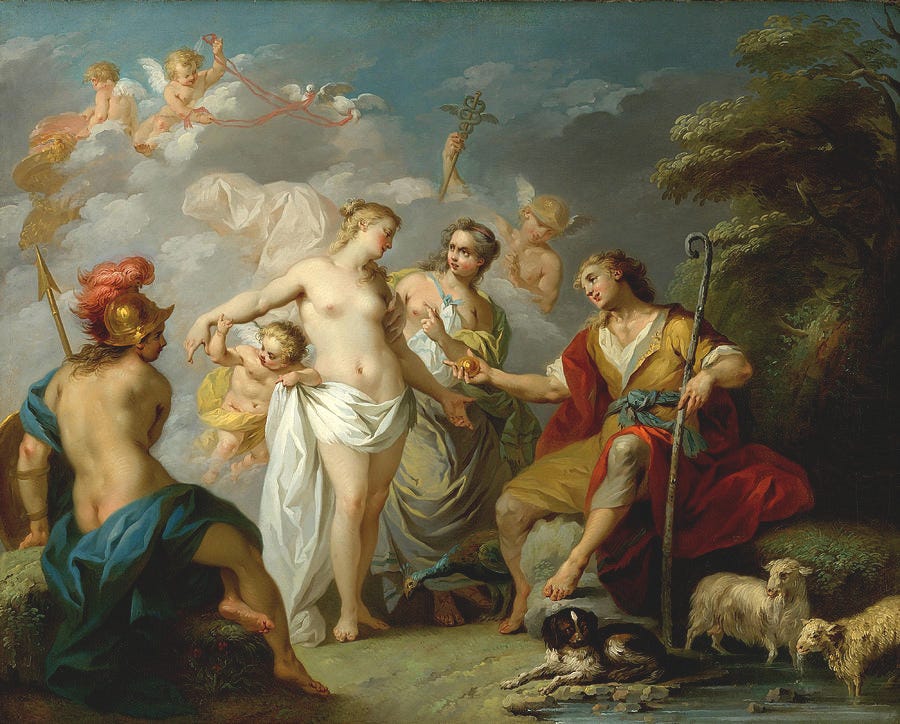

It’s not entirely clear from this account whether Aphrodite finally won Paris over by her own immodest self-display, or by invoking the name of the most beautiful mortal woman in the world. Either way, she has promised him marriage to Helen, and is obliged to deliver – although she has neglected to mention that he shall have to abduct (‘rape’) her first, because she is already married to King Menelaus of Sparta. Perhaps she deceived Paris, or perhaps she simply paid no heed to this detail – for what care has the goddess of love for the formalities of marriage?
Thus Paris abducts Helen, and dooms his father’s city to a losing war against her outraged husband – who has not only secured an agreement from all other Greek kings to uphold and defend his marriage, but can now also count on the divine aid of both Hera and Athena. And this is why Hera, as she (presumably) spies upon the meeting of Thetis and Zeus, is seething over something more than the way in which the sea-goddess clasps her husband’s knees.
So the two now parted,    having taken counsel;
She plunged from Olympus,    to plumb the sea-depths;
But Zeus went homewards    to the hall of gods,
Where the immortals sat.    To meet their sire
They arose at once;    not one could bear
To stay and await him;    they stood together,
As he sat on his throne.    But his sister-wife
Had seen and was wise    to his sharing counsels
With silver-footed Thetis,    the sea-elder's daughter.

So without delay,    she thus bespake him –
Zeus son of Cronus –    with snithing words:
"O all-wily one!    Which other god
"Has been sharing counsels with you?    Such is beloved of you:
"To plan and to ponder,    apart from me,
"And never venture frankly    to divulge your mind to me."

He answered, the father    of humans and immortals:
"Do not hope, Hera,    to wholly know
"My words and purposes;    that will not be;
 "It would be hard for you,    although you are my consort.
"What is fit to your knowledge    you are first to know
"Among mortal men    and the immortal gods.
"Of what I plan by myself,    sitting apart from ye,
"Pry not and probe not    with pestering questions!"
_Pompeian_Art.jpg)
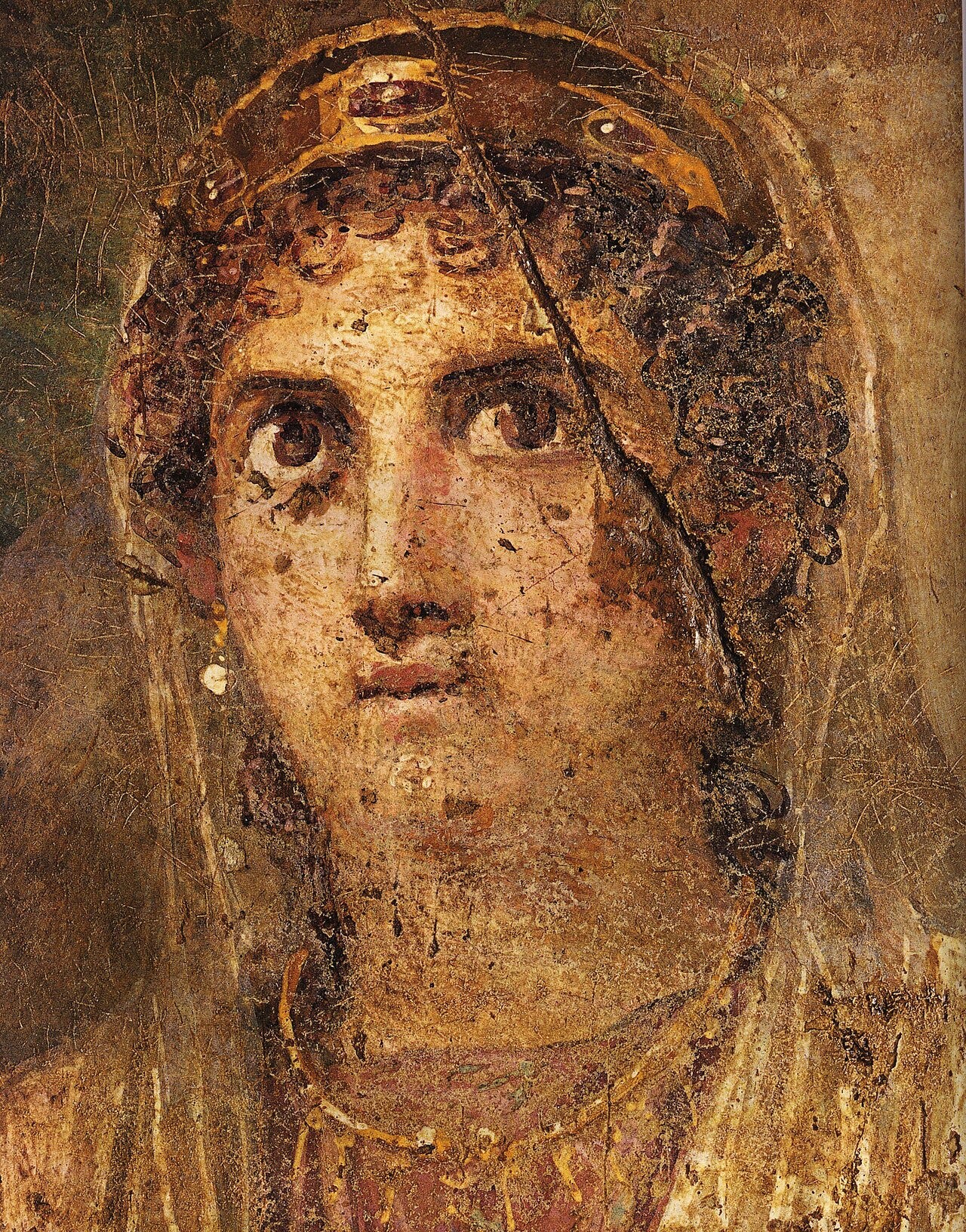
And his queen requoth to him,    cow-eyed Hera:
"Dread son of Cronus,    how comes this speech?
"In the past, truly,    I've not pressed you much
"With prying and quarrying;    as it pleases you,
"At ease, quiescent,    you work out your plans.
"But I fear, dreadfully,    you fall to the sway
"Of silver-footed Thetis,    the sea-elder's daughter.
"In the mists of the morning,    she made her way here,
"And sat beside you,    and seized your knees;
"And methinks you nodded,    and your troth did seal,
"To honour Achilles,    and help the Trojans
"To slaughter scores    beside the ships of Greece!"

Zeus the cloud-drover    spake in answer:
"O dear, O dear!    Does no doing of mine
"Escape your suspicion?    Yet this serves you ill:
"For it avails you nought    but to further drive you
"From my heart away;    and that shall harrow you worse.
"If what you say be sooth,    then as such I willed it;
"So now sit in silence,    and my speech obey –
"Lest I lay these hands on you –    unwithstandable –
"And none on Olympus    in the least might help you!"
After this open threat, at which Hera is at last cowed into silence, an awkward tension descends on the hall of gods – until the lame smith Hephaestus stands up to provide some much-needed comic relief.
Notes
To the hall of gods where the immortals sat
Interpolated for clarity; the δῶμᾰ (dooma) of Zeus is not described, but is presumably a large celestial hall or palace analogous to that of an earthly king.
But his sister-wife…
The text says simply ‘Hera’, but it seems apposite to remind modern readers of the relationship between the king and queen of the gods.
With snithing words
Hera’s words are described as κέρτομος (kertomos), ‘mocking’ or ‘stinging’, which according to some etymologists (see here) is related to words for cutting and shearing. The English word snithing, which means ‘cutting’, seems a better translation option than cutting itself because of its association with snide.
O dear, O dear
Zeus says δαιμονίη (daimoniee), feminine vocative of δαιμόνιος (daimonios), which can be used as a respectful or affectionate term of address but also has connotations of possession by a daemon (see here) and hence is often translated as ‘strange one’.
And that shall harrow you worse
We met the formula ῥίγιον ἔσται (rhigion estai) in Part V, spoken by Agamemnon of Achilles, and rendered it more literally as ‘[that] will chill [him] the colder’. The present metre does not permit us to render Homer’s formulas identically in each instance of their usage, at least not without straining the sense; for that we would need a different metre, worked out here, based on the six-stressed ‘hypermetric’ lines of Anglo-Saxon verse with the structural ornamentation removed.