
An Alliterative Iliad (I)
Apollo sends a plague upon the Greek army

Over the last four centuries, Homer’s Iliad has been translated into various styles of English verse. The earliest translators insisted on end-rhyme, which had long been orthodox in English but was totally absent from Ancient Greek poetry. Here is the opening of George Chapman’s pioneering 1611 translation, in long fourteen-syllable lines designed to mimic the hexameter lines of the original:
Achilles’ baneful wrath resound, O Goddess, that impos’d
Infinite sorrows on the Greeks, and many brave souls loos’d
From breasts heroic; sent them far to that invisible cave
That no light comforts; and their limbs to dogs and vultures gave:
To all which Jove’s will gave effect; from whom first strife begun
Betwixt Atrides, king of men, and Thetis’ godlike son.
Alexander Pope’s looser 1720 version departed further from the style of the original, by keeping the end-rhyme from Chapman and shortening his long lines to decasyllabic ones that did not permit line-for-line translation. Compare the same opening:
Achilles' wrath, to Greece the direful spring
Of woes unnumbered, heavenly goddess, sing!
That wrath which hurled to Pluto's gloomy reign
The souls of mighty chiefs untimely slain;
Whose limbs, unburied on the naked shore,
Devouring dogs and hungry vultures tore.
Since great Achilles and Atrides strove,
Such was the sovereign doom, and such the will of Jove!
Later translators became more interested in accuracy and fidelity, and more willing to abandon the convention of end-rhyme. This began with William Cowper in 1791:
Achilles sing, O Goddess! Peleus' son;
His wrath pernicious, who ten thousand woes
Caused to Achaia's host, sent many a soul
Illustrious into Hades premature,
And Heroes gave (so stood the will of Jove)
To dogs and to all ravening fowls a prey,
When fierce dispute had separated once
The noble Chief Achilles from the son
Of Atreus, Agamemnon, King of men.
Finally, modern translators liberated from both end-rhyme and iambic pentameter have often tended to revert to a Chapman-like use of longer lines. Thus, for example, Richmond Lattimore in 1951:
Sing, goddess, the anger of Peleus' son Achilleus
and its devastation, which puts pains thousandfold upon the Achaians,
hurled in their multitudes to the house of Hades strong souls
of heroes, but gave their bodies to be the delicate feasting
of dogs, of all birds, and the will of Zeus was accomplished
since that time when first there stood in division of conflict
Atreus' son the lord of men and brilliant Achilleus.
This development away from end-rhyme and towards the use of long lines is perhaps for the best, insofar as translators seem to be groping towards an ever-more precise imitation of Homer. But it’s a crying shame that no-one in all this time thought to translate the Iliad into the oldest English verse-style, commonly called ‘alliterative’ (though this is technically a misnomer) – that is to say, the meter of Beowulf and Sir Gawain and the Green Knight and Piers Plowman, revived from obscurity in the late 19th and early 20th centuries. Now that the heyday of ornamentation and paraphrasing has passed, it seems decreasingly likely that anyone will ever attempt such a thing.
By no means am I the man for this Herculean job. For one thing, I don’t even know Ancient Greek (though nor, it seems, did Alexander Pope). But much of this blog constitutes an exercise in biting off more than I have any right to chew. And to extend the analogy, perhaps it is necessary to put a bit of blood in the water in order to encourage others to the task, even if it be mostly my own.
Thus I present to you the beginnings of an Alliterative Iliad.
In truth this little project was begun and abandoned the better part of two years ago. My first intention was simply to take the translation of Cowper, supplement it with a prose crib, and render it into alliterative verse without any need to refer to the original. Then I realized that Cowper had the nasty habit of varying the wording of Homer’s oral-traditional formulas, and this set me looking for more accurate translations, only to conclude before long that no translation can be fully trusted. Thus I ended up working from the original Greek text as well as the translations, referring almost every other word to Wiktionary, in such a painfully laborious fashion that I was happy to have done with it a bare month after I had started.
But I did not give up until I had the entire first book of the Iliad translated. Since it seems highly unlikely that I will ever take up the project again (and even more unlikely that I will ever see it through to completion1), I may as well release it all here – as an experiment, as a positive or negative example to others, or simply as a poem. This post will be the first installment of many.
A couple of preliminary explanations are in order. First, with regards to the metre, ‘alliteration’ or ‘chime’ falls not on letters but on stresses – thus Achilles chimes with king, but not with anger, notwithstanding the common definition of alliteration.2 Where the intended stress-pattern of a word is unclear (as is sometimes the case with compound words), acute accents on vowels may be used. Another point worth mentioning is that I have assimilated some lesser-used sounds to others: sh and z to s, th to t, j to g, ch to k, v to f, and h to vowel-sounds (which all chime with each other). Other more radical assimilations advocated in other posts have not been used here.
Second, since I gave a fair bit of thought as to how best to render certain words in English, explanations of these will be given in the notes at the bottom of the post. These will be sparse indeed by the standard of my other posts on Old English poetry, since I am much less acquainted with the language, and at the time of writing had not yet acquired the habit of noting down translation puzzles and their solutions. The following points are best clarified at the outset:
That Homer’s ethnonyms Achaeans, Danaeans, Argives etc. are all equivalent to Hellenes or Greeks3;
That by the ‘king of men’ is meant Agamemnon of Mycenae, overlord of the Greek host, also called Atrides or son of Atreus (though this can also refer to his brother, Menelaus of Sparta, the affronted husband of Helen of Troy);
That the ‘son of Leto and Zeus’ is the god Apollo;
That personages are often referred to by patronyms, or derivative forms of a father’s name (thus Pelides means ‘son of Atreus’, that is to say Achilles, and the female names Chryseis and Briseis simply mean ‘daughter of Chrysa’ and ‘daughter of Briseus’ respectively).
Third, since I worked from translations as well as the original, some turns of phrase that are not my own come rather from these translations than from the original. As memory serves, I became more ‘literalist’ (within the limits of my abilities and metre) in the course of working through the first book.

O goddess, sing    of the son of Peleus:
Of the rage of Achilles,    and the countless pains
It heaped on the Achaeans;    and of heroes' shades
It hurled, ere their time,    into Hades' depths,
And gave them naked –    through the God's design –
To vultures of the sky,    and to feasting dogs;
For that a violent word-war    had forced asunder
Divine Achilles    from the king of men.

Who among the gods    engaged them in strife?
Leto's son and Zeus's.    Stoked to rage,
Incensed against the king,    he a sickness raised –
A plague upon the host –    and piled up corpses;
For the son of Atreus    had dishonoured his priest,
Venerable Chryses,    when he came to the fleet
With riches to ransom    his rapted daughter –
And the laurel garland    gracing his hand
Upon the gold sceptre    of farshóoting Apollo.
He supplicated all,    for his enslavèd girl,
In the host of the Achaeans;    but chiefly two:
The sons of Atreus,    highest-commanding.

"The two of ye Atrides,    and ye throng of Greeks,
"Well-gréaved Achaeans;    may the gods Olympian
"Grant to ye the plundering    of Priam's city
"And a safe return.    But take my gifts
"And sell me back my darling,    for the sake of honour
"To the son of Zeus,    farshóoting Apollo."

The rest of the Achaeans    cried assent
To reverence the priest,    and the ransom take;
But Atrides was displeased, and repulsed him harshly,
And sent him on his way    with a stark decree:

"Get hence, old man,    from these hollow barques,
"And nor loiter in this place    not later return,
"Lest the garland of the god –    if I again should find you!
"And his gold-decked staff    should not save your life.
"The maid is mine now;    I'll dismiss her not
"From my home at Argos;    till age has taken her,
"She'll partner me in bed,    and ply the loom,
"And everywhere she fares    shall be far from her country.
"Move me no more now.    While you may, begone!"

The old man trembled,    and in haste obeyed,
And went silently to mourn    by the tumultuous sea.
In solitude he went,    and he ceaseless prayed
To the Fulgent, whose birth    was of fair-locked Leto:

"Hear me now, O god    of the argent bow!
"Who bestrideth Chrysa,    and Cilla divine,
"And reigneth over Tenedos    as rightful lord!
"O Mousebane Apollo!    If it pleased your heart
"When I built your temple up,    and burned the thigh-fat
"Of bulls and goats to you,    then bring my wish about:
"Strike at the Danaeans    for your servant's tears!"

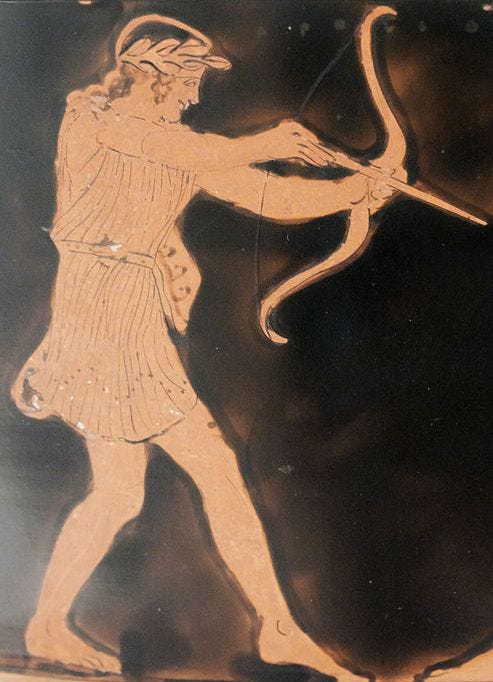
So Chryses prayed;    and Apollo heard,
And came striding from Olympus    with his shining bow
And quiver o'er his shoulders,    clashing as he marched,
And rattling with arrows;    enraged in heart
And bent upon vengeance.    To the fleet he came
As darkly as the night;    and he knelt apart,
And loosed off an arrow    with a lash and clang
Of the doom-knelling string    upon the silver bow.
He struck the mules first,    and swift-limbed dogs,
Then vengefully at men    sent his venomed darts –
And thus mounded up the dead    on cremation-pyres.
Nine nights the army    from his arrows suffered;
Til Achilles, on the tenth day,    called a meeting
Of the whole war-host.    White-armed Hera
Had sent that thought to him,    seeding his mind –
For she most dearly pitied    those dying before her.
Notes
As Achilles will explain later on in the poem, immediately prior to these events, the Greeks have captured and sacked a city allied to Troy. According to ancient practice, they slaughtered the young men and took the women as slaves and war-prizes.
Among the latter are two exceptional girls, Briseis (‘daughter of Briseus’, properly named Hippodameia) and Chryseis (‘daughter of Chryses’, properly Astynome), who have been respectively awarded to Achilles and Agamemnon by common consent of the Greeks. Agamemnon is much more taken with Chryseis than with his wife Clytemnestra (who will end up cuckolding and murdering him), hence is unwilling to give her back to her father, despite the rich ransom-gifts and the danger of offending a priest of Apollo.
In the original text at this point there is no specific word that describes what has happened to Chryseis, so I have added two by way of clarification: enslaved and rapted. The latter verb rapt is intended to restore the original sense of rape, which has come to mean ravishment or sex by force, but which originally meant abduction of a woman for sex or marriage. Older writers had no modern hang-ups on the concept of tacit willingness, and used the word rape regardless (e.g. as in the elopement-like Rape of Helen), so my usage of rapt is to be taken in the same sense.
During Chryses’s invocation to Apollo, we encounter two epithets of this god that are sometimes not translated into English. Fulgent is equivalent to Greek Phoebus (Φοῖβος), meaning pure, bright or radiant, and was applied first to Apollo and later also to the sun-god Helios. Mousebane or arguably Mouseherd is Greek Smintheus (Σμινθεύς), which may or may not come from the word sminthos (σμίνθος), meaning mouse; in any case, a cult statue of Apollo shows him in the act of stepping on a mouse, implying that he was viewed as a lord of mice or protector against rodents.
Even were I to do so, I would nowadays be more inclined to use unornamented six-stress ‘hypermetric’ lines (see here), since these would better imitate the Greek hexameter and allow for line-for-line translation with all oral-traditional formulas present and correct.
This rules out an excessively pedantic approach to the pronunciation of Greek names in English, such as is taken by some translators, since the stress-patterns are so counter-intuitive for us– for example, a Hellenified Akhilleos would chime with lord, not with king.
The words Greece and Greek are of Roman origin, from Latin Graecia and Graecus, presumably the name of a small tribe that was later extended to a whole culture-area. As for the words Hellas ‘Greece’ and Hellene ‘Greek’ and their relation to the other ethnonyms used preferentially by Homer, Thucydides in the introduction to his History of the Peloponnesian War (Rex Warner trans.) has the following to say:
Before the time of Hellen, the son of Deucalion, the name [Hellas] did not exist at all, and different parts [of Greece] were known by the names of different tribes, with the name ‘Pelasgian’ predominating. After Hellen and his sons had grown powerful in Phthiotis [the homeland of Achilles] and had been invited as allies into other states, these states separately and because of their connections with the family of Hellen began to be called ‘Hellenic’. But it took a long time before the name ousted all the other names. The best evidence for this can be found in Homer, who, though he was born much later than the time of the Trojan War, nowhere uses the name ‘Hellenic’ for the whole force. Instead he keeps the name for the followers of Achilles who came from Phthiotis and were in fact the original Hellenes. For the rest in his poems he uses the words ‘Danaans’, ‘Argives’, and ‘Achaeans’. He does not even use the term ‘foreigners’ (barbaroi), and this, in my opinion, is because in his time the Hellenes were not yet known by one name, and so marked off as something separate from the outside world.
excited for the next addition