
Andreas: The Triumph
The fall of the city of the cannibals in flood, blood and fire

In the last exciting episode of our Anglo-Saxon religious epic, we left the apostle Andrew locked up in prison, healed by the hand of God after three days of torture.
Yet by no means are we given to understand that this miracle will suffice to convert the heathen cannibals of Mermedonia. They and their city have been steeped in viciousness too long, and a reckoning is at hand. It comes in the XIVth fitt (chapter) of the poem, which picks up right where we left off.
In some ways, this part of Andreas corresponds to the Grendel fight in fitts XI and XII of Beowulf, which also deliver the expected comeuppance to a heathen cannibal who has been having his wicked way for far too long up to that point. And given the connection between Beowulf and Andreas, the one of which seems to have been the model for the other, it seems no coincidence that some distinctive formulas and motifs crop up in both poems at these corresponding points. Those interested in these are invited to consult the translation notes at the end of the post.
For details on the meter, and my small modifications to its rules, see the last post.
Fitt XIV
O how long have I,    in lay and song,
Been mucking my verse    on the immortal deeds
And story of this holy one;    a happening told;
It outmatches my measure.    Yet there's more to say –
A lengthy learning –    what in life he suffered,
The lot from the start;    one in lore more wise
Among the dwellers-on-earth    than I deem myself
Must find it in his soul,    from the first, to grasp
The whole of the hardship    that with heart he braved
In those brutal battles.    But abideth still,
For a shorter time,    a share of verses
Yet to be recited.    Tis a saga old:
How punishments were piled on him,    what pains he endured,
What harrowing havocks,    in that heathen town.

He saw by the wall,    set wondrous fast
In the confines of the prison,    pillars unlittle,
Standing columns,    by the storms weathered,
Works of old titans.    With one of them,
A mighty braveheart,    a moot he held –
Wise and wonder-sharp –    words spake swiftly:
"Hear now, marble-stone,    the Maker's rede –
"Before the face of whom    the full creation
"Shall shake in fear,    when they see the Father
"Of heaven and of earth,    with a host most mighty
"To the middle-garth come,    humanity to seek.
"Let streams flow forth now    from thy founding-stone,
"A river in full flood.    Reck that the Almighty,
"The Heaven-King, commands,    in haste that thou,
"Upon this folk perverted,    forth shouldst send now
"Wide-running water    to lay waste to men;
"A great gushing ocean.    Than gold thou art better,
"And superior to treasures;    on thee did the King,
"The God-of-Glory, carve,    and disclose in words,
"His terrific mysteries;    right commandments
"He inscribed here too,    in ten sentences,
"The might-wielding Maker.    To Moses he gave them,
"And thusly were they afterward    most truly held,
"By those keen young thanes,    those kinsmen of his,
"Joshua and Tobias,    God-fearing men.
"So be cognizant now    of how the King of Angels
"Fashioned thee anciently,    with far superior
"Gifts than he has given    unto gemstones' kind,
"Through his holy writ.    In haste now show me
"If thou hast any inkling    of Him and of this!"

After his speech,    without delay,
The stone split apart.    A stream outwelled,
Flowing o'er the earth.    Foamy billows
Had covered all the earth    by the crack of dawn:
A full flood advancing.    After feasting-time
Came a mead-sobering;    many an armsbearer
Torn from his sleep;    sea drowned the ground,
Stirred up from its depths.    Doughties were afeared
At the violence of the flood;    fay ones perished,
Youngbloods, in ocean,    yielding to the charges
Of abysmal salt-waves.    Twas a sorrow-brewing,
A bitter beer-taking.    Bearers of cups
And servants did not dally;    there was drink aplenty,
From the start of day,    to be dispensed to all.
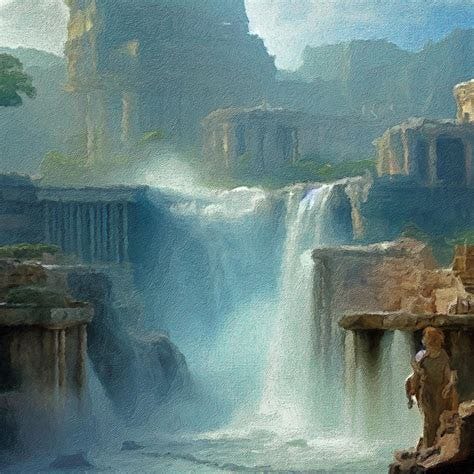
The wave-force waxed.    Warriors lamented,
Old ash-bearers;    wanted out of there,
The fallow flood to flee;    they would fend for life
By making a refuge    of the mountain-caves,
An earthen dwelling.    An angel stopped them,
Beswathing all the city    with sheer-white fire,
A broiling charnel-blaze.    Brutal on the inside
Was the beating of the brine;    the brigand-gangs
Could not succeed in escaping    from the sealed fastness.
The waves waxed higher;    the waters bellowed;
Fire-brands flittered;    the flood upwelled.
Then twas easy to find,    within the wall-town,
Songs of lamenting;    sorrow bemoaned
By the droves in death-terror,    dirge-songs wailing.
The terrifying firestorm    towered in sight;
A harsh destroyer,    horribly roaring.
Through the billows of the air,    the blasts of flame
Enfolded the fort-walls.    The flood increased.

Then the weeping of men    was widely heard;
A miserable mob;    and one man began –
A destitute valiant –    the folk to gather,
And speak through his sobbing,    sorely chastened:
"Ye may see now for yourselves    the certain truth:
"That we fared unjustly    when that foreign-comer
"We cast into prison    and clapped in bonds,
"Torturous fetters.    Ill-fortune smites us,
"Harsh and hostile –    here is the proof!
"It seems much better,    I say for truth,
"That we let him aloose    from his limb-shackles,
"Our folk as one,    the faster the better,
"And to beg for help    from that holy man,
"Succour and comfort;    soon will come to us
"Peace after pain,    if we pray to him."

Then, to Andrew,    it was utterly clear,
In the fastness of his soul,    how the folk inclined.
The bold ones' brawn-might    was bowed and humbled,
Proud pomp of warriors.    Waters enveloped them,
A full-flowing torrent.    The flood yet spated
Till the welling of the brinewater    waxed past the breast
To the shoulders' height.    Then the highbred bade
The stream-surge to still,    the storms to abate
About the stony cliffs.    He stepped out quickly,
Forsaking his prison;    strong-souled, bold,
Wise and God-loved.    At once he found
That a way for him was cleared    through the wave-currents:
Calm and ever-dry    was the conquest-field,
The ground, from the flood,    where his foot alighted.
Sweet were now the spirits    of the city-dwellers,
Rejoicing in their hearts,    now that hither had come
Aid after ail.    Now was ocean stilled,
Storm lost to listening;    at the saint's behest
The brine-road abode.    Then a barrow oped
To an awful chasm,    and inward swept
The enveloping flood;    the fallow waves;
The surging swirlstorm    was sucked underground.

Twas not solely the waves    that sank below,
But also the worst    among that war-battalion:
Vicious folk-spoilers,    fourteen in all,
Fell amidst the billows    under folds of earth,
Hasting to perdition.    Then horror-struck
And fearful were many    midst the folk remaining –
Awaiting yet more massacre    of women and men;
A harder punishment;    a humbler time,
After stained with sin,   slaughter-guilty,
Those arms-companions    plunged into the depths.

Out they cried to him,    all as one then:
"Now we can see    that the soothful Lord,
"King of all creatures,    holds court in might,
"Who hither has sent to us    this herald forth,
"An aid to the nations.    The need is great for us
"To make obeisances    with manly gallantry!"
Translation Notes
For all three of my posts on Andreas, I have consulted the scholarly edition and translation of Richard North and Michael Bintley, but I have looked at it critically and opted to dissent on several points. Since possess no formal qualifications in Old English that could possibly tempt others to take anything I say on faith, I think it best to explain my reasoning in detail.
Let’s start at the beginning. The poet opens this fitt with an apology for his lack of ability, saying that someone else will have to be found to tell all that he has omitted. At line 1480a we see the phrase wordum wemde, which North and Bintley translate as “pleading [in] words”, on the assumption that by wemde is meant the past tense of weman ‘to announce, to persuade, to convince’. But given the context of self-deprecation, it seems more likely to me that the intended word is wemman ‘to blot, to spoil, to mar’, or that the poet has taken advantage of the identical form1 to make a pun on this more negative word. Hence the translation ‘mucking [making] my verse’, which is about as close as I can come to the double meaning.
From here we move on to a more important scene, in which Andrew converses with a stapul in his prison. There is some debate as to the meaning of this word, centring on an ambiguous usage in Beowulf; here it clearly means a pillar or column, but it is worth noting that it may have a wider semantic range, because the Greek source of this tale describes not only a pillar but a statue carved into it. Although the Andreas-poet omits this detail, it seems implicit in the phrases mihtig ond modrof ‘mighty and bold-hearted’ and wis ond wundrum gleaw ‘wise and wonder-smart’, which seem to be interjections applying to the pillar-statue rather than descriptions of Andrew.2 Note also that we have already seen Jesus Christ bring a carven statue on a wall to life in a story related by Andrew in one of the earlier fitts of this poem.
The location of the pillar-statue is described as under sælwange ‘under the plain’, but North and Bintley are probably right in emending this to under sælwage ‘within the walls of the building’. Retaining the manuscript reading means envisaging the floor of the prison as very deep underground, with obvious implications for the strategic wisdom of starting a flood there; it seems more likely that the prison is level with the other buildings in Mermedonia, or even situated on a height, though this is not necessary to explain the survival of Andrew in the flood given his obvious enjoyment of divine protection. But what are we to make of the description of the pillars as storme bedrifene, ‘storm-beaten’, since the prison is presumably not open to the elements? This looks like a careless use of a traditional formula; but to steelman the poem a bit, it could be that the pillars were ancient ruins that were once exposed to the elements, and the prison a newer structure built around them.
This brings us to another traditional formula used of the pillars: eald enta geweorc, literally ‘old work of ents’. Tolkien’s conception of an ent as a treelike creature was mostly drawn from his own imagination; what the word denotes in Old English is a kind of ancient giant, not to be confused with a troll or eoten, believed to have lived in former ages and built various impressive artefacts.3 The ruins of classical buildings were especially liable to be passed off as ‘ent-works’; and such ruins are indeed to be found on the northern coast of the Black Sea, the purported location of the city of Mermedonia according to the Greek sources of this tale. It seems more likely that the Mermedonians, who are described in formulas appropriate to traditional warriors rather than monsters, are conceived as barbarian squatters in this ancient ruin than as the distant progeny of the ents.
With the flooding of Mermedonia, we come to a notoriously mystifying formula, which is actually a lot simpler than it has been made out to be. In Beowulf, when the Danes hear the terrible din of the hall-battle with Grendel, they are said to experience ealuscerwen ‘ale-shiring’; here, the flood-afflicted Mermedonians experience meodoscerwen ‘mead-shiring’. In my post on the XIth fitt of Beowulf, I noted the connection between the element scerwen ‘shiring’ and the verb scirian ‘to shire’ (i.e. ‘to dispense’, ‘to allot’)4, and made the case for reading this ‘shiring’ as ‘sobering’, on the grounds that a Gothic cognate usskarjan ‘to separate off’ is used twice in Wulfila’s Bible to translate Greek words meaning ‘to become sober’.5 The traditional connotations of the formula in poetry seem to include fear and shock, dramatic contrast with a previous instance of feasting (the Mermedonians are sobered up æfter symbeldæge, ‘after feasting-time’, which is also true of the Danes), and arguably a sudden awakening from sleep (inferred contextually in Beowulf from the fact that the Danes have gone to bed by the time of the hall-battle).
After the angel seals the Mermedonians in their doomed city by encompassing it with flames (the specific word used, oferbregdan, implies the spreading of a covering of fire over and around it), we see another eerie echo of Beowulf. Just as Grendel’s awful screaming in Beowulf’s handgrip is described in words that suggest a performance of song-poetry (gryreleoð ‘horror-lay’, sigelease sang ‘triumphless song’), so it is too for these other heathen cannibals trapped by water and fire, whose lamentations are described in the words geomorgidd ‘sorrowful tale’ and fusleoð ‘(death-)ready lay’; yet soon after this we see the word wop ‘noise of wailing’, which does not refer to singing, exactly as with Grendel. As North and Bintley note, the Greek sources mention no such singing at this point, and I suspect that this unlikely detail is no more than an ironic or poetic way of describing screams and lamentations.6
Once the Mermedonians begin to repent and talk about releasing their prisoner, we see a strange discrepancy in the story, which is that Andrew somehow knows of their change of heart despite still being locked up in prison. In the original source, the Mermedonians cry out to him for help, so perhaps we are to understand that he overhears the (presumably shouted) words of the man who convinces the rest of his people to repent. Alternatively, perhaps the phrase on fyrhðlocan ‘in [his] spirit-locker’ implies that he knows their minds in his heart by some manner of intuition. Another lost detail of the original source is the corrosive nature of the water, which of course does no harm to Andrew at any point.
For those interested in using Andreas to better understand the diction of Beowulf, it is notable that the word firgendstream appears in the last description of the flood before Andrew comes out of the prison, and is presumably not to be understood in its literal sense of ‘mountain stream’. This same word appears earlier on at line 390a in the form firigendstream, and the literal reading is even less likely here, since the poet is narrating a ship-journey in the middle of the ocean. Although North and Bintley opt to translate the word in that case as ‘mountainous seas’, and in this one as ‘mountainous stream’, it seems more likely that firgen(d)stream was used as a poetic term for a waterfall (in contrast to the prosaic wætergefeall) and by extension any fast-flowing torrent. Thus, although the mere of Grendel’s mother in Beowulf is described as being located near næssas ‘bluffs’ and fyrgenbeamas ‘mountain trees’ and hence is presumably under a mountain, by the fyrgenstream that flows into it we are almost certainly to understand the waterfall that appears in some of the folktale analogues.
The scene in which Andrew finally calms the flood has a number of poetic effects, such as occasional end-rhyme, which I have reproduced as best I could.
Although these two words were not identical in speech, since wemde (weman) has a long e and wemde (wemman) has a short one, vowel lengths were not marked in Old English writing and the potential for literary punning in such a system should not be overlooked just because we are dealing with an oral-derived poetic style. See also here.
Alternatively, perhaps both apply to Andrew; or perhaps the first phrase (mihtig and modrof ‘mighty and bold-hearted’) applies to the appearance of the statue, and the second (wis and wundrum gleaw, which could perhaps mean ‘wise and sentient through wonders’, or ‘wise and attuned to wonders’) applies to Andrew.
Among Christian Anglo-Saxons, the word ent became associated with giants and giantlike humans in the Bible, and seems to have been more or less synonymous with the Latin borrowing gigant. See the corpus examples here and here, which show the use of ent and related terms to describe Nimrod, Goliath, the sons of Anak and the giants of Genesis; note also that Beowulf names as an ‘ent-work’ a sword-hilt inscribed with the destruction of the giants in the Biblical Flood. What the term meant for the ancestors of those Christians is less clear; all we really have to go on is the form of the word, which according to Wiktionary may have branched from the same root as eoten (which is related to ‘eating’, so emphasizes cannibalism), and a couple of obscure place-names such as ‘ents’ ditch’ and ‘ent’s mound’ (among a great many others referencing dragons, trolls and gods like Thunor and Woden). The wider traditional connotations of the eald enta geweorc formula are those of past times, lost treasures, ruined glory, etc., and these unspoken inflections of meaning may have been the main cause of divergence from the word eoten (with its stress on the more immanent and sinister aspect of giants) as well as the reason why ent seemed the more appropriate word for the description of the Biblical giants; alternatively, there might have been a more complex pagan cosmology in which eotenas were distinguished from entas or conceived as their degenerate descendants, but one point against this is the fact that the same giant-sword in Beowulf is described as eotenisc when intact and entisc when reduced to its hilt. (Admittedly, this is complicated by the fact that line 2979 of the same poem uses eotenisc and entisc for a sword and a helmet that are both human-owned and almost certainly not the work of giants, though in this case the words can be interpreted as mere poetic flourishes with no narrative significance.) Tolkien, for his part, was well aware of all of this, and his conception of ents who are responsible for the ruination of stoneworks rather than their creation was an ironic subversion of the traditional meaning of ‘the old work of ents’.
The connection is established by a variant of scirian, namely bescirian ‘to deprive’, which is attested in the variant spellings of bescerian, bescyrian and bescerwan. Puzzlingly, some scholars (if memory serves, Arthur Brodeur) have tried to deny that *scerwan would also be a legitimate alternative form of scirian, but the fact that so many mainstream theories on scerwen have interpreted it as ‘deprivation’ shows that this is not generally accepted.
In that post, I assumed that the ‘sobering’ meaning had dropped out of Old English except in compound words, but this turns out not to be so. In the Bosworth-Toller entry for gescirian ‘to bestow, grant’, yet another scirian variant, we find the following sentence from the Anglo-Saxon translation of Gregory the Great’s Pastoral Care:
Ða him ðæt lið gescired wæs
When he was sobered up (‘yshired’) from the drink
Given that the context of the relevant passages in both Beowulf and Andreas entirely supports the ‘sobering’ reading, as does the etymological connection of the root of scirian, scerwen etc. with the meaning ‘to cut’ (several modern languages employ the metaphor of ‘cutting’ alcohol with water, that is to say diluting it, and this need only be extended to the same process inside the body to produce the meaning of ‘sobering’), I can think of very little reason for continuing to entertain the mainstream interpretations of ealuscerwen and meodoscerwen; and since the contrary evidence is all out there for anyone to find, I daresay that their days are numbered. No wish to sound like a gloater but you heard it here first.
Depending on how far this can be extended, it has possible implications for the interpretation of other parts of Beowulf, such as the Finnsburg Fragment in which Queen Hildeburh of Frisia is described as ‘mourning in songs’ (geomrode giddum). My own inclination in this case, however, would be to take the word at face value.
Great stuff as always!
To take up just one point, it's interesting to see 'mihtig ond modrof' (1496) applied to the pillar - North & Bintley seem to translate it as referring to Andrew ("he with one of them / held conference, mighty and brave of heart"). For these words to be referencing the pillar, would they need to take a different form (dative? or accusative, like 'anne', 1495?)? I would love to justify reading the pillar as 'mihtig ond modrof', but my knowledge of the syntax and grammar is shaky.