
The Non-Deception Principle
Dissidence should be about honesty, not rightist opinion

So it’s the end of January, and January is the month of Janus, and Janus is the god who has lent his name to all hypocrites and double-dealers. This modern idea of being ‘Janus-faced’ – duplicitous or at odds with oneself – was unknown to the ancient Romans, who revered the two-headed god as patron of all gateways, thresholds and transitions such as that of one year to the next. But times change, as do customs, and perhaps even so do gods; and it would seem to be appropriate for the moderns that Janus be enshrined as the patron god of hypocrites, not least because the most popular modern custom for his month is the making of solemn resolutions with no serious intention of carrying them out.
It would not be unfair to refer to the New Years’ Resolution as the Janus Resolution. Not all of them fail, but most of them do, and those that succeed must therefore do so in spite of and not because of collective cultural reinforcement. Partly for that reason, I am wary about making Janus Resolutions these days.1
But I’ve made and broken such resolutions before, not always at New Year’s; and more recently, I have had occasion to observe the making-and-breaking process from a more detached perspective, in the lives of others who are struggling with weight loss and alcoholism and other bad habits and addictions. What is interesting is that the eventual failure of a resolution is often written into it from its beginning. This might take the form of excessively demanding strictures that are bound to be broken by lapses (which are then taken as justification for giving up entirely), or endless exemptions and ambiguities that also lead to lapses and giving up, or simply a total lack of effort towards keeping the resolution early on. In short, a Janus Resolution always has a ‘second head’ that pulls it in the opposite direction to that intended.
This might be explained through the language of multiplicity, in which different aspects of a person (or even separate and mutually-opposed ‘selves’) are responsible for the sabotage of the resolution. Another possible explanation is that those who make Janus Resolutions don’t actually want to keep them at all. The latter theory can be found in by a certain highly controversial self-help book, which for the time being I shall quote first and name later:
We all display a kind of inconsistency among our beliefs, our wishes, and our actions in our own lives, although it may be easier to recognize in the lives of others. We have all listened to an argument play itself out between two (or more) voices within our own minds—one preaching about what we should do, and the other helplessly apologizing and explaining about how we would if we could but we can’t. We all share an awareness, if we are honest, that on some fundamental level, the apparent struggle among our beliefs, actions, and desires is a false one. More often than not, the “struggle” has emerged after a choice has already been made, though perhaps unconsciously. The “struggle” manifests itself mostly as effort: “trying” to decide; “trying” to be good; “trying” to keep our word. The false struggle is invented by our minds as a distraction, to “draw fire”—to draw the fire of our attention and keep us from seeing that we have already chosen…
The conditions we produce in our lives, the actions we repeat against our will…somehow we have perpetuated them, despite our professed beliefs and our efforts to change. ... The person who says he wants to lose weight, but says he just can’t give up midnight snacks, may believe he is in a struggle between “being good” and “giving in” to his cravings, but in fact he has already chosen to keep snacking. The “struggle” that he describes serves to hide this fact…
Instead of amalgamations of parts having contradictory and uncontrollable purposes, suppose we consider ourselves to be already what we long to be: functional, integrated wholes who produce the results we choose, effortlessly, with our entire beings. Suppose we all, already, are that. All the apparent contradictions and dichotomies—the fat person struggling to be thin, the sinner trying to be good, the workaholic longing for time with his family—are actually smokescreens, false struggles enacted by our own minds to hide from others or ourselves our true intent. Our true intent is to do just what we do.
Let us suppose, for the sake of argument, that this explanation is the true one. Why would anyone make a resolution that he has no intention of keeping? The obvious answer is that it lets him think of himself as one sort of person in theory while being another sort of person in reality. His present, day-to-day ‘false self’ might be a fat person addicted to eating junk, but his as-yet-unactualized ‘true self’ is a slim person who exercises and eats healthily. It is, of course, all too easy to see which self-image is true and which is false.
But such a self-delusion cannot be maintained unless some effort is being made to become what one is presently not. This creates an imaginary threshold between the present ‘false’ life and the future ‘true’ one, which is crossed by the making and performing of a resolution and then crossed back again by a lapse and renunciation. Someone who chronically makes and breaks Janus Resolutions, whether or not he does so at New Year’s, lives most of his life on this imaginary threshold – which, according to the argument from non-multiplicity, is precisely where he wants to be. And the fact that most people now live by such imaginary thresholds, rather than the natural ones presided over by the old Janus, would be the reason why the patron god of transitions is now the demon of hypocrisy.
It follows that whole modern societies can be deluded by Janus Resolutions, and entire political mythologies erected on the endless crossing and recrossing of an imaginary threshold. Communist societies are famously devoted to a historical transition that has never actually happened, and fascist ones according to the theory of Roger Griffin (see Modernism and Fascism) are much the same way. And our own democratist political order, being in many ways much more similar to these two than it is to any premodern order, is also much the same way – the difference being that it has more than one political cult, thus more than one Janus-threshold.
Perhaps the ‘woke’ left is the most obvious example. Much could be said, for example, on transgender ideology as a personal and political myth of threshold-crossing – one that can never succeed, because it is based on what is perhaps the boldest medical swindle in history.2 But they say you should write about what you know, so let’s look not at the ‘woke’ but at the ‘awakened’, that is to say the online dissident right.
The dissident right (the latest of many rebrands – a classic symptom of Janus-delusion) is founded on a basic myth of transition from a ‘false’ collective ego to a ‘true’ one. The past and present ‘false self’ is mainstream conservatism, which is failed and cucked and co-opted and cravenly subordinate to the left and all the rest of it. The longed-for ‘true self’ is the new right that will replace conservatism and finally defeat the left, and of which the present-day dissident right is the advance guard. Conceptions of this true right vary from one mind to another, from the aesthetics of fascism to those of much older orders; but suffice it to say that it is always conceived as young, smart, unafraid, awakened, willing to do whatever it takes to win.
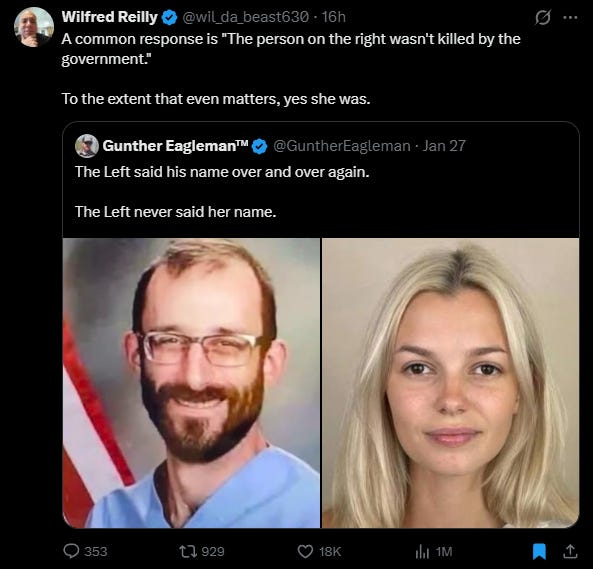
Yet whatever their dreams of tomorrow may be, today the more radical rightists must support conservatives and compromise with conservatism, and so the threat of lapse is always present. And sometimes it erupts from the core of the movement. That is what has happened this January, with the shootings of leftist activists Renée Good and Alex Pretti by ICE agents in Minneapolis.
This is the sort of thing that people have been xeeting on Xitter:



Admittedly, none of these are particularly ‘based’ or well-known individuals, though their sentiments chime with those of such big names as Morgoth and Darryl Cooper. I have chosen the examples for their particularly evident Janus-facedness.
Note that none of them are saying that they changed their minds on mass deportations. They are not saying they supported the enforcement of US immigration law in theory, but got cold feet after seeing it end up hurting some people who are not ‘appropriately’ brown and criminal-looking. Whatever you may think of these positions, they would all be examples of basically honest self-reportage. The same cannot be said for what these people are saying: that ICE agents should arrest and deport vast masses of illegal immigrants from the US, without ever endangering the leftist activists who choose to drive their cars into said agents or confront them on the street while armed with loaded handguns.
In principle – we will get to the practice in a moment – what these people are demanding is as chimerical as the decision to stuff yourself with snacks while resolved to lose weight. What did they think ‘mass deportations’ meant?3 Either the immigration laws on the books are to be enforced, as per Donald Trump’s election promises, or leftist activists and the media will get to veto the ones they don’t like by making their enforcement practically impossible. Yielding to the latter means ending up back at the sort of ‘rule of law’ tolerated by the bad old conservatives, in which one side has the rule and the other gets the law. However you split the hairs, it is ultimately a question of which is to be master: the magistrates and legislature elected by the popular sovereignty of the mass electorate, or the demokratia of the media, activists and extended governing class that presumes to circumscribe that sovereignty.
Hence the calls from the rough end of the right for these lapsers to ‘lock in’: to harden their hearts, man up and stay the course. This may seem reasonable enough on the current topic4; but once we zoom out a little, things no longer look so simple. The modern hypocrite-Janus has two heads, remember, and woe to him who trusts either.
Let us start with a statement of the obvious: Minneapolis, home of St. Floyd, is a leftist open-air insane asylum located in a notoriously leftist state far up north on the US-Canadian border. One has to wonder why a huge surge of ICE agents was being deployed to deal with the relatively small numbers of illegal aliens there, while little was being done to restrict their widespread employment in Texas and other red states. And the answer would seem to be that Trump wanted to generate online videos of triggered libs rending their pussy hats over ICE raids (perhaps so that the White House Xitter account could set them to pop songs and convert them into AI slop memes), so as to fob off his schadenfreudy base without having to touch the thankless task of weaning pro-Republican big and small business off illegal labour.5
This means that he sent his troops into a trap, and got people killed and lives destroyed largely for the sake of edgy street theatre. Apparently Trump’s enemies are still taking all of this much more seriously than he is; it is no exaggeration to say of some of them that they are engaged in a low-level guerrilla war, and the tactical playbook for that was laid out a decade ago by William S. Lind in his 4th Generation Warfare Handbook (with reference to the guerrilla insurgencies in Iraq and Afghanistan). It mainly consists of mingling with ordinary citizens, harassing the occupying force (preferably after taking enough pot-shots at them to make them suitably jumpy and trigger-happy), goading them into hamfisted reactions that get people killed and then using the resultant outrage to fuel the cause.6 All of this works best in a community sympathetic to the agitators, which is why Minnesota was the perfect place for the left to establish its power of legal nullification before (no doubt!) seeking to expand it to other states.
This, then, is the problem with ‘locking in’ – it tends to end up in a lockstepped performative larp behind some Pied Piper of a leader, and towards an avoidable disaster, a pattern foreshadowed in the Charlottesville protest of 2017. At this point the signal-spiral is broken, and the ‘based’ diehards go the same way as the ‘squishy’ backdowns. And the reason why this sort of thing happens, in lieu of effective political action, is that the ‘based’ are no less deluded in their own way than the ‘squishy’; in the terms of our analogy, the former correspond to the fifty-point weight loss resolution that demands eight days a week of hard gym training, and the latter to the inevitable lapse and resultant binge on the snack pile in the fridge.
So what is to be done? Well, since we are clearly Not OK, let’s go back to our mystery self-help book. The argument continues as follows:
Our unwillingness to explore the possibility that what we have is what we want—that our lives function, that we are comfortable and fear change in most areas of our lives—prevents us from producing change in other areas. Our energy is totally invested in maintaining our lives the way they are, and the phony struggle for change only conceals the ways in which the status quo serves us. Our apparent battle for change is a tempest in a teapot…
As long as I identify my “self” only as that desire to change and not also as a presently more powerful desire to remain the same, I will remain stuck. In a sense, I can change, finally, only by giving up trying to change.
In order for things to get better, they must first get worse. In order to get out of debt, we have to acknowledge how it serves us to be in debt. In order to lose weight, we have to be in touch with, and confront, how we also want to stay fat. We have to stop paying attention to our struggle and turn our awareness to the ways in which these circumstances we claim we want to change serve us—the payoffs. Only after experiencing ourselves the way we are, dropping our phony struggle to change, and telling the truth about all of it, can we create the lives we have been saying we want.
This examination of our subconscious desire to avoid change, and of what lies beneath the phony struggle, can get us “unstuck.” It also leads to a deeper place, a scarier place, than that of mere struggle to change. Struggling to change is what you do to hide from something worse. Struggling to change is a way to avoid facing the abyss, and if the abyss could be avoided, it would be a good idea.
These book from which these quotations are taken is Radical Honesty by Brad Blanton (Chapter 10, pages 206-210). Its thesis is that almost everyone in modern society is deeply corrupted from constant pathological lying, which has a way of spreading inwards and causing self-delusion. Its solution is to tell the truth, all the time, everywhere and to everyone (except government officials!), to the point of blurting out practically everything that crosses your mind.
Yes, Blanton is a bit of a nutcase. No, I would not be able to recommend his advice to anyone – even to those whose opinions are mostly acceptable to the judgement of their fellow-citizens in a free and fair democracy – at least not without appending a warning and perhaps also a long legal disclaimer.7 But none of this means he is wrong about the modern habit of pathological lying, its connection to deeper self-delusion, and the corrective power of the elementary truthfulness called honesty.
So how does this work when we transpose the principle from a struggling, conflicted, self-deluded individual to the struggling, conflicted, self-deluded dissident right?
Well, in this case we have some inking of how it works, because the dissident right has a reputation for telling the truth – albeit one largely acquired during earlier, nameless incarnations, when anonymous people writing on the internet were truly irrelevant to official politics. Had the integration with politics not taken place, we might today have a very different sort of online dissidence – perhaps one that aimed at truthfulness rather than a unity of rightist opinion, and allowed many disparate opinions to exist within it, stipulating only that they thrash out their differences without recourse to a liberal conceptual language that has come to describe our reality about as well as Don Quixote described the sights and souls of La Mancha.8
But whether or not this was ever likely, in the event it was not to be, and the present-day dissident right has become surgically attached to right-wing populist politics. As such, more than ever, it wields truth and honesty strictly as rhetorical weapons against its political enemies and everyone outside its demographic core, which is of course low-status white males (LSWMs9). The truths may be true (though they have long been degrading to untruths – to quote Blanton again, “truth turns to bullshit in the mind as food turns to excrement in the body”), but the motives for telling them are essentially spiteful and thus inevitably hypocritical.
Thus, dissidents will tell those who have undergone irreparable ‘gender transition’ surgery that it cannot in fact turn them into the opposite sex. They will tell childless thirtysomething career women that they have wasted their lives pursuing a simulacrum of a masculine life path. They will tell those who think of themselves as idealistic rebels that they are in fact conformist power-sniffers, the sort of people who would have been card-carrying Nazis in 1930s Germany. They have no time for the myths and excuses that justify endless official discrimination against whites on the grounds that this is needed to build a free and fair pan-racial utopia. But whenever that dangerous and unpredictable weapon known as the truth slips its holster, and starts firing in the direction of the dissidents and LSWMs and their chronically-failing political causes, they either shrink from it entirely or discover a new appreciation for prudent caveats and sheltering nuances. Typically they ‘rationalize’ this hypocrisy by declaring the truth in question to be a blackpill, and accusing anyone through which it expresses itself of demoralizing them.
What, then, did they think they were doing to everyone else? And why do they think that anyone else should have listened?
Were the dissident right to somehow become embodied as a single individual, he would surely make a great song and dance of his honesty – and yet stand to the radical honesty of Blanton much as ‘Zarathustra’s ape’ stood to the philosophy of Nietzsche, who excoriated him as follows in Thus Spake Zarathustra (Chapter LI):
What was it that first made thee grunt? Because no one sufficiently flattered thee—therefore didst thou seat thyself beside this filth, that thou mightest have cause for much grunting; that thou mightest have cause for much vengeance! For vengeance, thou vain fool, is all thy foaming; I have divined thee well! But thy fools’-word injureth me, even when thou art right!
Ironically, in striving to give away the ‘blackpills’ (truths) and monopolize the ‘whitepills’ (delusions), the dissident right injureth only itself. But it’s a simple matter to swap these prescriptions around. Let us imagine that dissidents were to approach their own self-justifying myths and excuses as if they were the official ones that justify the democratist state and its client groups.
Take for example the essays and occasional commentary posted on this site, in which I have certainly not been practicing this principle. I have deplored the tendency of rightists to sink into complacency after very limited victories, and noted that both the ‘whitepill’ and ‘blackpill’ seem to serve them as convenient excuses to give up dissent. I have allegorized conservative politics to a fraudulent casino that constantly absorbs the energies of dissidents, who compulsively return to it time and time again. I have wondered why the right constantly neglects the contest for intellectual authority for rearguard actions in the realm of political power. And in this post I have criticized the partisans of squeamishness and performative cruelty alike. The tacit assumption that runs through all of this is that externally-imposed delusions, no doubt serving the interest of the Current Regime, are perverting the dissident right from its ‘true’ nature and what it ‘really’ ought to be doing to win.
But a more parsimonious (and Blantonesque) interpretation of the facts would be that these delusions are internally-generated squid-ink, and serve the interest of the dissident and wider conservative right in doing just what it does. And most of what it does can be understood as the natural survival strategy of a weaker faction desperately trying to simulate more power than it actually has.
In this analysis, rightists tend to win a little before declaring victory and giving up because they lack the political energy for prolonged struggle with the left. They do not try to take authority (beyond the lowest-hanging fruit) because they lack the energy for this as well, to say nothing of the intellectual ability. And their vacillation between squishiness and performative hardness might best be understood as representing the two sides of Batesian mimicry: the paralyzing fear of a predator that you do not have it in you to defeat, and the impetus to present yourself to that predator as more of a threat than you really are. This is a more complex phenomenon than the relatively straightforward predator camouflage represented by leftist ‘virtue-signalling’.
This analogy of the right to a prey animal holds not just for the loserly LSWMs and struggling MSWMs in our movement (who would never have formed a ruling class in any society), but also for the strong, virtuous and competent in our ranks. In a society deeply pacified by a violence-monopolizing state, which has in turn become bloated and decadent due to its swallowing most social functions into itself, traditional strengths and virtues cease to function as advantages. The perennial tendency to aggression, violence, brigandage, now comes from within the state-machine, and hinges on a game of avoiding the threat-detection mechanisms of the government as well as the public perception of participation in its terribly absolute power. And, of course, mobilizing both against one’s targets. This is what leftism does, and does well, by a whole host of mechanisms that are built into its ideological nature and thus difficult or pointless for the right to replicate: the passive-aggressive provocations, the vitilitigation, the majoritarian scapegoating (note to white nationalists, this does not work in your favour), the use of women as informants and enforcers, the willingness of power-players to ride upon the least-resistance paths of social collapse, the outsourcing of more direct forms of violence to tacitly tolerated criminals outside the formal command chain of the state.
There is little point in your or my proclaiming that these devious predation tactics do not work on us, because the fact of leftist power shows that they work on almost everyone else including many on our own side. And while it is theoretically important to understand how leftism builds a ruling unelite and a client kakistocracy, composed of those whose status would be much lower in previous social orders, anyone who takes comfort from this is engaged in Ah Q-esque cope – he might as well intone the formula “it is as if a son is beating his father” while he is bilked and bullied by those who may have been his inferiors in the past.10 And let us not get started on the delusion that those playing at a forced disadvantage under the current system would necessarily be able to turn the tables in the event of its collapse. While it is probably true that the Mouse Utopia we have erected has to die so that our species may continue to live, one imagines that the immediate results of this will be good for the criminal gangs in informal alliance with the left11 and very bad for the domesticated males who idly fantasize about ‘burning it all to the ground’.
And this brings us to the strange inability of radicalized rightists to kick the old habits of janitorial conservatism. Could it be that the payoffs of conservatism – status quo preservation, sporadic relief from leftist predations, ceremonial leadership over the state – far outweigh the slight sting inside that comes with electoral consent, and perhaps even constitute the best possible deal for the prey animals of Our Democracy? Could it be, perhaps, that the ‘true nature’ of the dissident right and its white male demographic core is in fact best expressed by mainstream conservatism, and not by quixotic fantasies of kingship or theocracy or ethnostatism? Could it be that, without conservatism, the predations and humiliations would be much worse – and the uprising of sturdy yeomen who have proved all their counts and begun to hate as far away as any other imaginary transition?
Remember, I am not necessarily asking dissidents to accept any of this as true; only to practice this sort of bleak honesty on themselves and their own kind, at least from time to time, and accept that this is the sort of conclusion that may result from it.12
If the conclusion is true, then it is a hard truth to swallow. For if it is true that conservatism was the shelter and not the prison of our people, then it is just as true that it is cracked and crumbling – partly as a result of pressure from a dominant political faction that has become too greedy to grant it any honour, but more so as a result of deliberate subversion by a dissident right now beginning to recoil from what it has done. Just as Blanton warned, honest self-examination can lead us to the ‘abyss’ – or, in modern parlance, the blackpill. But it can also lead to the whitepill, that is to say, the light at the end of the tunnel – for what is falling cannot be pulled, and only by following a via negativa away from delusions and dead ends can we hope to make it out of the wreckage in one piece.
Incidentally, this concept of blackpill and whitepill is in its essence very old – old enough to be wrested from the modern hypocrite-Janus, and restored to the old and venerable one. The medieval alchemists were wiser than the moderns who imagine a false choice between black and white, between cold dark reality and an escape into optimism that can only be based on a heaping up of copes. The alchemical way was rather to place the nigredo or ‘blackening’ before the albedo or ‘whitening’, the first being a necessary precondition to the second. To transpose the basic logic behind this into the language of our present subject (as is, I think, legitimate, not as psychological reductionism but as universal analogy), you cannot be whitepilled until you have been blackpilled – that is to say, you cannot have genuine hope unless you stop clinging to false hope in order to salve your delusions. One might of course think that this is a very obvious point, but it is easier said than done.
Coincidentally, or perhaps not-so-coincidentally, what comes after the nigredo and albedo is none other than the rubedo – the ‘reddening’, the end of the work, the Philosopher’s Stone. Well – that’s what we were all after from the beginning, isn’t it? What did we think it was going to mean?
Resolving to do something before you do it can be surprisingly effective in focusing your attention; but it is best to keep such resolutions small and piecemeal, and build up the habit of keeping them by starting with very easy ones. As for a resolution to devote a whole year to doing something, I am of the opinion that it should be made (if it is made at all) around the end of February or on Lunar New Year, or at the beginning of springtime. This is the morning of the year, whereas the beginning of January corresponds to 12:01 at midnight.
As an aside, I have never cared for standard conservative arguments against ‘gender transition’, which focus on the immorality and delusion of desiring to join the opposite sex. The more obvious argument is not that the desire is wrong, or that its fulfillment could never improve anyone’s life, but that the available means to effect such a transition do not work and that the edifice of verbal fudge erected around the issue represents a scandalously brazen attempt to detract attention from this fact.
When living in China I was always told by locals never to give money to mutilated beggars, because it only encourages the sociopathic criminal gangs that are responsible for lopping their limbs off and sending them out to beg. Hearing Good’s lesbian partner express her shock that ICE had real bullets in their guns, then going on Xitter and finding leftists brazenly lying that they have no actual law enforcement powers, has given me quite the feeling of déjà vu on the question of whether to give political capital to martyred cop-baiters.
To say nothing, of course, of weaning his whole country off a political system that incentivizes every red and blue state to pointlessly increase its population (including non-citizens!) so as to avoid losing electoral power.
Of course you needn’t take my word for it that this is what the Minneapolis activists are up to; by all means, take that of Nicholas Decker instead:
ICE must be goaded into murdering people. That is the point of non-violent protest. Every brutality they commit means people who are otherwise on the fence being forced off it. The protests are to create tension, and to induce the dogs in ICE to reveal their own nature.
This, admittedly, is unusually candid. Matt Yglesias, with more of a soft hiss than a jarring rattle, says only that “the Minneapolis activist community has tactically out-dueled ICE and the Border Patrol” and “protesting really does work if you stay organized and disciplined”.
Another point worth mentioning here is that an ethos of saying everything you think may also result in a habit of thinking only what you may say.
Imagine, for example, arguments for the virtues of democracy that made no reference to the foolswill account of that political system as ‘self-rule by all the people’, or heated discussions on whether or not formal marriage should exist in which no-one forked his tongue around the hypocrite-concept of ‘marital rape’ (unless of course he was talking about what the Romans did with the Sabine women). For examples of political arguments that mostly chime with those of the left, but are delivered through a conceptual language similar or identical to that of the dissident right, look no further than Deep Left Analysis.
Pronounced a bit like losewombs, but with schwa vowels. Coined, as far as I am aware, by Rintrah Radagast. And yes, the present author certainly falls into the category.
To put this point another way, for those who are naturally less than familiar with Lu Xun’s commie Chinese parody of Don Quixote: once the sea has been drained, the whale can hardly boast of his natural virtues to the snake, snail and crab (even if he is really a whale and not some blowhard puffer-fish identifying as a ‘whale of the soul’).
Of course it is important not to have an overly simplistic view of the relationship between virtue and power in the past; there are plenty of tales of insecure kings favouring the venal and mediocre, for example. The difference today, arguably, is that the social dynamics of the tyrant’s court have been extended across the whole breadth and depth of society.
One might imagine the development of a king-priest relationship between the tattooed gangster-lords and the post-collapse progressivist mandarins. The latter would not be without influence, though they might be in more danger of catching bullets to the head.
It must also be said, of course, that bleak honesty is not the be-all and end-all of truth, and that those who only ever direct it at others may not always appreciate this.
Best footnotes I've read in a while. And a good article, to boot! :)
I liked Sam Harris's book on honesty. It is a tough pill to swallow.