
An Alliterative Iliad (III)
The battle of words between Achilles and Agamemnon

According to Greek legend, the Trojan War was set in motion by the Rape of Helen (in modern parlance, her abduction) by Paris, son of King Priam of Troy. Helen’s husband was Menelaus of Sparta, whose brother was the powerful Agamemnon of Mycenae, and a host of other Greek kings and princes had sworn an oath to her father Tyndareus to uphold and defend their marriage. When Paris carried Helen off to Troy by force – or, alternatively, led her into a willing elopement – he brought into being a mighty Greek war-coalition that doomed his father’s city to sack and cinders.
Thucydides, in his History of the Peloponnesian War1, brings a much later scepticism to bear upon the ancient story of the poets:
Agamemnon, it seems to me, must have been the most powerful of the rulers of his day; and it was for this reason that he raised the force against Troy, not because the suitors of Helen were bound to follow him by the oaths which they had sworn to Tyndareus. Pelops, according to the most reliable tradition in the Peloponnese, came there from Asia. He brought great wealth with him, and, settling in a poor country, acquired such power that, though he was a foreigner, the whole land was called after him. His descendants became still more prosperous. … It was to this empire that Agamemnon succeeded, and at the same time he had a stronger navy than any other ruler; thus, in my opinion, fear played a greater part than loyalty in the raising of the expedition against Troy.
Be that as it may, in the traditional account of Homer, the formal motive of the lesser Greek chiefs fighting under Agamemnon’s leadership is loyalty to the oath. And this sets the context for the latest installment of our alliterative-verse rendering2 of the Iliad, in which a meeting of the Greek host degenerates into a furious quarrel between Achilles and Agamemnon – culminating in the withdrawal of Achilles from the war. What we are seeing here is not an act of military insubordination, but the revolt of an essentially free agent who believes that he has been mistreated.
The cause of this mistreatment has been explained in the first and second parts of the tale. Agamemnon took as war-bride Chryseis, the daughter of a priest of Apollo, and refused to give her back to her father when he came to ransom her. This incensed the god and caused him to send a plague upon the Greek host. Achilles called a meeting, at which the soothsayer Calchas pointed out the cause of the plague, and prophesied that it would not end until the girl was sent back with no ransom-price. Agamemnon reluctantly agreed, but stipulated that the other Greeks were obliged to compensate him with an equivalent honour-prize (γέρας):
“But see to it at once that a reward is found,
“For to make amends to me. Unmeet ‘twould be
“If it were I alone in the Argive troop
“Who should want an honour-prize; as all ye witness,
“The prize that was mine own now elsewhere wends.”
This equivalent prize will turn out to be none other than Briseis, the war-bride of Achilles. But we are getting ahead of ourselves. Let us see what Achilles has to say to the speech just made by Agamemnon, and let the meeting head downhill from there…
To which swift-foot Achilles    responded thus:
"Son of Atreus,    overstanding all,
"And as greedy for gain    as you are great in rank:
"How shall us greathearts    grant you a prize?
"None are lying about here!    The loot from cities
"That we captured and sacked    has been claimed and doled,
"Distributed generally;    unjust 'twould be
"To regather it again    from all the Grecian host.
"But for the moment send    the maid to her god,
"And you shall take repayment –    three or fourfold –
"When the walls have fallen    around well-fenced Troy,
"And Zeus has granted us    to sack and to gut her."

But answered the lordly one,    Agamemnon:
"O divine Achilles,    valiant as you are,
"Do not steal to subtlety!    Deceitful wit
"Shall not persuade or escape me;    you shall slip not past me!
"What it is you want?    To be well-repaid,
"While I sit down emptily    and sore with lack?
"You demand I give her;    our greatheart host
"Must then compensate their king    with an equivalent prize,
"To gratify my heart.    But should they grant it not,
"I shall seize it myself!    I shall set my hands
"Upon the prize allotted you,    and lead her away;
"Or the prize of Odysseus,    or the prize of Ajax,
"And whomever I visit    shall be filled with gall.
"But such may be considered    at a seemlier time.
"So now come, let us haul    to the heaven-bright brine
"A sable ship,    staffed with rowers,
"Stuffed with a hecatomb;    and set on board
"Fair-chéeked Chryseis –    and let charge be taken
"By some man of counsel    who shall make the trip:
"Idomeneus or Ajax;    or deific Odysseus,
"Or thee, Pelides –    terriblest of men –
"By making sacrifice    to seek appeasement
"Of the long-armed god,    and to lift his scourge."

Yet he responded scowl-browed,    swiftfoot Achilles:
"O my, so covetous,    cloaked in shamelessness
"With loot upon the brain!    Who would liefly serve you
"In this host of Achaeans?    Your hest obey?
"Wage war at your command?    Or wend on a mission?
"I came not for vengeance    on these foreign spearmen!
"No Trojan has touched me;    none thither drove
"My horses or beeves;    none has harmed or plundered
"Any fruit of field    in my fertile Phthia,
"Nurse of the mighty –    for remote she lies,
"Protected by much territory    between us standing:
"The deep-valed mountains    and redounding sea.
"O grossly shameless one,    we gathered behind you,
"Dog-eyed ingrate,    to do you honour –
"Yourself and Menelaus –    to settle the wrong
"That you suffered from those Trojans,    that you turn not to heed.
"And at that you threat me    that you'll take my prize
"That I earned by mine efforts,    and the Argives gave me!
"I have never taken    from the throng-filled cities
"Sacked on our adventures,    any share your equal:
"Though my hands bear the brunt    of the hardest fighting,
"When we fall to the dividing,    by far the greater
"Of the prizes is yours;    and with paltry winnings –
"Yet dear-beloved –    to my dark-tarred ships,
"Wearied by war-works,    my way I take.
"But my course I'll turn now,    with my curve-prowed boats,
"To my home Phthia;    and I hardly think
"That you shall pile up treasures    in proportion to your greed
"When I, who am dishonoured,    aid you no more."

And the host-king answered him,    Agamemnon:
"Well then fly, and fleetly,    if you feel in heart
"Such ardency of urging    to be out and gone.
"Do not stay for my sake;    I'll beseech you not;
"I have others around me    who will honour me more,
"As will the highest Counsellor,    all-wise Zeus.
"I regard you loathest    among God-kept kings:
"For in strife you rejoice,    and in shedding blood,
"In combat and carnage.    Yet perchance your might
"Is the gift of some god,    and thus no ground to boast on.
"So hence you to your home,    with your house-companions,
"To lord the Myrmidons.    No loss I count you,
"And I reck your raging    not a wretched jot.
"But I threat you thus:    just as taken hence
"By Apollo the Fulgent    is my prize Chryseis,
"And I send her on my ship    with my sworn companions,
"Fair-cheeked Briseis    will surely be mine.
"I shall move upon your camp    and demand your prize.
"Thus lessoned, you shall learn    your lower place –
"And another shall be cowed by it,    and know far better
"Than face-to-face with me    to vaunt his peerhood."
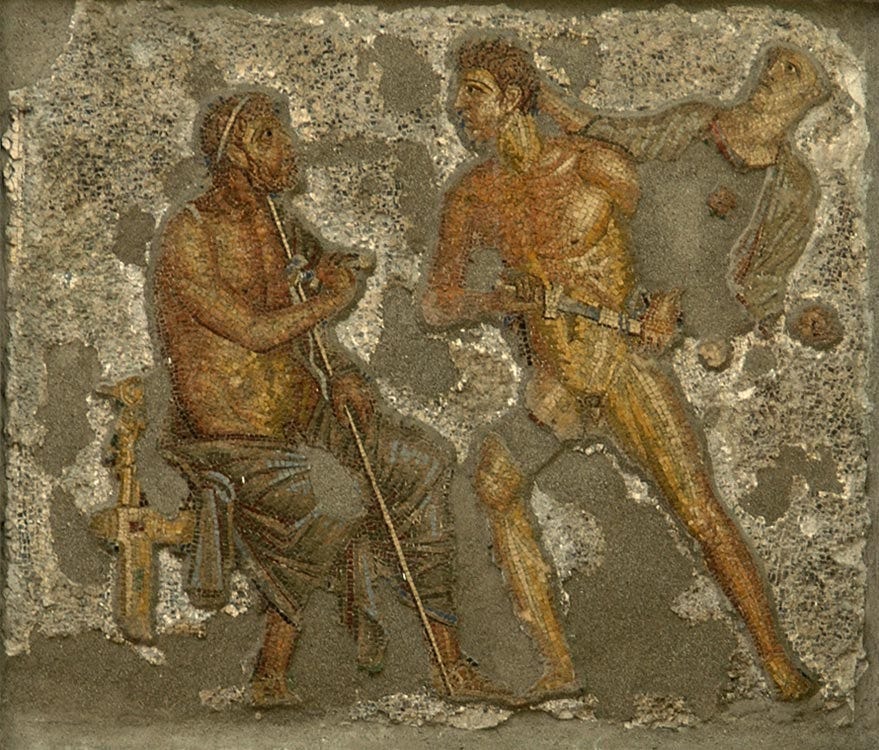
He so bespake him;    and the shaggy breast
Of the son of Peleus    was seized by pain;
Divided and debating:    if to force a path
With his unscabbarded blade,    through the scattering crowd,
And lay Atrides    lifeless at his feet;
Or if to stop his gall up    and restrain his heart.

And as he doubted in his mind,    and drew from its sheath
His trenchant sword,    Athena came,
From heaven descending;    snow-armed Hera
Had sent her swiftly,    for the striving pair
She dually regarded    as dear to her spirit.
So the Spear-Shaker    stood behind him –
Appearing to none of them,    apart from him –
And grasped his gold locks.    Jarred, he turned round,
And instantly knew her    by her eyes that flashed
With a terrible light.    He thus bespake her
With feather-fletched words:    "O why have you come,
"O child of the Aegis-Bearer,    all-wise Zeus?
"Would you witness for yourself    the wanton insolence
"Atrides inflicts on me?    I tell you outright:
"His overfórceful bombast    might just burst the life from him."

Owl-eyed Athena    returned these words:
"From heaven I've been sent here    to stay your anger –
"So will you obey me?    White-armed Hera
"Dually regards you both    as dear to her spirit.
"So halt your hand now,    and heft no sword,
"With your tongue retort to him –    let that suffice.
"For I foretell you truly    that the time shall come
"When you take for this outrage    a threefold payment
"In splendid bounty-gifts!    Stay, obey us!"

Swift-foot Achilles    responded thus:
"O Goddess I will hear you,    though galled in heart,
"For 'tis always best    to obey your words:
"Who hears the gods    is heard by them louder."

Such words he spake;    and on the silvered hilt
Laid his heavy hand,    and homeward thrust
His sword into its sheath;    he did not scorn obedience
To the word of Athena.    She went Olympusward
To mingle with her kindred,    the immortal gods,
In the high halls of Zeus,    the Aegis-Bearer.

But ceasing not his anger    'gainst the son of Atreus,
Pelides spoke out    with scathing words:
"You stout sack of wine,    with the shameless eyes
"And aspect of a dog,    and the heart of a deer!
"When the host takes arms,    I have not ever seen you
"Arm yourself for battle;    or an ambush dare
"With the doughtest Achaeans;    the din of war
"Is like the call of death to you,    and cows your heart.
"Much rather would you range    through the rear of the host
"To steal from whomever    dares dispúte your words.
"You're a people-eating king,    holding pówer over nobodies
"Tamed to abuses –    or else they would make
"This loathsome outrage    the last you wrought.
"But I'll speak against you,    and I'll swear an oath
"By this very sceptre –    that will sprout no buds,
"Nor bear more leaves,    nor boughs bring forth –
"Since 'twas severed from its source    on the slopes of mountains,
"And lopped by the bronze blade    of leaves and bark –
"And is carried by the justicers,    Achaeans' sons,
"Those who guard the ordinances    got from Zeus –
"By this sign I swear now    a resounding oath:
"That Achilles will be missed    by the Achaeans' sons;
"And the time shall come    when you will crave his aid;
"When haplessly you grieve,    and cannot help your men,
"When man-slaying Hector    mows down droves of them;
"You'll rend your heart then,    and rue the day
"That you did no honour    to the doughtest Achaean."
With that, he throws down his sceptre and sits out the war in the very face of the Trojan host. And just as he foretold, this proves to be disastrous for them, because Achilles is by far the greatest warrior among the Greeks. Next time we shall see how the elderly Nestor tries (and fails) to smooth things over.
Notes
As mentioned in previous posts, while I do alright in Old English, I have next to no knowledge of Ancient Greek. All the same, I worked from the original text (as well as from translations) for every line and almost every word of this ‘rendering’. This practice can only lead to the development of extremely unqualified opinions on textual interpretation, some of which are given below. Just remember to take them with a pinch of salt (and if you know the language and see anything that is downright wrong, feel free to let me know in the comments).
How shall us greathearts grant you a prize?
The word used is μεγάθυμος (megathymos), which naturally evokes for us the Latin term magnanimous (apparently derived from the similar megalopsykhos ‘great-souled’, used by Aristotle to describe the Golden Mean between vanity and petty-mindedness). Since thymos is more like spirited passion than heart or soul, this cannot be the sole meaning of this word; but it does apparently contain the meaning ‘high-minded’, and crops up twice in this scene where the voluntary giving of a prize to Agamemnon is mentioned, so the association is probably not wrong. Elsewhere in the Homeric corpus the same word is used with the apparent meaning of hearty or courageous (as can be ascertained from a word search in the very useful Chicago Homer).
To seek appeasement of the long-armed god…
The god is of course Apollo, and the original epithet is ἑκάεργος (heka’ergos), which probably means ‘far-working’ and refers to his quality of being an archer. If the meaning is rather, as some have argued, ‘free-working’, then perhaps liberant will do.
Those Trojans that you turn not to heed
The specific phrase used here is τῶν οὔ τι μετατρέπῃ οὐδ᾽ ἀλεγίζεις (crudely transliterated, ton ou ti metatrepe oud’ alegizeis), meaning ‘of which you take nor regard nor care’. It is not entirely clear (at least not to me) whether this means that Agamemnon is failing to heed the Trojans, the war, the efforts of Achilles and the other Greeks, or all three. But from the order of words, one is led to think that the primary referent is the Trojans; and from the fact that the word metatrepo ‘to show regard for something’ literally means to turn toward something, one is led further to suspect that Achilles is making a veiled accusation of cowardice against Agamemnon, a suspicion that becomes stronger as he goes on to complain that he must always bear the brunt of the fighting. Of course, once all semblance of civility has broken down, he does not stint from openly accusing Agamemnon of cowardice.
Well then fly, and fleetly…
This sarcastic pun on Achilles’ signature epithet (‘fleet-footed’ or ‘swift-footed’) is not in the original text, but is hard to resist when translating into this metre.
So the Spear-Shaker stood behind him…
The standard traditional epithet for Athena is Pallas (Παλλάς), which apparently derives from a verb πάλλω (pallo) meaning ‘to brandish a weapon’ or ‘to poise or sway a spear before it is thrown’. Since Athena was often depicted with a spear, Spear-Shaker or Spear-Poiser would be the likeliest candidates for a direct translation; and since both the name and epithet of Pallas Athena are associated in later tradition with wisdom and learning3, the resemblance of Spear-Shaker to the name Shakespeare is not unwelcome, as long as it does not become too obvious.
With feather-fletched words…
This is the famous Homeric epithet ἔπεα πτερόεντα (epea pteroenta), usually translated ‘winged words’. Since Ancient Greek, like many other languages, used the same word for wing as for feather, I suspect that the true image in the mind of Homer was along the lines of ‘words shot like fletched arrows’ and not ‘words flapping around on wings like birds’. The epithet is often thought to denote words spoken in a high passion, or particularly to the point; but according to oral-formulaic theorists (memory fails me as to which ones, but probably Milman Parry and/or Albert Lord), no special use of the term for such words can be discerned in the corpus.
The wanton insolence Atrides inflicts on me…
For ‘wanton insolence’ read ὕβρις (hybris), which has been ported into our own language as hubris. While the English term refers to an essentially inner pride, the Greek original had more to do with external behaviour that crosses the bounds of reason and propriety (a clue to this can be found in the related verb ῠ̔βρῐ́ζω hubrizo, meaning ‘to run riot’ or ‘to insult or maltreat others’). The word outrage can sometimes serve as a translation for this word, as long as it is understood to refer to the behaviour and not the reaction to it; the word abuse, while being much-abused these days, also has its virtues as a translation in certain contexts.
His over-forceful bombast might just burst the life from him
Needless to say, Achilles’ meaning is that he may end up killing Agamemnon for his arrogance, but this is not the way he words it to Athena. He accuses Agamemnon of ‘over-forcefulness’ (ὑπεροπλία hyperoplia, ‘hyper-oply’, conceivably ‘ultra-armament’ and often translated as presumptuousness or arrogance), and says that it may ‘destroy his life’ (θυμὸν ὀλέσσῃ thymon olesse, literally ‘destroy [his] thymos or spirit’, this being understood to leave the body like a breath of smoke at the moment of death. The image that naturally suggests itself to me is that of Agamemnon bursting from his own self-inflated bombast. But one might also recall in this connection a much later scene in the Iliad, in which Hector is temporarily puffed up with power so that he can wear the armour of Achilles (taken from the slain Patroclus who was wearing it) in which he is doomed to go to his death.
With the shameless eyes and aspect of a dog…
The word ‘shameless’, used elsewhere by Achilles of Agamemnon, is my own interpretation of his assertion that the Mycenaean king has ‘the eyes of a dog’. It seems most likely to me that this refers to the shameless, greedy look of a hungry cur, the sort who would certainly have roamed the battlefields of the Trojan war looking to despoil the dead of their fleshly armour.
A people-eating king, holding power over nobodies tamed to abuses, or else they would make this loathsome outrage the last you wrought
This is somewhat expanded from the original, in which Achilles simply takes for granted that Agamemnon would not be alive to perpetrate abuses if his subjects were not worthless nonentities. Note that Achilles is not using the ‘people-devouring’ (δημοβόρος demoboros) accusation against Agamemnon in direct reference to the present situation, because he is not one of Agamemnon’s subjects; rather, he is just throwing it as a generalized insult like coward, wine-bibber, etc., or perhaps making the assumption that someone who would take an honour-prize from a fellow king must perpetrate even worse abuses on those subject to his rule. Needless to say, ‘people-eater’ was seen as a shameful epithet for a king (and it is worth making a mental note of this for when someone tries to tell you that the notion of kingly benevolence to subjects came into being with Christianity or Platonism or whatever).
Note here also that Agamemnon does in fact end up being murdered (and cuckolded) by one of his subjects, namely Aegisthus.
Carried by the justicers…who guard the ordinances got from Zeus…
For δικασπόλοι (dikaspoloi) and θέμιστας (themistas) we might as well read ‘judges’ and ‘laws’, but it seems appropriate to avoid our accustomed terms. Those who arbitrate justice in the Homeric world are the kings and noble leaders like Achilles, Agamemnon, Odysseus, and so on. What they guard is not a body of written law, but that which was personified by the goddess Themis: “right custom, proper procedure, social order, and sometimes merely the will of the gods”.
From the Rex Warner translation published by Penguin, pp.39-40.
I suppose that I should purloin this suitably humble term from Doug Wilson, ‘verse renderer’ of Beowulf, since I have no more Ancient Greek than he had Old English.
See for example Poe’s The Raven, in which the narrator owns a “bust of Pallas” intended to symbolize his scholarship (and, perhaps, his precarious hold on reason).
This is a very enjoyable read.