
An Alliterative Iliad (IV)
Pouring sweet honey on the wrath of Achilles

At the end of the last installment, we left Achilles and Agamemnon in the midst of a bitter quarrel over the war-bride Briseis. When Agamemnon announced his intention to take the girl from Achilles, the latter responded by swearing an oath to abstain from the war for Troy that the Greeks have been fighting for the last nine years. Since Achilles is by far the best warrior among the Greeks, this is as great a disaster for them as was the plague upon their host for which they have only just found a remedy.
So up stands Nestor of Pylos, the wise and eloquent elder of the Achaeans (i.e. Greeks), with an attempt at mediation that will eventually prove unsuccessful. In the course of his speech, he harks back to another famous war in which he participated during the course of his long life, and that stands much closer to myth than does the history of the Trojan War. This is the Centauromachy, or ‘Centaur fight’.
The legend is as follows. King Pirithous of the Lapiths, who lived in Thessaly, invited the Centaurs to his wedding. After one of them got drunk on wine and attempted to carry off the bride, a battle ensued in which the great Athenian hero Theseus came to the Lapiths’ aid. The Centaurs lost, and the Lapiths expelled them from Thessaly.
Nestor presents Theseus and the Lapiths as vastly stronger than the Trojan war heroes, and drops a few of their names so as to make the point that even such godlike warriors yielded to his advice. Some of them are quite obscure (Exadius), and one (Polyphemus) is liable to be confused by the unsuspecting reader for the Cyclops in the Odyssey. Since Homer gallops through the name-list on the assumption that his audience would have known the story, I have taken the liberty of interpolating some words and phrases into the passage so as to slow it down and add more context (see the translation notes for the details).
Perhaps the most interesting Lapith hero is Caeneus, whose tale is told as follows by H.J. Rose in A Handbook of Greek Mythology (pp.256-7):
The other outstanding Lapith [that is to say, other than Pirithous] was Kaineus, originally a girl, Kainis. But, being raped by Poseidon and told she might have what she liked as a reward, Kainis asked to be turned into a man, that no such thing might again befall her, and in addition, to be made invulnerable. Being thus transformed, Kaineus was noted, in some stories, for his impiety, for he would worship nothing but his own spear, probably a trace of some local aniconic cult. He also had some quarrel with Apollo. … Kaineus met his end in the battle [of the Lapiths and the Centaurs]; being invulnerable, he was driven into the earth by the Centaurs’ blows.
The scene of Caeneus’s ‘death’ was a favourite art motif, and can be easily recognized from his partial submersion in the earth.
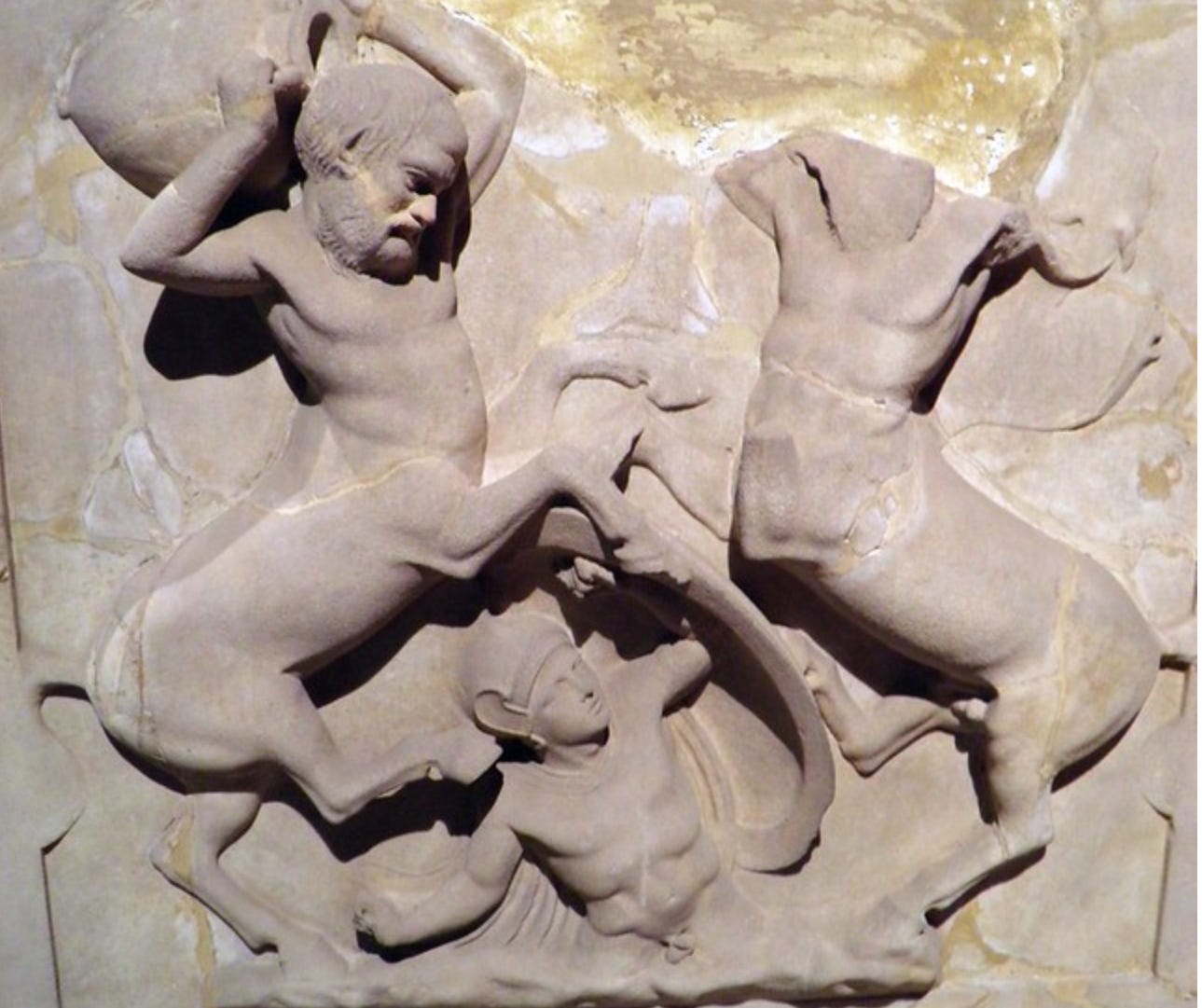

See the first installment of this series for details on the meter used here. Note with regards to the passage on the Lapiths that the ‘alliteration’ of stressed syllables, or chime, that defines it is liable to be distorted unless names are pronounced in the received way (which is not the same as the Greek way). Pirithous is stressed on the second syllable (chiming on r), as is Caeneus (chiming on n); Aegeus, the name of Theseus’s father, is stressed on the first syllable (chiming with vowels) and rhymes with egregious. The word Centaur is usually pronounced with an s sound in English, but this is completely wrong, and it ought rather to be pronounced with a k sound.
The action begins just after Achilles has insulted Agamemnon and made a solemn oath to fight no more.
Then hard to the earth    he hurled his scepter,
Studded with gold nails,    and sat back down;
And yet Atrides seethed there    on the side opposing;
So arose another:    Nestor of Pylos,
Sweet-tongued orator;    sheerest eloquence
Dripped from him dulcetly    like delicate honey;
In his long lifetime    there had lived and perished
Two generations    that were reared and born with him
In godly Pylos;    now he governed the third.
In their midst he stood,    and spake goodwill:

"O what shame and disaster    has struck Achaea,
"And how Priam and his sons    would be pleased to hear it!
"All the other Trojans    would at heart rejoice
"If they could hear the two of you    in heated quarrel,
"Who in battle and counsel    are the best of Greeks!
"But yield to persuasion:    ye are younger, both of ye,
"Than I, who in old days    oft consorted
"With yet nobler men –    and was ne'er disdained by them.

"I've seen none like them,    nor will see the like again
"Of King Pirithous,    who ruled the Lapiths;
"Or that herdsman of the people,    the hero Dryas;
"Caeneus and Exadius,    noble warriors;
"Polyphemus the Lapith,    who was like an immortal;
"Or Theseus son of Aegeus,    who was equal to gods.
"They were the mightiest bred    among mortal earthborns:
"The mightiest indeed,    and with the mightiest fought –
"With the mountain Centaurs,    and crushed them utterly!

"With such I consorted,    coming straight from Pylos,
"When they called me forth    from my far-off land;
"And I fought my part –    although to fight with them
"Would overmatch the might    of any man alive.
"And they observed my counsels –    to my speech they yielded –
"So yield ye also,    since to yield is best.
"Agamemnon –    mighty as you are –
"Do not seize the girl    that the Greeks awarded him;
"And thee, Pelides –    do not think to set
"Your face against his –    for no higher glory
"Has been granted by Zeus    to a sceptred king.
"Though your strength be great –    though you be goddess-born –
"Nathless he stands the lordlier    in lands and men.
"Son of Atreus!    Cease your anger,
"And leave it to me,    by polite entreaties,
"To calm the choler    of Achilles here,
"Who is the bulwark of our side    in this bitter war."
#/media/File:Getty_Villa_-_Collection_(3151231788).jpg)
The kingly one answered him,    Agamemnon:
"Indeed, elder,    on all these things
"You have fitly spoken;    but this fellow here
"Will not sate his desire    'til he stands o'er all:
"Over all lording,    over all commanding,
"And all deeds dictating;    but I doubt that one
"Will abide his lordship    or obey his words.
"The immortal gods    have made him a spearman,
"But they gave him no licence    for disgraceful insults –"

He cut in and answered,    deific Achilles:
"I'd be called a coward,    and a cheap nonentity,
"If everywhere, in everything,    unresistingly
"I bow to your bidding.    Let your beck and call
"Be laid upon others –    I'll no longer yield.
"But now hark, and hold this    in your heart and mind:
"I'll not strive for the girl –    I'll not set my hands
"On thee, or any other    who intends to come
"And remove once more    what to me you gave –
"But of what sundries are mine    beside my swift black boats,
"I'll not suffer one    to be seized unwilling:
"Should you come and try me,    let this crowd observe
"Your black blood billow    round the blade of my spear!"
Thus fails Nestor’s attempt at mediation – setting the stage for Agamemnon’s requisition of Briseis, of whom we shall have more to say in the next installment. In the meantime, if you’re at all interested in the question of whether Homer’s epics were orally-composed or not, don’t skip the translation notes below.
Notes
Two generations that were reared and born with him…
This order of words might seem confusing, but it is straight from the original and ought not to be reversed. The meaning is that Nestor’s own generation of men were reared around him, then another generation was born, then both generations died off during his lifetime – leaving him to govern the third generation as king. One would assume Nestor’s age to be at least sixty, and probably a lot older given the reverence in which his age is held (see here for a discussion of this question).
Pirithous…Dryas…Caeneus and Exadius…Polyphemus…Theseus son of Aegeus…
As mentioned above, I have interpolated some words and phrases into this passage in order to help the modern reader along. The ethnonym ‘Lapith’ is not found in the original; nor is Pirithous specified as ‘King’; nor are Caeneus and Exadius described as ‘noble warriors’. Polyphemus is given the epithet ‘equal to a god’ (ἀντίθεον antitheon), and Theseus described as ‘like to the immortals’ (ἐπιείκελον ἀθανάτοισιν epieikelon athanatoisin), but I have reversed these in translation because it seemed that the greater compliment was being paid to Theseus. Dryas is not called a ‘hero’, but he is given the epithet ‘herdsman of the people’ (ποιμένα λαῶν poimena laoon), which is precisely equivalent to the Old English folces hyrde used of kings.
I doubt that one will abide his lordship or obey his words
The line in the original text is very interesting, and I would like to see it analysed by someone with more (i.e. any) expertise in Ancient Greek. Here it is in full, with a crude transliteration and literal translation:
πᾶσι δὲ σημαίνειν, ἅ τιν᾽ οὐ πείσεσθαι ὀΐω (pasi de seemainein, ha tin’ ou peisesthai oioo) - And give orders to all, which I think that no-one will obey
It contains two ambiguities, which seem more likely to be intentional than coincidental:
The pronoun τιν᾽(tin’), i.e. τις, which could mean ‘anyone’ or ‘someone’ – thus Agamemnon’s meaning could be “I think that no-one will obey Achilles” or “I think that one [i.e. I myself] will not obey him”, and translations differ on this;
The word πείσεσθαι (peisesthai), which according to Wiktionary could be the future middle1 infinitive of πείθω (peithoo) ‘to obey or yield to persuasion’ or of πάσχω (paskhoo) ‘to suffer something at someone’s hands’ – thus the reference could be either to obeying Achilles’ dictates or to suffering his dictation.
What should really interest us here is the fact that these ambiguous words are found close together, indeed in the same line. In the course of my self-studying and translating Beowulf (on which I have a much better grasp of the language and scholarship), I have found not only that double meanings exist in the text but also that they tend to be clustered together in certain passages. The most obvious reason for this clustering would be that the poet slowed down his writing pace in order to write these passages, and moved at a faster pace through the larger narrative sections of the poem in which there is little or no ambiguity to be found.
Although the existence of intended ambiguity in Beowulf is controversial (and, truth be told, most of the leading scholars don’t seem to like it at all), the basic idea of that poem’s having been composed pen in hand by an author who could speed up and slow down his writing pace is not. And this is because the contrary idea – that Beowulf was orally-composed, in the preliterate style, while a scribe took it down – has been quite decisively refuted and no longer commands much allegiance. But in the case of Homer, the oral-composition theory stands on stronger ground: there are no literary references in the text to contradict it, the style of the poem is more obviously influenced by oral-compositional techniques (e.g. it has developed type-scenes, whereas Beowulf does not), and there is of course the formidable work of Milman Parry purporting to show that Homer’s choice of epic formulas was determined by the need to construct hexameters in the heat of performance.
By no means has Parry’s thesis gone without question. David Shive attempted to refute in his book Naming Achilles, by offering proofs that Homer’s formulas are not purely determined by meter but also by conscious choice. But as Gregory Nagy observed in his review of the book, Shive does no more than prove that Homer’s formulaic technique was less mechanical than Parry had to make it out to be in order to construct a theory of its mechanics. Since Parry’s disciple Albert Lord, working with his teacher among illiterate oral poets in Yugoslavia, claimed to have found at least one poet skilled enough to break his formulaic technique at will2, this clearly does not constitute sufficient refutation.
But what if it could be proven that the Homeric texts contain instances of intentional ambiguity, and that these are found clustered together, implying a slowing-down of compositional pace? Now I am not saying that this one instance would constitute sufficient evidence, nor that I am qualified (in any sense of the term) to interpret it correctly. But if a scholarly rereading of the corpus were to be carried out, and if it were both to confirm this instance of intended ambiguity and to find others like it, then surely the implication would be that the Iliad and Odyssey were not composed at the fast pace of oral performance. We would have to assume literary composition, or a very slow and leisurely oral dictation, or fixation of the poems in memory prior to their transcription (a possibility backed up by the analogy of the Rig Veda). Needless to say, none of this would tarnish Parry’s discovery that the style and diction of these poems are everywhere indebted to the recompositional techniques of oral poetry.3
Ancient Greek, unlike English, had a middle voice between the active and passive voice.
From Lord’s Singer of Tales (Third Edition), p.140:
We should not be surprised to find a fair number of nonformulaic expressions in such a talented oral singer as Avdo Međedović. It would be fantastic to expect that a gifted poet who has thought in poetic form all his life should not have sufficient mastery of that form to be able not only to fit his thought into it but also to break it at will. No more should we be surprised to find formulas in Chaucer or William Morris, or to learn that at some periods there are more “formulas” in the “literary” style than at others.
To draw an analogy, the skilled skateboarder can on occasion leap, flip and somersault from his board, although his technique is in all respects determined by his use of it.
Most of the problems with the oral theory do not stem from Parry’s reconstruction of the compositional technique, nor from his analogy between Homer’s art and that of the South Slavic poets, but from the argument made by Lord in Singer of Tales that there can be no such thing as a ‘transitional text’ – that is to say, a literary work that uses or partly utilizes the oral compositional style. This argument was also based on analogy with the South Slavic oral poets, whose recompositional technique swiftly died out as soon as both performers and audience were exposed to written media; but in this respect, the analogy with Homer does not hold. To 20th-century Bosnians and Montenegrins, literacy was synonymous with exposure to modern culture; for early medieval Anglo-Saxons, similarly, it meant Christianity and Latin culture; but for Greeks in the time of Homer, at the very dawn of Western literary culture, it was a bare technology that could only record the products of an oral culture to which there was as yet no rival.
By way of illustration, let us imagine that a handful of exceptional intellectuals, poets, artists and other ‘sages’ were to be granted immortality tomorrow. Initially, these immortal sages would have no more influence on the culture around them than they would have had were they still mortal; and one or two hundred years into their new lifespan, their influence would still be little felt. But after hundreds or thousands of years, these living relics of the past would exert a huge distorting influence on the new cultures and civilizations grown up in the ruins of those in which they were born. And so it is with immortalized literary works. Homer composed in the style and tradition of his own time and country; but it was he who convinced Virgil and other Romans to forsake their own native traditions; and it was those influenced by the Roman church and Latin language who convinced the Anglo-Saxons and other Germanic peoples to partly forsake their own traditions; and it is the English and other Western Europeans who have since brought almost everyone else into a hyperliterate modern culture, in which the constant mutations of literary poetry have carried it about as far from oral tradition as it is humanly possible to go.